Alan Lester
On 7th June 2025, it will be the 5th anniversary of Black Lives Matter demonstrators toppling Edward Colston’s statue into the harbour whence his slave ships had sailed. Immediately following the protests of 2020, I and other historians objected to right-wing journalists and politicians describing the event as an attempt to ‘erase’ or ‘cancel’ the past. Until we have a time travel machine, it will, very obviously, be impossible to change what has already happened. But it was also said that this act of ‘statuecide‘ was an attempt to to ‘rewrite history’.
Upon reflection this is true, albeit not quite in the sense intended by the Conservative government of the time, the Telegraph, Mail, GB News etc. This dramatic episode in Bristol and the broader Black Lives Matter movement that developed in the wake of George Floyd’s murder rewrote history in two senses.
First it prompted individuals, institutions & politicians to revisit dominant historical narratives in which trans-Atlantic slavery had been deliberately obscured, and secondly it prompted a nationalist, conservative backlash that continues to shape our politics. In the USA that backlash informs the Trump government’s blatantly fascist injunction to ‘remove improper ideology‘ from schools, museums, archives and the cultural sector.
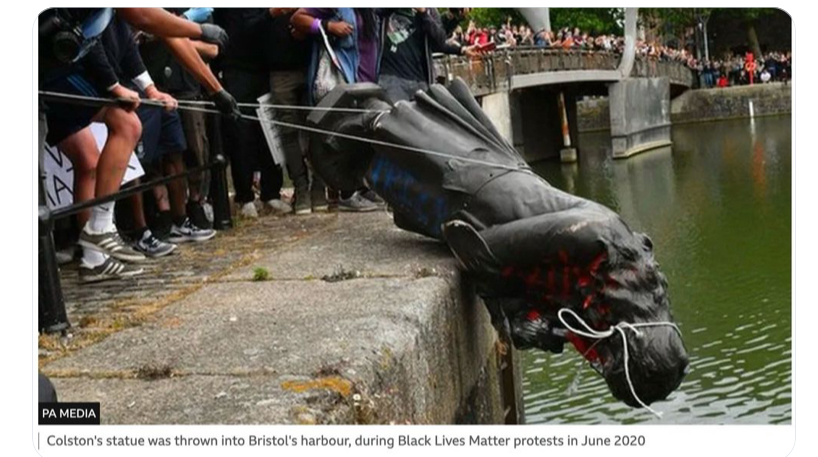
Edward Colston, a deputy governor of the Royal African Company, was a perfect symbol of the continuities between a past steeped in the trafficking of Black bodies and a present in which Black people were dying at a 23% higher rate from Covid than White people in June 2020, due to enduring inequalities in health, employment and housing.
This particular statue, in the port that dominated the British slave trade in the late 17th and early 18th eighteenth centuries, crystalized the frustration of a movement that was still, two decades into the twenty-first century, having to point out that Black lives (should) matter as much as White lives.
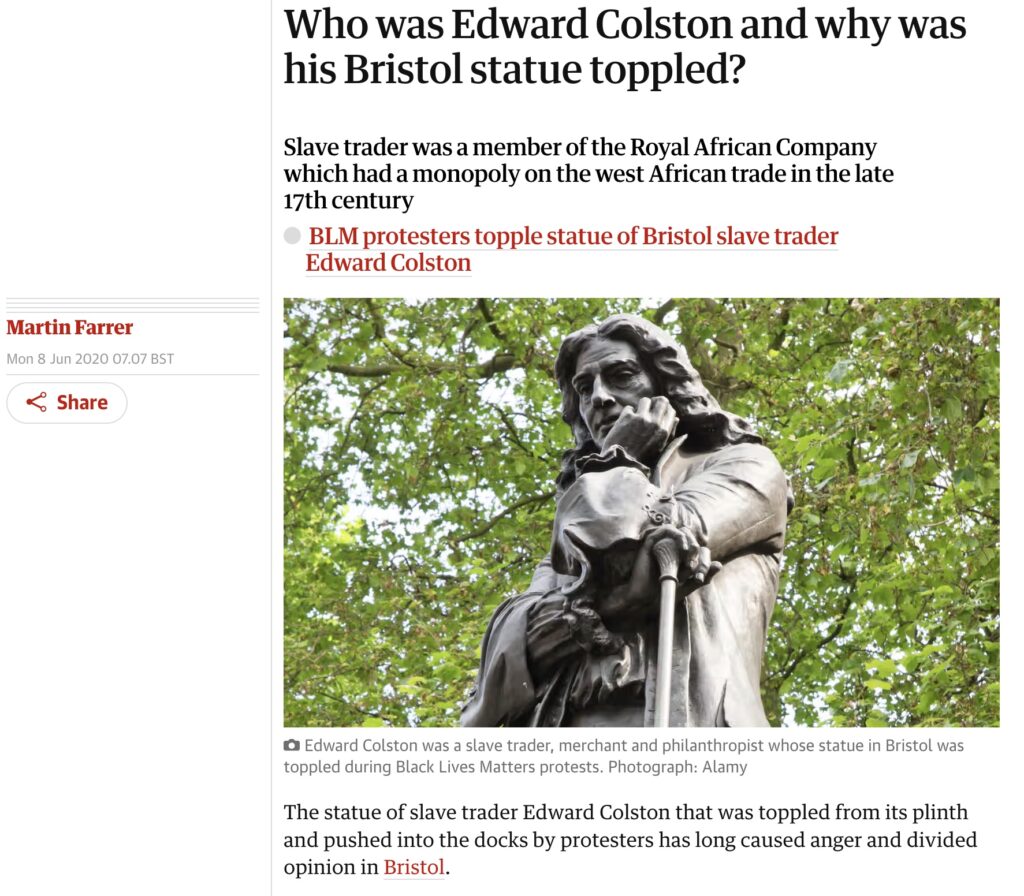
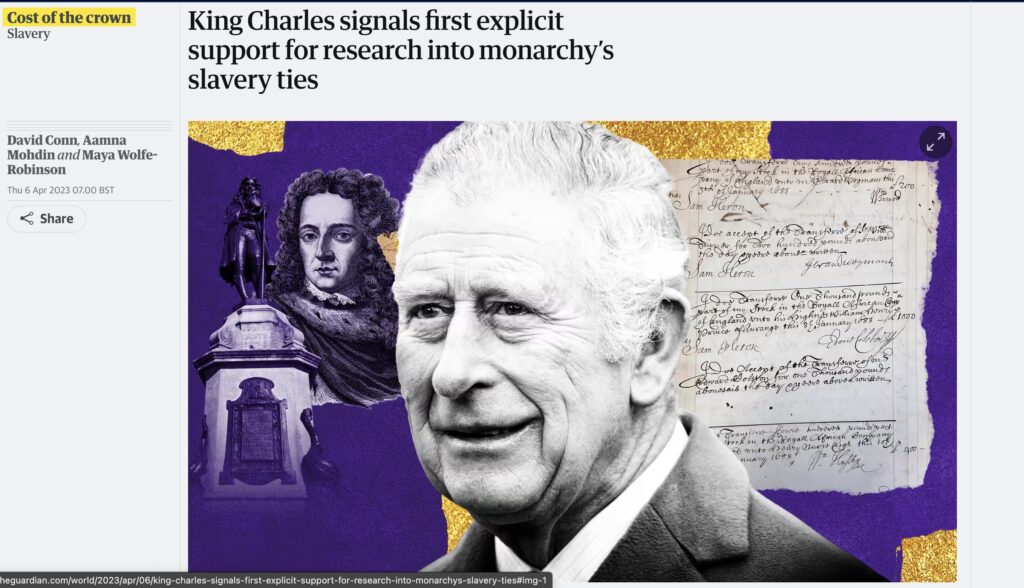
After antiracist activists had campaigned unsuccessfully over decades to negotiate an additional plaque on the plinth explaining Colston’s atrocities, their resort to drowning his effigy drew public attention to the centrality of slave trading and slave ownership in British history far more effectively. That attention obliged even the Establishment to respond. When the Bank of England, colleges of the Universities of Oxford and Cambridge, the Church of England and the Royal Family started to recognise that their foundations lay partly in slavery, it became possible to imagine that structural racism in Britain might at last be seriously addressed. The toppling of Colston was rewriting history by bringing a hidden aspect of the past into the light of public scrutiny and promising to effect meaningful institutional change in the present.
It was, however, precisely that incipient Establishment response that led to Black Lives Matter’s second impact. Entirely inadvertently, it provoked the populist, racist reaction that shapes much of our current politics. Colston’s drowning was met with a furious right wing culture war backlash. Fury at the prospect of meaningful structural change to address racism was one of the key reasons that conservatism on both sides of the Atlantic became detached from its moorings in variants of liberalism and morphed into something more like fascism. The liberal hypocrisy of promising universal rights only to withhold them in practice seemed no longer adequate to sustain entrenched white privilege. The backlash against Black Lives Matter was not the only tributary feeding the right wing populist surge in Europe and the USA, as reactions against more fluid ideas of gender and ‘non-white’ immigration were also prominent, but it was certainly a powerful one.
The stage had already been set when Rhodes Must Fall activists moved their campaign from Cape Town to Oxford in 2015. Rather than accepting Rhodes’ role in the violent dispossession of Southern African peoples and considering what then to do about his statue, the conservative theologian Nigel Biggar pioneered a new form of historical denialism by attempting to rehabilitate the man himself. Justifying what Rhodes had done soon led Biggar to a defence of the morality of the British colonialism as a whole.
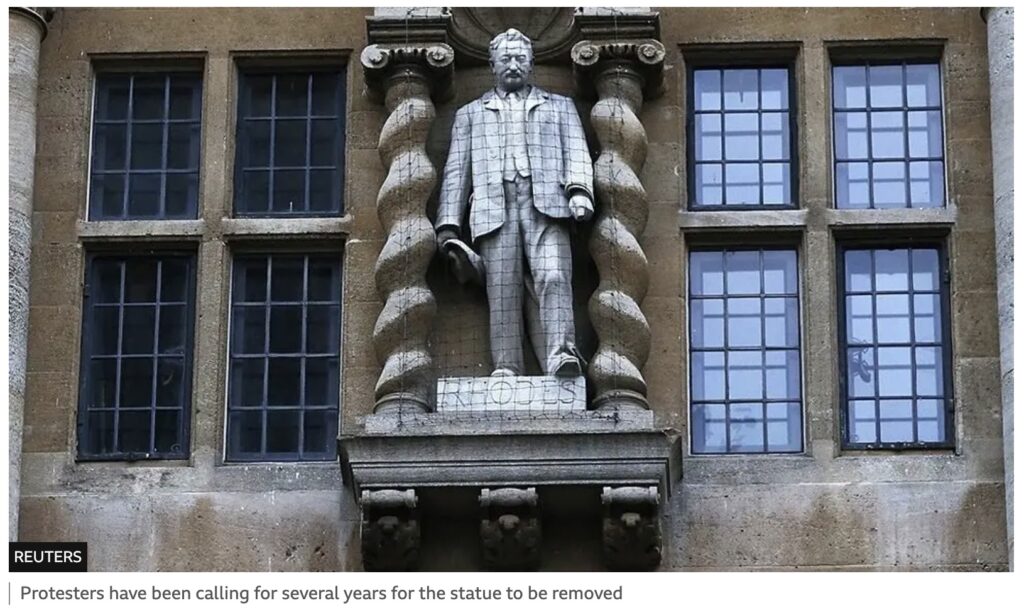
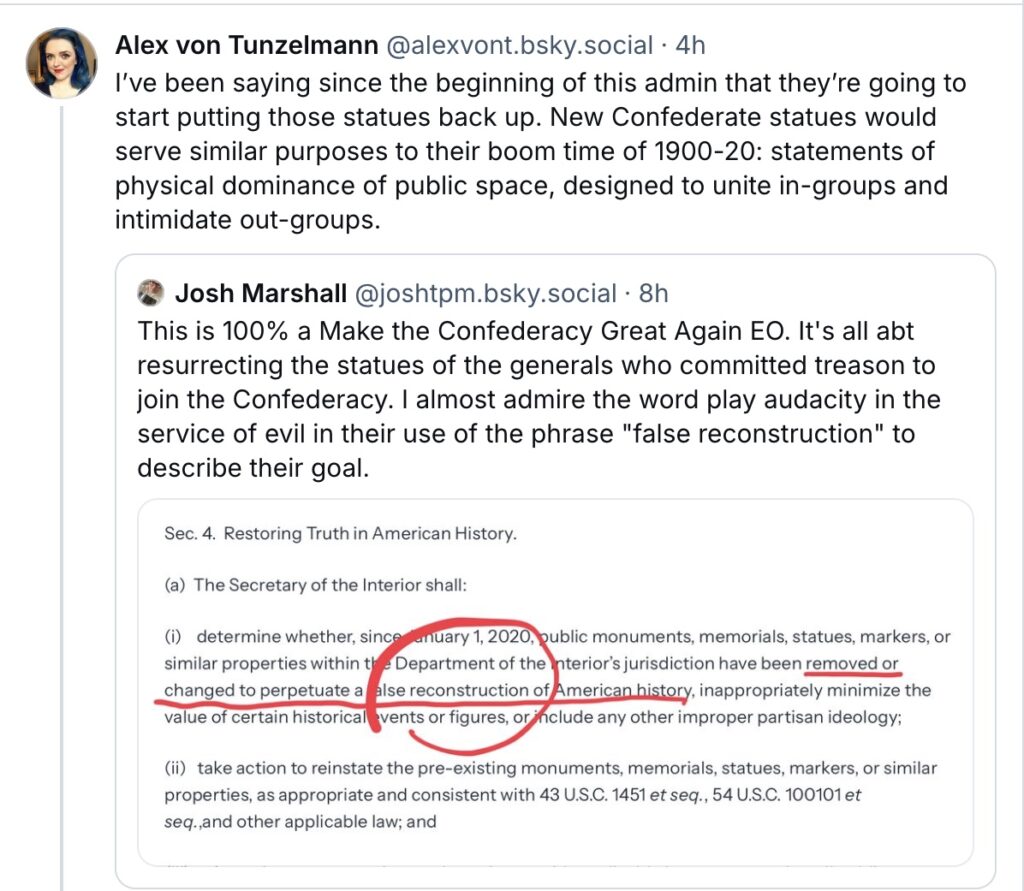
In June 2020, the very same people who decried the ‘woke’ rewriting of history with Colston’s toppling were already rewriting history in the way that Trump has now decreed. Ignoring the findings of historians about the significance of trans-Atlantic slavery and the role of racist ideas in European colonialism, members of History Reclaimed, which Biggar helped to form, and a proliferating cluster of right wing allies in parliament and the press, returned determinedly to the celebratory histories of Empire that Britons had consumed so avidly back when White ‘sahibs’ and ‘bwanas’ ruled the roost. Britain’s pro-Empire propagandists prefigured the Trump administration’s desire to restore Confederate statues in the USA.
Biggar and his allies developed this variant of historical rewriting not because they were interested in the history, but because they wanted to provide the intellectual underpinnings for a political backlash. For them, history was just the means to an end. And in the summer of 2020 they felt especially empowered. Biggar declared that ‘Those like me who think that the “anti-colonialist” narrative is wrong and politically damaging are delighted that the Government is supportive’.
Immediately Colston fell, Robert Jenrick declared ‘We will save Britain’s statues from the woke militants who want to censor our past’. Oliver Dowden instructed Britain’s leading museums, galleries and heritage organisations that they ‘must defend our culture and history from the noisy minority of activists constantly trying to do Britain down’. Boris Johnson appointed a commission to report on issues of racial inequity. Rather than identifying structural racism as previous reports had done, the Sewell report argued that Black Britons of Caribbean descent had failed to appreciate that ‘the system is [no longer] deliberately rigged against’ them. The report did not uncover structural racism of the kind that caused the disparity in Covid deaths because it did not allow it as a possibility.
As the Sewell Report was being aired, over 50 Conservative MPs formed the Common Sense group. Chaired by Sir John Hayes and formed in part of ‘red wall’ MPs, it described Black Lives Matter as ‘an extreme cultural and political group … fuelled by ignorance and an arrogant determination to erase the past and dictate the future’, with ‘an intolerant woke dogma’ and initiated the assault on the National Trust and other institutions for succumbing to ‘cultural Marxism’.
Although they were voted out of power decisively last year, Trump’s electoral victory in the USA has allowed the UK’s anti-BLM culture warriors to take heart. The backlash against Black Lives Matter is still a major Tory political platform as they fight to prevent Reform taking over their pitch entirely. Much of our politics will continue to be shaped by attempts to return to the pre-June 2020 denial & disavowal of White violence against Black subjects.
