Background
In 2019 the booklet Brighton & Hove Black History was updated by Brighton & Hove Black History community group. The group was co-founded created in 2002 by Bert Williams MBE and Sarah Lee, via a grant from the Scarman Trust. After a career in the RAF Bert spent much of his retirement researching the hidden stories of Black people’s presence in the city and presenting that work to every audience he could access. However Bert faced racism and prejudice when trying to present that work and was excluded from heritage and archive spaces which did not take him or his work seriously.
Sarah Lee, treasurer and co-founder of the group, alongside a thriving group of volunteers from diverse backgrounds have since contributed to Bert’s aim of ‘challenging racism and prejudice by raising awareness of the multi-cultural history of Britain, with particular reference to Brighton & Hove and Sussex’. The group is resolutely inclusive in welcoming all people (including white people) to participate in the group so long as the group is majority Black lead in terms of governance and management structure.
In 2025, Bert experienced a period of serious illness which alerted the group for the need to safeguard his research. That, and an awareness of the ever-greater, right wing populist tendency to deny and disavow Britain’s colonial and multi-racial past, encouraged Professor Alan Lester and Sarah Lee to discuss the possibility of shoring up Bert’s original research with rigorous source referencing that validated and protected it. We were concerned that, no matter how verifiable Bert’s findings were, bad faith actors were increasingly determined to undermine them, and we thought that subjecting them to the kind of source attribution that is the gold standard for academic rigour would be a valuable safeguard. It would also give an opportunity to add to his findings in the light of more recent scholarly enquiry.
The means by which we took this idea forward was a scheme run by the University of Sussex for undergraduate students between their second and final years. The Junior Research Associate (JRA) scheme is a paid internship, awarded competitively, for students to undertake a summer of research aligned with the longer-term programmes of academic faculty. We were exceptionally lucky in not only being awarded one of the placements but attracting an outstanding student to conduct the necessary source checks and updates.
Samuel Emmott Lozano has been a better fit for this project than we could possibly have imagined. He took Bert’s work in the Brighton & Hove Black History booklet (a publication that Sarah Lee has described as Bert’s ‘calling card’ as he spreads the word throughout Sussex and the country), tracked down Bert’s sources, attributed them thoroughly and updated them in the light of the most recent academic publications.
What follows is an account of key actors and episodes in Brighton & Hove’s diverse and fascinating history that we have informally been calling ‘Samuel’s Uber-document.’ The entries have been rearranged, broadly in chronological order.
Brighton & Hove Black History 2026
By Bert Williams and Brighton & Hove Black History Group, revised and updated by Samuel Emmott Lozano, edited by Alan Lester
Part 1: The Eighteenth and Nineteenth Centuries
- Francis Barber
Francis Barber was employed as a servant and eventually heir of perhaps the greatest English literary figure of the time, Dr. Samuel Johnson, writer of the first English dictionary.Born into slavery in Jamaica, Barber was brought to England by the Bathurst family, who were friends of Johnson’s.[1] Upon his arrival in Britain, Barber was freed and baptized. His Jamaican name ‘Quashy’, was replaced with the English name Christian name Francis.[2]
When Johnson’s wife died, Barber went to work as Johnson’s servant, and Johnson came to think of him paternalistically.[3] Johnson gave him lighter the housework and Barber became primarily responsible for organising Johnson’s letters, sometimes joining him on his trips outside London.[4] Barber was very unhappy, however, with his superior in the domestic service hierarchy, Anna Williams, complaining that she often had a short temper.[5]
In 1756, Barber left Johnson’s household to join the Ferrand household, becoming a paid employee at their apothecary, preparing medicines for sale.[6] Unfortunately, he was never able to become an apprentice and trade on his own behalf because of a law forbidding Black apothecaries[7].
Johnson hoped for Barber’s return and sought to coax him back. But Barber was now independent and on 7 July 1758, he decided to volunteer in the Royal Navy.[8] Some researchers believe that this is not only because of the steady salary he would receive, but also because of the more open attitudes towards Black sailors, many of whom had joined the expanding Navy as it fought a succession of wars against France and Spain.[9] Barber was still taking a risk in signing up though, since Black people were sometimes kidnapped and sold off by shipmates, especially when ships docked in a slave-holding colony.[10] This was something that Olaudah Equiano noted in his well-known Interesting Narrative.[11]
Meanwhile, Samuel Johnson wrote a letter to the Royal Navy to plead for the discharge of Barber so that he may return to his service in London.[12] Johnson’s ability to pull strings eminent status meant that Barber was discharged from the Royal Navy in 1760 despite wanting to continue in its service.[13] Now unemployed, he had no other option than to return to his role as a servant to Johnson.
Barber often invited Black friends, some of them possibly former shipmates, to Johnson’s house. Hisa period of relative liberty had enabled him to become part of the wider Black community, which included both escapees from enslavement and free Black people, including former sailors, in London.[14] As Johnson grew richer, he decided to send Barber to the grammar school of Bishop’s Stortford, where he learned Latin and became an enthusiastic reader.[15]
Upon Samuel Johnson’s death, Francis Barber inherited 2,000 pounds and his large estate. However, this was placed under the control of three trustees chosen by Johnson, which limited Barber’s freedom in accessing his inheritance.[16]
Some of Barber’s writings survive today, as he was key to the making of Johnson’s biography. Given that he was so close to Johnson and knew him during important parts of his life, Johnson’s friend James Boswell often wrote to Barber to gather information. Barber in turn appreciated Boswell’s efforts to rebut John Hawkins’ apparently flawed biography of his former employer:
‘To James Boswell Esqr, Barrister at Law.
Lichfield, Monday July 9th 1787
Sir: I had the unspeakable Satisfaction of receiving your Letter on saturday last by the care of Mr. Green, and agreeable to your request with a heart full of Joy and gratitude I took Pen in hand to enform you that I am happy to find there is still remaining a friend who has the memory of my late good Master at heart that will endeavour to vindicate his cause in opposition to the unfriendly proceedings of his Enemies; as I myself am incapable to undertake such a task. The aspersions Sir John has thrown out against my Master as having been married to a relation of his who has been long dead; notwithstanding which my Master never withdrew his friendship but was always very kind to him in every respect. I have not had the mortification to fall in with that impious production of Sir John Hawkins relating to the Life of my Dear Master, but assure yourself Dear Sir it will be to me a subject of the greatest happiness to render abortive the unworthy and false pro[c]eedings of the above mention’d Gentleman and from hence you may justly infer that fuller exposition of that basest of Mortals in as much as he has reflected not only on me and my consort, but on the unsullyed Character of the best of beings my affectionate and unparallel Master: if necessity, if God spare my Life (for I am at present very poorly) I would willingly attest what I have related personally with which I beg leave to subscribe myself, your most obedient humble Servant
Fra:s Barber’[17]
Barber’s letters also show that despite his inherited fortune, the end of his life was marked by financial issues, illness and loneliness:
Address; James Boswell Esqr. To the Care of Mr. Dilley – Bookseller in the Poultry, London.
‘Stowe Street, Lichfield, 29th Septr. 1790
Honoured Sir: It is with much Concern, and Feeling, I pen these Lines, which I hope you will consider and pardon the Liberty I have taken.
I wish I never had come to reside at this Place, but being persuaded by my late poor dear worthy Master, to whom I was, and ought, in duty bound, to oblige, was the occasion. Some time ago, I was extremely ill for a considerable time, which of course incurred a long Doctor’s Bill, which when I came to pay astonished my greatly at the Total thereof, however I paid it: viz. 23.5.6, and some few months prior thereto, I observe I paid him another of the Faculty, upon Account of myself, my Wife and Family – 14 (pound symbol). odd.
I have also been at great Expence in the care an[d] Education of my Children, as it is my wish, upon my Master’s Account to see them Scholars.
When I first came here, people never minded, but rather urged to entrust me with Articles into the House, but now they see my rather reduced, (but can assure you has not been through my Extravagancy in the least, but trusting in mankind to be honest and just, put too much Confidence in them, who have now rewarded me for my pains,) and through some spiteful Enemy, or busy person, several with whom I dealt, hastily have sent in their Bills, pressing immediate payment, as if in a manner they would eat me at once, and as my Quarterly payment (as it becomes due) will not be sufficient to discharge the same and to leave me a farthing in Pocket to subsist upon, and having no friend here to assist me, or confide in; beg you will assist me in my distressed situation, and this a Neighbour of mine, a poor honest Man, advises me to do; if you would therefore be pleased to advance me 20 (pound sign). I will repay you honestly, by Eight Guineas on every my Quarterly days, with Interest, and for further Security, will give you a Schedule of part of my household Goods, to such amount, in Case of Non-payment, and this will be the means of Extricating myself from my present difficulties and put me straight into the world once again, and put my almost broken heart at rest, and for this kind and tender feeling Friend, from whom, ‘till I hear, shall be very miserable.
Mr. Burk upon the day of my Master’s funeral was so obliging to say, that if ever my inclination shou’d lead me to go to Service he wou’d render me his best Assistance – and as timings as Circumstanced, I could wish he, you, or some of my Worthy Master’s friends would get me a Place in the Stamp Office – India-house, etc. I will leave this dead place as I cannot get any Employ therein.
I have my Masters Diploma Box by me and several other Articles if any of them you should like to have – shall be at your Command.
You will excuse me Writing in my own hand as my Eyes are not so good as they were some time back. I remain Sir, Your distressed and most obedient humble Servant
Francis Barber
P.S. The Eight G[uine] as Quarterly may be paid to Mr. Dilley, or any person you shall be pleased to name in Town – but my naming Mr. Dilley is on Account being near to the Bank as my business is negotiated.’[18]
Boswell declines to send any money, suggesting that there would be a public scandal if he was seen to have squandered the funds bequeathed by Johnson. He recommended that Barber spend less on luxuries and not move to London because of the spendthrift temptations there.[19]
Francis Barber accompanied Samuel Johnson as his servant during his visits to Brighton. One such trip was in 1777, to check up on Johnson’s friend Hester Thrale who was ill.[20] A passage from her diary refers to Barber:
‘The other Day speaking of his Negroe Francis; I observed that we was very well-looking for a Black a moor; Oh Madam says he Francis has carried the Empire of Cupid farther than many Men: When we was in Lincolnshire seven Years ago, he made hay as I was informed, with so much Dexterity that a female Hay Maker followed him to London for Love.’[21]
Sources:
Boswell, James. The correspondence and other papers of James Boswell relating to the making of The Life of Johnson, Volume 2, ed M. Waingrow. William Heinemann Ltd., 1969.
Bundock, Michael. “A New Name” in The Fortunes of Francis Barber: The True Story of the Jamaican Slave Who Became Samuel Johnson’s Heir. Yale University Press, 2013.
Bundock, Michael. “Servant or Slave” in The Fortunes of Francis Barber: The True Story of the Jamaican Slave Who Became Samuel Johnson’s Heir. Yale University Press, 2013.
Bundock, Michael. “An Apothecary in Cheapside” in The Fortunes of Francis Barber: The True Story of the Jamaican Slave Who Became Samuel Johnson’s Heir. Yale University Press, 2013.
Bundock, Michael. “The Stag” in The Fortunes of Francis Barber: The True Story of the Jamaican Slave Who Became Samuel Johnson’s Heir. Yale University Press, 2013.
Bundock, Michael. “A Race Naturally Inferior” in The Fortunes of Francis Barber: The True Story of the Jamaican Slave Who Became Samuel Johnson’s Heir. Yale University Press, 2013.
Bundock, Michael. “This Is Your Scholar!” in The Fortunes of Francis Barber: The True Story of the Jamaican Slave Who Became Samuel Johnson’s Heir. Yale University Press, 2013.
Bundock, Michael. “Lichfield” in The Fortunes of Francis Barber: The True Story of the Jamaican Slave Who Became Samuel Johnson’s Heir. Yale University Press, 2013.
Ingledew, John. “Samuel Johnson’s Jamaican Connections”, Caribbean Quarterly 30, no 2 (1984): 1-17. https://www.jstor.org/stable/40653532.
Johnson, Samuel. The letters of Samuel Johnson, with Mrs Thrale’s genuine letters to him. Clarendon Press, 1952.
Jones, William. R. “Barber, Francis (c. 1745-1801), servant”. Oxford Dictionary of National Biography. 23 September 2004. https://doi.org/10.1093/ref:odnb/59398.
Thrale, Hester. Thraliana: the diary of Mrs. Hester Lynch Thrale (later Mrs. Piozzi) 1776-1809. Volume 1, 1776-1784. Clarendon Press, 1951
2. Sake Dean Mohamed (1759-1851): The East India Company and India’s Presence in Britain
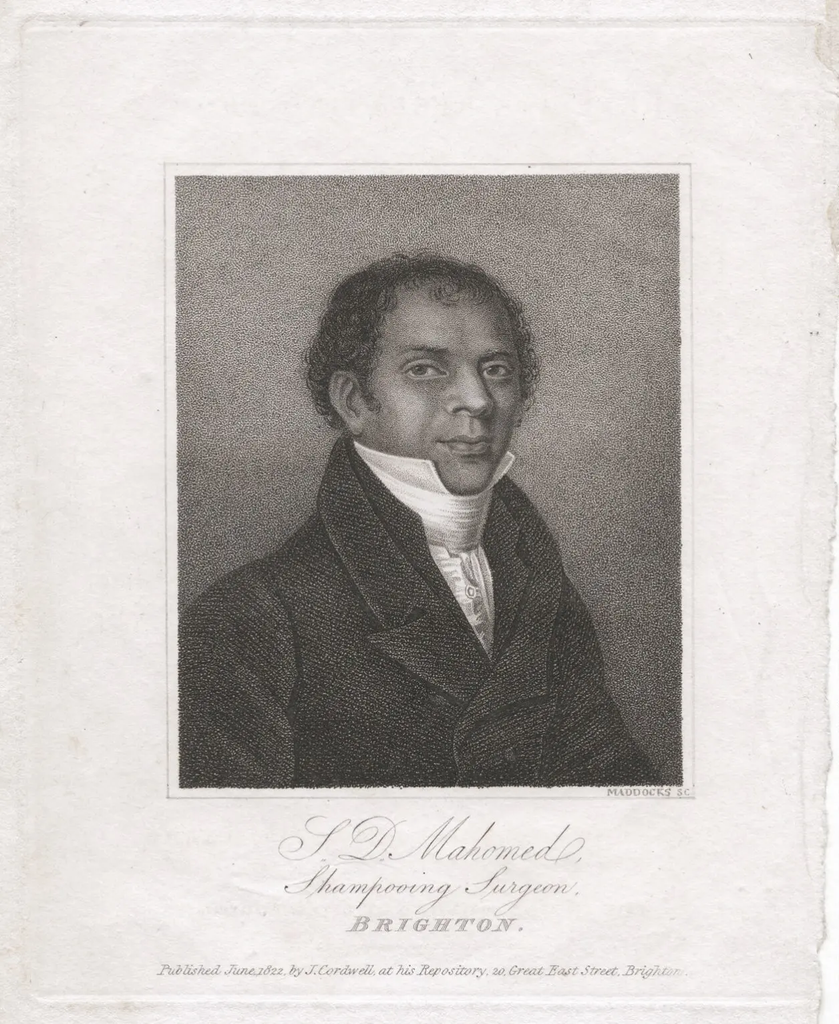
Sake Dean Mahomed, writer, businessman and ‘shampooing surgeon’, who opened the first Indian restaurant in Britain:https://www.npg.org.uk/schools-hub/sake-dean-mahomed-by-william-maddocks
This shampooing surgeon opened an Indian Vapour bath on the site of the Queen’s Hotel in Brighton and catered to George IV and William IV.
Born in Bihar, India in 1759 to an upper-class family, Sake Dean Mohamed joined the East India Company’s Bengal Army in 1769 around the age of just 10, rising from camp follower to subaltern officer under his Irish patron and captain Godfrey Baker.[22] Baker was later dishonourably discharged from the Company for corruption.[23]
The East India Company, founded in 1600, was a British joint stock company, allowing British investors to profit massively from overseas colonial activities from the comfort of their own homes.[24] Challenging rival Portuguese and Dutch companies, it quickly consolidated power in the Indian Ocean after the fall of the Mughal Empire in India.[25] Not only did this company act as its very own state, in some ways it was as powerful as the government of the United Kingdom at that time: the company’s own private army became far larger than the British army and was deployed all around the Indian Ocean and beyond on behalf of the British Empire.[26] Having set the precedent for many multinational companies today, its business model consisted of extracting wealth from India to mainly British shareholders by conquering territory and charging rent to its Indian subjects.[27] Thus, Indians paid for the ‘privilege’ of being colonised in the name of the British crown.[28]
Given many competing powers in Sake Dean Mohamed’s time, it was commonplace for a family to continue sending their later generations to the same military power hoping to gain protection, stable income and prestige. In this case, both Dean Mohamed’s elder brother and father had served with the Company’s Bengal Army.[29] By the time he retired as a soldier in 1782, some 115 000 Indians soldiers, or sepoys, were serving under the command of European officers in the Company’s armies.[30]
Daen Mohamed then followed Baker to Cork in Ireland, a key Atlantic-facing port for British trading. There, he lived through the historic Irish uprising of 1798 against British colonial rule, which united Catholics and Protestants.[31] The uprising also eliciting French Revolutionary support, including two attempts to bring French soldiers across in support of the rebels.[32] Though ultimately unsuccessful, with 30, 000 Irish killed by British forces,[33] the rebellion remains a key moment in the Irish anti-colonial struggle.
In 1786, Dean Mohamed met a young Irish student called Jane Daly whom he later partnered with through an expensive substantial bond. Rather than an official marriage, this distanced the church from their union if it came to be considered illegal given Dean Mohamed’s provenance.[34] It is unclear when he converted from Islam to Christianity. Yet his marriage was seen as unacceptable among Britons who were increasingly opposing sexual relations between Indian Muslims and white women, seeing them as challenges to the idea of British racial supremacy – an idea that was beginning to underpin the British empire even as the antislavery campaign was mounting.[35]
During this time, Dean Mohamed worked as a ‘manager’ for a revived Anglo-Irish elite, arriving from India to settle in Ireland.[36] Remaining in East India Company circles, he was not quite a servant but not totally independent either.[37]
In 1794, Dean Mahomed published his book The Travels of Dean Mahomet. The book is important not only because it was the first to be written and published by an Indian in England, but also because it recorded views about India, and the British occupation of colonial India, from an Indian’s point of view.[38] Having spent a large part of his early life within the East India Company and seeing himself as a British person, his vision was largely imperial, targeting his writing to British people sympathetic to the Company’s activities.[39]
This did not stop him from describing the terrible Bengal famine of 1770, in which the Company’s increased rent-extraction played a devastating role, hugely exacerbating a crisis initiated by monsoon failures. According to some experts, around 10 million people died:[40]
‘Numbers of people have dropped down in the streets and highways: none fared so well as those whose plantations were watered by wells. The proprietors, some of whom were Nabobs [British employees of the East India Company who had gained their wealth in India]and other European Officers, distributed as much rice and other food as they could possibly spare, among the crowds that thronged into their court-yards and houses: but the poor creatures, quite spent and unable to bear it, fell down and expired in their presence: some endeavoured to crawl out and perished in the open air. Little did the treasures of their country avail them on this occasion: a small portion of rice, timely administered to their wants, would have been of more real importance than their mines of gold and diamonds’.[41]
Dean Mohamed’s writing was alsoinfluential because, along with the works of Olaudah Equiano, Ottobah Cugoano, Phyllis Wheatley and Ignatius Sancho, it challenged those supporting slavery who believed people of colour could not write for themselves.[42]
Around 1807, Mohamed and Jane along with their children moved to London. As we have seen in the case of Francis Barber, the metropolis attracted many people including Irish and Black and Asian subjects of the Empire. British ‘nabobs’ returned from India with large amounts of wealth, some Indian ambassadors travelled to London, and Indian merchants and sailors (lascars) often found work around the docks. However other Indian communities in London were servants with limited freedoms.[43]
Mohamed lived in fashionable Portsmouth Square, briefly working in the London vapour baths opened by Basil Cochrane, a returning Madras civil servant for the East India Company. Here, he began shampooing customers. The baths were one among a number inspired by Turkish baths at the time, but by 1809, when Cochrane fell ill and was in financial difficulty, Dean Mohamed determined to start his own ‘Indian’ business, initially a coffee house rather than baths.[44]
By 1810 Dean Mohamed had opened the Hindostanee Coffee House on the corner of George and Charles streets, the very first Indian curry house in Britain. Serving a range of meat and vegetable dishes with Indian spices and seasoned rice, the coffee house featured Indian-themed decoration ranging from bamboo-cane sofas to paintings of Indian landscapes. His target audience were ‘Indian gentlemen’, or the British and Indian elite returning from India.[45]
British East India Company employees returning from India flocked to the restaurant and it proved so successful at first that Dean Mohamed expanded it into the neighbouring building.[46] However, the Hindostanee Coffee House faced large competition from already established coffee shops and the ability for rich nabobs to hire their own Indian staff to cook for them at home. Dean Mohamed was unable to retain loyal customers and filed for bankruptcy in 1812.[47] We can imagine this may have been a very painful moment for 45-year-old and his family, as his time in London is not mentioned in his autobiographical writings.[48]
Dean and Jane Mohamed moved to Devonshire Place, Brighton in 1814, first selling Indian goods as luxuries with medical benefits. By 1815 they were already advertising their services of the ‘art of shampooing’ which treated ‘the Nobility with the happiest results’ from the now Devonshire Place Baths. Their baths became so popular they moved their business to Battery House, now Mohamed’ Battery House Baths. Finally, with the wealthy, London-backed Thomas Brown’s assistance, Mohamed’s Baths were built near Old Steine and overlooking main the main seaside road, on the site of today’s Queen’s Hotel. The design, both inside and out, was orientalist even including intricate balconies.[49]
Dean Mohamed’s Baths began in 1821, benefiting from a population a tourist boom in Brighton. King George IV quickly became an important patron for Mahomed, also building the Royal Pavilion with its orientalist architecture, reflecting the British feeling of India as the ‘crown jewel’ of the growing British empire. His vapour bath treatments were so successful, he was given a Royal Warrant as ‘shampooing surgeon’ and installed an ‘Indian Vapour Bath’ in the Pavilion’s royal bathroom. George’s brother King William IV often came for treatment at Mohamed’s baths, despite having installed baths in the Royal Pavilion.[50]
Dean Mohamed also benefited from medical recognition, as many people came to his baths with the hope of curing any illness or injury. The following letter sent to Jane Mohamed shows a grateful customer in London, who enclosed 10 pounds (over 1000 pounds in 2026 terms) to thank them for their medical services:
‘Islington 24 November 1822
My dear Mrs. Mohamed I fear will think me somewhat negligent in not writing ere this but since my return to Islington various circumstances have occurred which prevented the pleasure have now enclosed a ten pound note which I trust will arrive quite safe and will you oblige me by putting my name down for one of your books which it was my intention to do but entirely forgot it as we wish much to peruse the new edition of cases and I think also it may be in our power to recommend some patients which I feel it my duty as well as inclination to do so.
My hand still continues mending although a little painful at times but another considered it a great mercy it is thus far restored – be assured I shall anticipate the fulfilment of your promise that of spending a week or as many days with us as is agreeable or convenient to yourself my o’ mother is prepared to love and esteem you for your kind attention to myself and will by truly happy in your society therefore do not disappoint us
How is Lady Trisden no doubt fast mending from your indefatiguable exertions it will indeed be a great thing if she entirely recovers, how can they prove sufficiently grateful Mother unites with me in best regards wishing you and Mr Mohamed uninterrupted health and prosperity for many years with every comfort this life can afford, – as a small token of respect she has sent a genealogy of Holy […] commencing with the earliest period to the feelings of time which in her opinion renders it valuable and may afford you and your dear family many hours amusement to pursue at your leisure – nor have long prized it for its antiquity – and now My dear friend I must conclude remaining
Yours very sincerely
14 Wells Row
Hannah Neave’[51]
Unfortunately, his baths faded away from public attention in the 1830s, as Queen Victoria was uninterested in Brighton and many Britons had lost their curiosity about ‘Indian Vapour Baths’. This did not stop from Sake Dean Mohamed from requesting that local authorities build a crossing in front of his baths, showing his continuing efforts to promote his business but also his experience in navigating upper class circles:
‘To S. Slight Esq.
1 Kings’ Road
January 1st: 1840
Sir
As a housekeeper of many years standing, and an old Inhabitant of this Town, to which I have contributed no small sum in Rates and Taxes; I am induced to make a request to the commissioner, under the impression and hope that they will not refuse to comply with my wish, which is, simply to allow me a foot crossing from the opposite side of the Street to my door – So many Persons complain of the want of it, and Ladies frequently are compelledto go to other establishments because in wet weather there is no approach to minewithout wading through the mud, this is a [illegible] evil and likely to be of great injury to me, and I think of the Commissioners will bearin mind the advantage I have individually been of to the Town by attracting so many Persons to my justly celebrated Baths they will notconsider my request an unreasonable one
I shall feel much obliged to you to lay it before them, and to add if you please that I was once at the expense of putting [one] down myself, but even when the road was […], it was taken up and never replaced.
I remain Sir
Yours faithfully
Sake Dean Mohamed
P.S. Should the Commissioners not feel inclined to go to the expense of putting down a crossing I will defraythat myself, if they will grant me permission to do so.
I feel of […] a remembrance of past friends life will […] you to will my request to the full extent of your power.’[52]
Nevertheless, Dean Mohamed’s business partner Thomas Brown died in 1841 and the bath house was sold two years later on 12 August 1843.[53]Ultimately, the business had been overly dependant on royal and noble patrons.
The Mohameds’ children remained in Brighton after their parents’ passing. Jane Mohamed died on 26 December 1850 and Sake Dean Mohamed died on 24 February 1851.[54] They are both buried in St. Nicholas churchyard in Brighton. Their gravestone states the Sake Dean Mohamed died at the age of 101.
Sake Dean Mohamed’s legacy cannot be understated. He revolutionised British cuisine, opened the literary scene to today’s British-Indian authors and helped to popularise the word ‘shampoo’, which comes from the Hindi word ‘chāmpo’.[55] Mohamed’s story shows how Britain became multicultural as a result of its multicultural empire.[56]
Sources:
Primary sources:
The Keep, East Sussex. “Letter to the wife of Sake Dean Mohamed from Hannah Neave of 14 Wells Row, Islington, London”, 24 November 1822, DB/H/3/3/3/4.
The Keep, East Sussex. “Sake Dean Mohamed asking for permission to install a foot crossing on the road”, 1 January 1840, AMS 6432/1/106.
Secondary sources:
Alan Lester. “Newtimber Church and the British Empire” Last modified August 4, 2025. https://alanlester.co.uk/blog/newtimber-church-and-the-british-empire/.
Preston, Charles. “List of English Words from India”. Last modified March 31, 2026, https://www.britannica.com/topic/List-of-English-Words-from-India#ref476514.
Ansari, Humayum. ‘The infidel within’: Muslims in Britain since 1800. C. Hurst, 2004.
Bhambra, Gurminder. “Colonial global economy: towards a theoretical reorientation of political economy”, Review of International Political Economy, 28, no 2, (2021): 307-322. https://doi.org/10.1080/09692290.2020.1830831.
Dalrymple, William. The Anarchy: the relentless rise of the East India Company. Bloomsbury, 2019.
Egenolf, Susan B.. “Maria Edgeworth in Blackface: Castle Rackrent and the Irish Rebellion of 1798:, ELH 72, no 4, (2005): 845-869. https://www.jstor.org/stable/30029992.
Elliot, Marianne. Wolfe Tone. Liverpool University Press, 2012.
Fisher, Michael H. “Cork’s Dean Mahomet”, Journal of the Cork Historical and Archaeological Society 101, (1996): 81-93. https://corkhist.ie/wp-content/uploads/jfiles/1996/b1996-007.pdf.
Fisher, Michael H. “The World of Eighteenth-Century India” in Travels of Dean Mahomet, ed Michael H. Fisher. University of California Press, 1997. https://www.jstor.org/stable/jj.8501294.6.
Fisher, Michael H. The First Indian Author in English. Oxford University Press, 1997.
Hobbs, John. “United Irishmen: Seamus Heaney and the Rebellion of 1798”, The Canadian Journal of Irish Studies 21, no 2, (1995): 38-43. https://www.jstor.org/stable/25513030.
Mahomet, Dean. “The Travels of Dean Mahomet, A Native of Patna in Bengal, Through Several Parts of India, While in the Service of the Honourable The East India Company Written By Himself, In a Series of Letters to a Friend” in The Travels of Dean Mahomet, ed. Michael H. Fisher. University of California Press, 1997, https://www.jstor.org/stable/jj.8501294.7.
Mallik, Senjuti. “The British East India Company and the Great Bengal Famine of 1770: Towards a Corporate Colonial Biopolitics”, Geographical Review 114, no 4, (2024): 464-488. https://doi-org.sussex.idm.oclc.org/10.1080/00167428.2024.2325977.
Narain, Mona. “Dean Mahomet’s “Travels” Border Crossings, and the Narrative of Alterity”, Studies in English Literature, 1500-1900 49, no 3, (2009): 693-716. https://www.jstor.org/stable/40467318.
Patnaik, Utsa. “Revisiting the “drain”, or transfer from India to Britain in the context of the global diffusion of capitalism” in Agrarian and other histories: Essays for Binay Bhushan Chauduri, eds. Shubhra Chakrabarti and Utsa Patnaik. Tulika Books, 2017.
Roberts, Danile Sanjiv. “‘In Service of the Honourable East India Company’: Politics and Identity in Dean Mahomet’s Travels (1794)”, Eighteenth-century Ireland 24, (2009): 115-134. https://www.jstor.org/stable/27806958.
Sanghera, Sathnam. “We Are Here Because You Were There” in Empireland. Penguin Random House, 2022
3. George Augustus Polgreen Bridgetower (1778-1860): Musical Genius and Royal Patronage
Born on the 13 August 1778 in Poland, George Bridgetower was originally baptised in October of that year as Hieronymus Hyppolitus de Augustus. It was common practice for Black servants to take up classical names, like ‘de Augustus’ in 18th century Europe.[57] His father was likely from Barbados, and was a servant to Prince Nicolas Esterházy in Austria. He employed the aristocratic social skills he gained there to advertise his talented son through elaborate, if doubtful, tales and rich clothes.[58] His mother Maria Ursula was either German or Polish and remained in Germany.[59]
Bridgetower senior managed to reinvent himself as an ‘African Prince’, something the media and aristocratic circles of the time appreciated as a curious and entertaining story. It is through his aristocratic interest and financial support, as well as a well-regarded liberal arts education, that the Bridgetowers were able to climb the social ladder.[60]
George Bridgetower moved with his family to Austria, gaining his early musical education and showcasing his talent. His father changed George’s name to the that of the Prince of Wales, likely to secure him as his son’s patron.[61] Making his debut in 1786 in Frankfurt, at the age of just 7, George became a virtuoso violinist, gaining public attention and playing to monarchs across Europe in the following years.[62] Having succeeded in gaining the Prince of Wales, later became King George IV’s interest, George Bridgetower was taken on as violinist of the Prince’s private band for 14 years, playing either in London or at the Royal Pavilion, Brighton.[63]
At the same time, George IV was receiving income from his two crown-owned slave plantations in Grenada.[64]
Despite the profits made through George’s many concerts, his fathe Frederich Augustus, managed the funds very poorly, spending extravagantly and often borrowing money from friends. As a result, Frederich was exiled to Germany with a small sum of money, while the Prince of Wales fully took over George’s patronage.[65]
George Bridgetower is equally famous for his close friendship with Ludwig van Beethoven, who dedicated his Kreutzer sonata to him, writing: “Mulatto sonata composed for the mulatto Bridgetower, great loon [in an affectionate way] and mulatto composer”.[66] Bridgetower was the first to ever play the composition in 1803 in Vienna, with Beethoven on piano.[67]
The pair sent each other letters. While it was not possible to find Bridgetower’s responses, Beethoven’s outgoing letters can still be found:
‘Vienna, May, 1803
Go, my dear B[ridgetower], at about noon today to Count Deym’s, that is to say, to the same house where we both were the day before yesterday. Those people would probably like to hear you play one of your own compositions. Well, that is for you to decide. I can’t turn up there till about half past one. Until then I look forward to seeing you today; and in the meantime I take pleasure in merely remembering you.
Your friend,
Beethoven[68]
Beethoven even gifted his tuning fork, an important tool for a musician, to Bridgetower’.[69]
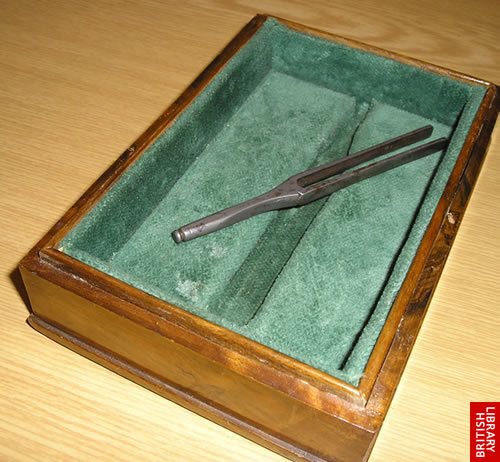
The tuning fork, a present to Bridgetower from Beethoven. It has a much higher pitch than normal.
British Library Add. MS 71148A and B
not for a dispute between the two over a love affair, it is widely understood that the sonata would have been named after Bridgetower, instead of after French violinist Rodolphe Kreutzer.[70]
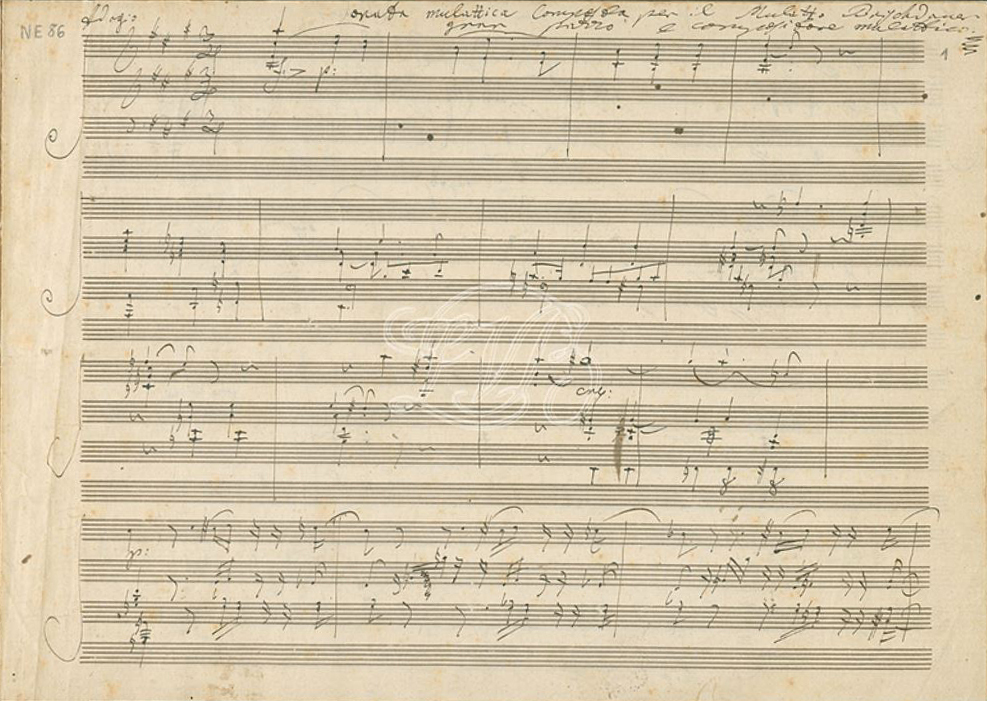
Top right in Beethoven’s hand is: “Sonata mulattica Composta per il Mulatto Brischdauer gran pazzo e compositore mulattico” (Mulatto sonata, composed for the mulatto Brischdauer, great madman and mulatto composer). From the threefold word repetition and the phrase “gran pazzo”, this dedication must clearly be classed as intending amicable teasing: https://blog.henle.de/en/2020/10/12/beethovens-change-of-dedication-a-small-search-for-motives/
George Bridgetower married Marry Leech Leake on 9 March 1816 in London and they had two children together, after which point he stopped performing public concerts.[71] The two separated eight years later while Bridgetower remained in the social circles of fellow musicians.[72]
George Bridgetower died on 29 February 1860 in Peckham, London and is buried at Kensal Green cemetery.[73]
Sources:
Primary sources:
British Library. “Tuning fork said to have been given by Beethoven to the violinist George Augustus Polgreen Bridgetower”, Add MS 71148 A.
Secondary sources:
Fryer, Peter. “Appendix G. Eighteenth-century biographies”, in Staying Power: The History of Black People in Britain. Pluto Press, 2018, https://www.jstor.org/stable/j.ctv69tgjn.24.
Hart, William. “New light on George Bridgetower”, The Musical Times 158, no 1940 (2017): 95-106. https://www.jstor.org/stable/44862826.
Wright, Josephine, R. B.. “George Polgreen Bridgetower: An African Prodigy in England 1789-99”, The Musical Quarterly 66, no 1 (1980): 65-82. https://www.jstor.org/stable/742137.
Squire, W. B. and Golby, David J.. “Bridgetower [Bridgtower], George Polgreen”. Oxford Dictionary of National Biography. 8 August 2024. https://doi.org/10.1093/ref:odnb/3398.
Van Beethoven, Ludwig. The Letters of Beethoven, ed. E. Anderson, Volume 1. Macmillan, 1961.
4. Nathanial Wells (1779-1852): From Enslavement to Slave-ownership
Born 10 September 1779 into slavery in St Kitts, Nathanial Wells was one of at least six children of Welsh slave trader and sugar plantation owner William Wells.[74] Nathanial’s mother, Juggy, was enslaved by Wells and remained his property until his death.[75] Upon Wells granting her manumission (freedom from slavery) she took that name Joardine Wells.[76]
Having been baptised into Christianity in 1783, Nathanial’s father sent him off to live in the care of his uncle and be educated in London, as was common for rich planters with mixed-race sons.[77]
William Wells died in 1794 and left almost all of his large slaving and plantation estate to Nathanial, his then only legitimate son, who became its manager and owner. The estate comprised three plantations in St Kitts: Vambelles, Point Estate and The French Ground or Fahies, as well as hundreds of enslaved people, managed by two agents appointed by Nathanial while he remained in London.[78] The value of this inherited estate in 1794 is estimated at 120,000 pounds[79], or just over 14 million pounds in 2026 terms.[80] In this way, Nathanial Wells went from enslaved to slave owner, willingly participating in the brutal and lucrative business.
In 1801 Wells decided to free some of the enslaved people under his ownership. These were two of his cousins, his mother’s nephew and niece.[81] Earlier that same year, he married Harriet Ester[1] [AL2] in the church of St. George’s in Hanover Square, London.[82]
Wells moved to Monmouthshire, pursuing the link to his former master’s Welsh heritage. Using his wealth gained from the St Kitts sugar plantations, he purchased Peacefield Mansion for £90,000, a large part of his fortune, hoping to cement his role in high society.[83] Many country mansions were funded through plantations at this time, closely linking the traditional British country house with the trans-Atlantic slave economy.[84] Ester died in 1820, aged 29, leaving their 10 children motherless. Wells then repeatedly tried to sell the mansion, given that dry rot had made its upkeep very costly.[85]
Wells was able to enjoy freedoms in Britain that would have been impossible in St Kitts at the time, where even freed Black people were denied social and political rights.[86] Although Wells had joined the community of planters, they often refused to accept owners of mixed-heritage as social equals, frequently scapegoated them for any trouble to the community.[87] Through his status as a British landowner though, Wells became Deputy-Lieutenant, Justice of Peace in 1806 and even the sheriff of Monmouthshire in 1818[88], making him the first Black sheriff in Britain.[89]
In 1822, Wells remarried to Esther Owen, who’s family were abolitionists and linked to the same circles as the Wilberforce family.[90] It is unclear how being a slave-owner surrounded by abolitionists shaped his life at the time. We do know that, despite his wealth and status he was never able to escape aspersions about his origins and appearance. The landscape artist Joseph Farington suggests as much: ‘Piercefield near Chepstow […] sold to Mr Wells a West Indian of large fortune, a man of very gentlemanly manners, but so much a man of Colour as to be little removed from a Negro’.[91]
Nathanial later found himself in financial trouble, accruing large debts due to his extravagant lifestyle and donations to St Arvans church. He began divesting from his plantations in 1823, leasing out most his St Kitts estate and its enslaved people.[92]
The conditions of enslaved ‘property’ on Wells’ plantations at the time were horrific, as documented by abolitionist James Stephen. Between 1812 to 1819, only 60 of the original 140 enslaved people from one of Wells’ plantations survived, with no new births recorded.[93] Wells ended up selling two of his three plantations and their captives, holding on to Fahies and Ortons until he received compensation for his loss of human ‘property’ when Parliament abolished slavery in 1833 (see below). Wells obtained £1400 from the government, around £148,000 pounds in 2026 terms,[94] for the loss of 86 enslaved people on his two remaining plantations.[95]
According to the 1881 census, Nathanial Wells’ wife Esther and daughters Catherine, Cecilia and Matilda lived in Brighton on Victoria Road, presumably heaving deployed some of this inheritance to maintain themselves.
Sources
Primary sources:
Farington, Joseph. The Diary of Joseph Farington, eds. K. Garlick and A. Macintyre. Yale University Press, 1979.
Stephen, James. “Appendix, case no. 4 – Account of the treatment of the Slaves on two united Estates, called Fahie’s and Orton’s, in the island of St. Christopher, and the fatal effects that followed”, in The Slavery of the British West India colonies delineated, as it exists both in law and practice, and compared with the slavery of other countries, ancient and modern. Butterworth and son, 1830. https://go-gale-com.sussex.idm.oclc.org/ps/i.do?p=MOME&u=sussex&id=GALE|U0104577717&v=2.1&it=r.
Secondary sources:
Alan Lester. “Talking about Slavery and Responding to Objections”. Last modified July 10, 2024. https://alanlester.co.uk/blog/talking-about-slavery-and-responding-to-the-objections/.
Bailey, Frances, Conroy Rachel, Chessum, Sophie et al.. Interim Report of the Connections between Colonialism and Properties now in the care of the National Trust, Including links with Historic Slavery. National Trust, 2020. https://nt.global.ssl.fastly.net/binaries/content/assets/website/national/pdf/colonialism-and-historic-slavery-report.pdf.
Bank of England. “Inflation Calculator”. Accessed June 22, 2026. https://www.bankofengland.co.uk/monetary-policy/inflation/inflation-calculator.
Evans, J. A. H.. “Wells, Nathanial”. Oxford Dictionary of National Biography. 11 March 2021. https://doi.org/10.1093/ref:odnb/74450.
Lester, A., Boehme, K. and Mitchell, P.. Ruling the world: freedom, civilisation and liberalism in the nineteenth-century British Empire (Cambridge University Press, 2021), 35-60. https://doi.org/10.1017/9781108584227.002.
National Archives. “First Black Sheriff”, accessed 3 July 2026. https://www.nationalarchives.gov.uk/education/resources/georgian-britain-age-modernity/first-black-sheriff/.
Newman, Booke, N. A Dark Inheritance: Blood, Race, and Sex in Colonial Jamaica. Yale University Press, 2018. https://doi-org.sussex.idm.oclc.org/10.2307/j.ctv47wfjk.
Rainsbury, Anne. “Nathanial Wells: The Making of a Black Country Gentlemen” in Britain’s Black Past, ed. Gretchen H. Gerzina. Liverpool University Press, 2020. https://www.jstor.org/stable/j.ctvz937c0.19.
Simpson, D.. “Phrenology and the neurosciences: contributions of F. J. Gall and J. G. Spurzheim”. ANZ Journal of Surgery 75, no 6 (2005): 475-482. https://doi-org.sussex.idm.oclc.org/10.1111/j.1445-2197.2005.03426.x.
The National Archives. “The 1833 Abolition of Slavery Act and compensation claims”. Accessed June 22, 2026. https://www.nationalarchives.gov.uk/explore-the-collection/explore-by-time-period/georgians/1833-abolition-of-slavery-act-and-compensation-claims/
UCL Centre for the Study of the Legacies of British Slavery. “St Kitts 685 (Fahies and Ortons): Claim Details, Associated Individuals and Estates”. Accessed June 22, 2026. https://www.ucl.ac.uk/lbs/claim/view/25396.
UCL Centre for the Study of the Legacies of British Slavery. “Nathanial Wells: Profile and Legacies Summary”. Accessed June 22, 2026. https://www.ucl.ac.uk/lbs/person/view/25474.
5. Brighton and the Abolition of Slavery
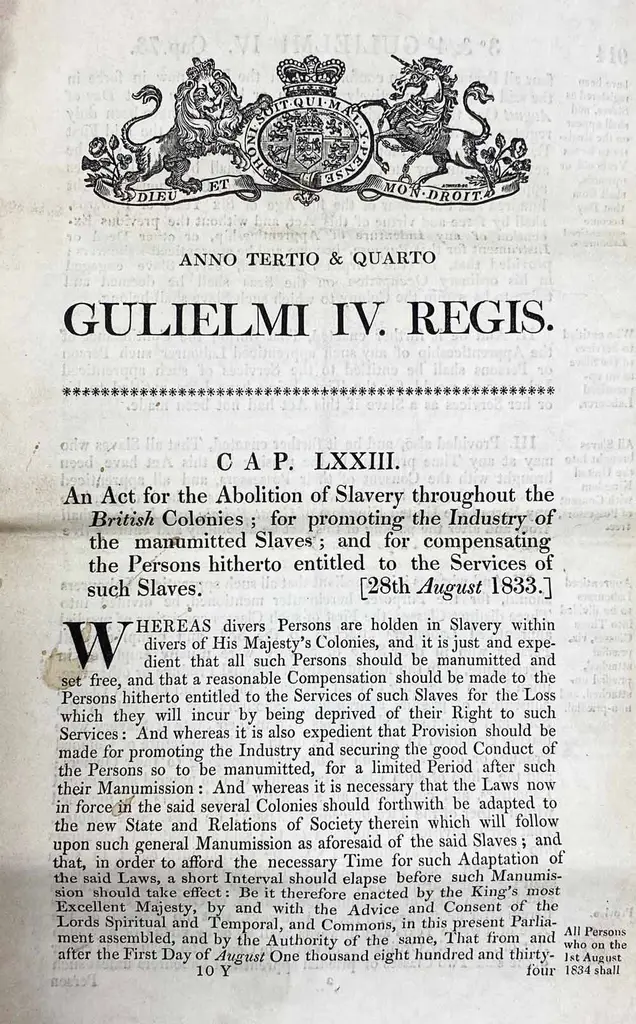
The published Act for the Abolition of Slavery throughout the British Colonies, 28 August 1833: Ther National Archives,
Catalogue reference, PC 1/4444
Following a long campaign in which freed Black people living in Britain including Olaudah Equiano, Ottobah Cugoano and Ignatius Sancho were highly active, the antislavery lobby galvanised unprecedented public support after the loss of the American colonies in the 1780s. By then, some 13,000 British individuals are known to have invested in the trafficking of African captives to the plantations of the Americas. They ranged from ‘plumbers as well as politicians, instrument-makers as well as monarchs, women and immigrants alongside aristocrats and merchants; playwrights, poets and artists, too’.[96]
Equiano and Cugoano’s Sons of Africa campaign group allied with the newly founded Society for Effecting the Abolition of the Slave Trade, which included Quakers as well as Anglicans, the best known of whom is William Wilberforce. The Quakers had prohibited slaveholders from the fellowship in the 1760s and first petitioned Parliament for abolition in 1783. The Sons of Africa were able to present personal testimony of the horrors of trans-Atlantic slavery in the Society’s public meetings and they persistently lobbied members of parliament to vote with Wilberforce for abolition of the slave trade. In just three months during 1788, over 100 petitions calling for abolition of the slave trade were presented to the House of Commons.
Equiano pointedly proclaimed his conversion to Christianity, while pointing out the hypocrisy of those co-religionists who had trafficked and enslaved him. He wrote:
‘O, ye nominal Christians! might not an African ask you, learned you this from your God, who says unto you, Do unto all men as you would men should do unto you? Is it not enough that we are torn from our country and friends to toil for your luxury and lust of gain? Must every tender feeling be likewise sacrificed to your avarice? Are the dearest friends and relations, now rendered more dear by their separation from their kindred, still to be parted from each other, and thus prevented from cheering the gloom of slavery with the small comfort of being together and mingling their sufferings and sorrows? Why are parents to lose their children, brothers their sisters, or husbands their wives? Surely this is a new refinement in cruelty, which, while it has no advantage to atone for it, thus aggravates distress, and adds fresh horrors even to the wretchedness of slavery.’
Writing of the Barbados planters’ assembly proclaiming that the punishment for a white man killing a slave was merely a fine for the destruction of property, Equinao wrote ‘And do not the assembly which enacted it deserve the appellation of savages and brutes rather than of Christians and men?’ [97]
The campaign against slavery won its first success, against entrenched opposition within Parliament, the Church of England and the monarchy, representing some in 1807, when Britain’s slave trade – the trafficking of Africans to the Americas – was banned. But it was not until 1833 that slavery itself was made illegal by the British government.[98] The growing costs of plantation maintenance because of the many slave revolts, as well as the idea that those enslaved across the world would become more productive workers and more compliant subjects once they were free, were key arguments used by the antislavery activists.[99]
Between the abolition of trafficking in 1807 and of enslavement in 1833 was a period of ‘amelioration’, in which enslaved people’s conditions were supposed to be more closely monitored and owners’ punishments regulated. The refusal of many Caribbean planters to implement the changes helped to stimulate the series of rebellions in Barbados, Demerara and Jamaica that hastened the 1833 Abolition Act. The end of slavery, however, was followed by a system of apprenticeship, essentially a legal workaround to enforce further unpaid work, until 1838.[100]
As well as conceding a further four years of unpaid labour to the planters, the 1833 Act was passed only after another enormous concession was granted to the slave-owners. The British government took out a loan to compensate some 46,000 owners for the loss of their 800,000 captives.[101] The sum dispensed was £20 million pounds, worth at least two billion poundsin 2026 terms.[102] For comparison, this is a similar amount of money to the amount used to bail out UK banks during the 2008 financial crash.[103] Around half of this sum, which was only finally paid off by the Treasury in 2015, went to the 3,500 ‘absentee’ slave owners who lived in Britain, such as Nathaniel Wells.[104] The descendants of enslaved people now living in Britain, will have contributed to paying off the loan on behalf of their ancestors’ owners. The 800,000 men, women and children who were ‘freed’ in 1833 and the millions who had endured enslavement before them, of course, received no compensation whatsoever. The newly emancipated entered a market economy with no capital of their own, in colonies where the productive land belonged to their former ‘owners’. Most faced little choice but to accept the low wages that planters were now willing to offer.
Some of the wealthy British slave-owners such as John Gladstone in Demerara (father of the future Prime Minister William Ewart Gladstone), were well-known. But others ranged from ‘modest widows living on annuities that were funded by the labour of the enslaved to middle-range merchants, bankers and lawyers, and rich “West Indians”’ Like Nathaniel Wells ‘enjoying a country residence’. Twenty per cent of those who received compensation in Britain were women, many of whom were widows inheriting their husband’s estates, and the awardees included 96 Anglican priests. This snapshot of those who owned enslaved people at slavery’s end encompassed some 10-20 per cent of Britain’s wealthiest classes, although many more wealthy families had owned enslaved people at some time or another over the two centuries preceding.[105] Investments of some of the £10 million compensation retained in Britain have been traced to the country’s railway and canal systems, merchant banks and insurance companies, urban developments in spa towns such as Leamington, and country houses. Compensation money was also recycled from the Caribbean to new colonising ventures in Australia, the Cape Colony and New Zealand, with Aboriginal, Xhosa and Māori people paying the price. At the same time, British slave-owners contributed to philanthropic enterprises such as asylums and schools for the urban poor, hospitals, an Institute for the Blind and the Lifeboat Institution, enabling ‘modern Britain’ to be ‘better equipped to respond to ill-health, poverty and disability than were the lands and peoples it colonised’.[106]
The University College London Legacies of British Slavery database contains the records of all those paid compensation for the loss of the captives they ‘owned’ in 1833. Using it, we can trace those who registered their address in Brighton. In total 46 Brightonians registered claims for compensation, 38 of whom were successful in one claim or another.
Between them, they received £231,756 for the loss of ‘ownership’ of 9,877 enslaved people. In today’s (2026) money, this would amount to around £23 million pounds, or an average of £605,000 each.
The captives these Brighton residents ‘owned’ were distributed across the Caribbean, with 48 in Trinidad, 100 in Tobago, 160 in the Virgin Islands, 285 in Barbados, 444 in St Kitts, 453 in Montserrat, 480 in Belize (then British Guiana), 528 in Mauritius, 728 in Antigua, 970 in St Vincent, 1801 in Grenada in 3880 in Jamaica.
Brightonians joined with many other Britons in the sudden cash grab to prove they were in fact owners of captives and the ‘rightful’ beneficiaries. A further £47,000 pounds, or around £4.7 million pounds in today’s (2026) money was claimed unsuccessfully, with other beneficiaries being identified as the ‘rightful’ claimants for these same captives. Many more people than the 9,877 found to be enslaved by Brighton residents in 1833 had been owned by Brightonians before that census date, ‘bought’ and ‘sold’ over the preceding two and a half centuries.
One example of a contested, but successful claim of £2,678 pounds, or £272,000 pounds in today’s (2026) money, was that of Rev. George Washington Philips, a Church of England clergyman and former vicar of Wendy in Cambridgeshire, then living in Brighton, who obtained compensation for the loss of ‘ownership’ of 161 enslaved people on the Stone Fort Estate in St Kitts. Philips was living at the Pier Hotel when he died in 1865. He left his son with an impression of his great ‘benevolence’ as a slave-owner: ‘I satisfactorily demonstrated that a mild and equitable treatment is incalculably beneficial to the master, no less than to the servant. After entirely abolishing all harsh measures and having recourse to rewards for the encouragement of industry and subordination, I succeeded in procuring the largest return that had been obtained for several years … and lastly, in increasing a healthy population.’[107]
Brightonians were linked to 85 large estates across Caribbean colonies, many named after places in Britain, such as Windsor Park Pen or Swansea Sugar Estate. Others were given idyllic names despite the horror of slavery, such as Good Hope Estate or Paradise Estate. All of these four estates were located in Jamaica where owners in Brighton made their fortune. Of the 85 estates, 1 was in Tobago, 1 in Trinidad, 1 in the Virgin Islands, 2 in Montserrat, 3 in St Kitts, 3 in Barbados, 4 in British Guiana, 4 in Antigua, 9 in St Vincent, 13 in Grenada and 44 in Jamaica.
But Brighton’s colonial links do not stop at slavery. Some of Brighton’s residents were returning employees of the companies colonising and extracting wealth from across the British empire. There were Brightonian investors in and employees of the East India Company, including a civil servant in the government of Madras, and a recorder living in Penang, Malaysia. One of the most prominent individuals was Charles Lushington, of Marine Parade, Brighton, who benefited from compensation of £5,849 (£682,000 today) for his wife’s family’s estate in Jamaica, and was also East India Company Secretary for the government of Bengal (1823-1827). He later returned to England to become a Whig politician and MP for Ashburton, Devon and later Westminster, Middlesex. His brother Stephen Lushington, a Whig politician and judge, was a leading campaigner for the abolition of slavery.
Ralph Darling, first a soldier in the West Indies (1786-1802) was governor of New South Wales, Australia (1819-1824), then governor of Mauritius (1825-1831), before moving to Brighton in 1837 until his death in 1858.
Colonial merchants also lived in Brighton, making huge profits from their merchant companies as senior partners. Often the wealth made from colonial and slaving ventures was channeled into British institutions. Vast amounts of money were invested by slave owners and traders from Brighton into British railways, the largest being a £46,875 (around four million in today’s money) pound investment in the Brighton and Chichester railway for a Portsmouth extension followed by a £15,000 (around one a half million in today’s money) pound investment to the Keymer railway branch from the director of the London, Brighton and South Coast Railway. He was compensated £800, or over £81,000 pounds in today’s (2026) money, for the loss of ownership of 55 enslaved people on Darby’s Estate, Antigua.
Another case is Thomas Hankey, a West Indies merchant, owner of multiple slaving estates and plantations, who retired to Brighton and invested £2,000 pounds (around £200,000 today) in the Sunderland, Durham and Auckland Union railway and another £2,000 pounds (around £200,000 today) in the Cork and Limerick extensions of the Great Southern and Western railways. He was awarded £49,711 as compensation for the loss of ownership of 1,636 enslaved people in Grenada and 283 enslaved people in St Kitts. His compensation is equivalent to just over £5 million pounds today (2026). Hankey also founded the Thomas Hankey Charity in 1854, with funds of £10,000 pounds (just under one million pounds today) for the ‘widows, or sons and daughters of clergyman of the Church of England, being in poor circumstances’, reflecting the tendency of a number of slave traders and slave owners to engage in charitable works within Britain.
Even the director of the Bank of England, Nathanial Bogle French senior, wo also lived in Brighton,was partner of a West Indies merchant company and sold Palmiste Estate, Grenada and its enslaved people, which he inherited as trustee in 1792. The earliest available records show 150 enslaved people on this estate in 1797.
Sources:
Nicholas Draper, ‘The Price of Emancipation: Slave-Ownership, Compensation And British Society At The End Of Slavery’ (Cambridge Studies in Economic History – Second Series), Cambridge University Press, 2013.
Olaudah Equiano (Author), David Olusoga (Foreword), The Interesting Narrative of the Life of Olaudah Equiano, Hodder, 2021.
Alan Lester, Kate Boehme and Peter Mitchell, “Setting the scene for emancipation” in Ruling the World: freedom, civilisation and liberalism in the nineteenth-century British Empire (Cambridge University Press, 2021), 35-60. https://doi.org/10.1017/9781108584227.002.
William A. Pettigrew, Britain’s Slave Traders: A Forgotten History, The Bodley Head, London, 2026.
“The 1833 Abolition of Slavery Act and compensation claims”, The National Archives, accessed June 22, 2026. https://www.nationalarchives.gov.uk/explore-the-collection/explore-by-time-period/georgians/1833-abolition-of-slavery-act-and-compensation-claims/.
UCL. “The Centre for the Study and the Legacies of British Slavery”. Accessed July 20, 2026. https://www.ucl.ac.uk/lbs/project/centre.
6. Ina Sarah Forbes Bonetta (c.1842-1880): Suppressing Slavery?
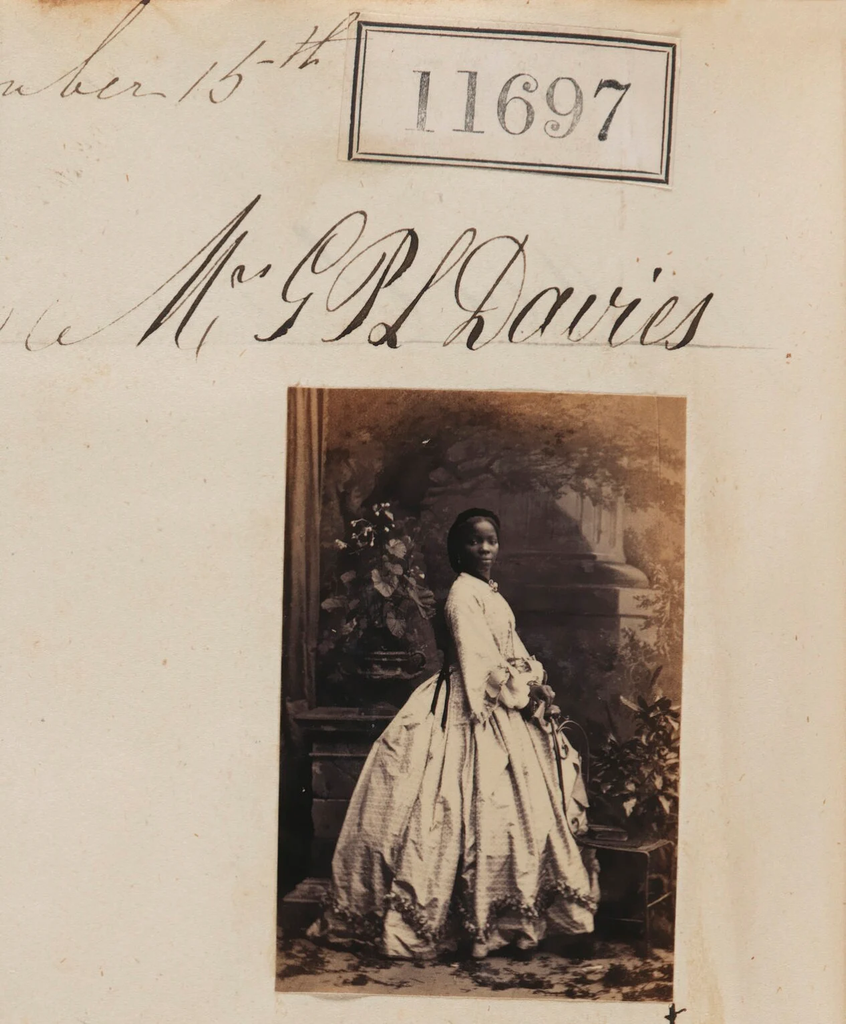
Aina (Sarah Forbes Bonetta (later Davies)), by Camille Silvy, 15 September 1862: https://www.npg.org.uk/schools-hub/aina-sarah-forbes-bonetta-by-camille-silvy
Ina Sarah Forbes Bonetta was a formerly enslaved, Christianised Yoruban woman. She was married at St Nicholas Church, Brighton on 14 August 1862, in a ceremony that became a public sensation, sanctioned by her godmother Queen Victoria.[108]
Born in South-West modern-day Nigeria, Ina had been captured by Dahomey enslavers in a raid as a child, in which her parents had been killed. She was taken to the Dahomian royal palace.[109] Dahomey was a kingdom built on conquest and the enslavement of captives, initially for ‘sale’ to European slave traders on the coast as well as for domestic exploitation.
After Britain abolished its own participation in the trans-Atlantic slave trade in 1807, the Royal Navy was tasked with suppressing the slave trade of other European nations. Along the West African coast former British slave traders turned instead to the palm oil trade, lobbying for the overthrow of African rulers who dominated production on the grounds that they still practiced domestic slavery. Their self-interested employment of anti-slavery rhetoric merged with British officials’ genuine antislavery commitments to produce a complex and often contradictory British approach to African forms of slavery in the mid-late nineteenth century – sometimes intervening to undermine it and at other times utilizing it.[110]
In 1845, Captain Frederick Forbes of the Royal Navy attempted to persuade King Gezo, the ruler of Dahomey, to end his role in the slave trade. Having proved unsuccessful, Forbes set sail homeward upon the H.M.S Bonetta in 1850, bearing gifts from King Gezo – including, ironically the young, enslaved girl, Ina.[111] Forbes reconciled his acceptance of this ‘gift’ with his antislavery disposition by baptizing her before departing. In another irony, he adopted the practice of many slave-owners by inserting his own name in Ina’s new, Christian identity, as well as that of his ship.[112] Henceforward Ina would have the double-barreled surname Forbes-Bonetta.
Through his position as a government official, Forbes made the case to Queen Victoria for the privileged education of this ‘intelligent and good tempered (I need hardly add Black) girl about six or seven years of age’.[113] The Brighton Guardian, intrigued by reference to her intelligence, reported ‘phrenological admiration’ of her skull, which was apparently ‘almost caucasian in regularity’.[114] Britain might have become a proud antislavery nation but as Nancy Stepan wrote, ‘just as the battle against slavery was being won by abolitionists, the war against racism in European thought was being lost’.[115] The fascination with phrenology persisted in Brighton until the 1930s. Despite the fact that its premise had been discredited by the late 1800s, as biological racism turned instead to eugenics, J. Milliot Severn and his wife A. M. Severn continued to work at their ‘Brighton Phrenological Institution’ at 20 Middle Street in front of the Hippodrome. Known as the ‘Prince of British phrenologists’, his promotional pamphlets, including diagrams of Black people as the biological lesser of white people, claimed that over 200,000 Britons had come to him for consultations.
Although Bonetta was never embarked on a European slave ship for the Americas like other ‘Liberated Africans’ intercepted by the Royal Navy, she was treated in the same way. Historians often refer to these people, taken into the custody of the Royal Navy from other nations’ slave ships after the abolition of the slave trade, as ‘Recaptives’ because they were generally never freed to return home. Most were instead assigned by courts of commission as unpaid ‘apprentices’ in parts of the Empire was required. Many of them were sent to work alongside those still legally enslaved in the Caribbean until 1833. Most continued to lack the freedoms of white British subjects even after the expiration of their usually 15 year ‘apprenticeships’.
Not really an honoured ‘princess’ as some newspapers presented her, Ina was ‘apprenticed’ to an assigned master or mistress. The difference was Forbes’ request that to the Secretary of the Admiralty that ‘the government would consider her the property of the Crown’.[116] Ina was assigned not to a colonial planter, settler, or free Black resident of Sierra Leone like other ‘Liberated African girls’, but to Queen Victoria.
The Queen was also impressed with Ina’s intelligence and sent her to a school run by the Church Missionary Society in Freetown, Sierra Leone, where she was educated and faced physical punishment alongside other Liberated Africans.[117] However, the Royal Household then recalled her to Britain where she might serve as an exemplar of the Empire’s ‘civilising mission’.
Hoping to make of Bonetta a true Victorian lady, Queen Victoria arranged for James Pinson Lubolo Davies, a wealthy Black African missionary and palm oil businessman, to propose to Ina in 1860.[118] She refused. As a result, the Queen sent Ina to a finishing school in Brighton to educate her on the benefits of marriage and dependency.[119] In one of her letters, Ina wrote of her despair regarding the unwanted marriage, writing how she ‘could never either love or marry’ Davies, adding ‘Am I to barter my peace of mind for [his] money? No – never!’.[120]
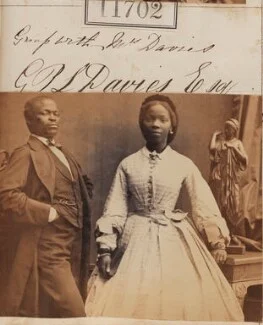
James Pinson Labulo Davies; Aina (Sarah Forbes Bonetta (later Davies)) by Camille Silvy, albumen print, 15 September 1862, NPG Ax61385
Ina, however, was nevertheless obliged to marry Davies, on 12 August 1862 in St. Nicholas Church, Brighton.[121] At the time, her wedding and wider education were widely publicised, highlighting Queen Victoria’s benevolent patronage, before being swept away from the public historical eye.[122] The public was fascinated with Ina’s model, ‘civilised’ and freed African wedding, as well as the colourful clothes of the African bridesmaids. Demand to attend the ceremony was so great that members of the public who had been unable to obtain an entry ticket waited in the rain, trying to catch a glimpse of the proceedings.[123] We can only speculate about what Ina felt as her enforced marriage became a public spectacle.
The ceremony itself was performed by the Right Rev. Henry Venn. Son of the famous John Venn who had been at the centre of the antislavery Clapham Sect, Venn was honorary secretary of the Church Missionary Society and founder of the Sierra Leone bishopric to which the ‘Liberated African Samuel Crowther was appointed. The Rev. William Nichol, described by newspapers as ‘a gentleman of colour’, also participated.[124]
Ina opposed her marriage to Davies till the end, refusing to sign the marriage certificate. A bridesmaid signed it on her behalf.[125] Nevertheless, Sarah named the first of her three children after Queen Victoria and presented one of her daughters to the Queen as a godchild. Ina Sarah Forbes Bonetta died of tuberculosis in 1880 in Madeira, aged 37.[126]
Sources:
The British Newspaper Archive. “An interesting marriage at Brighton”, Sainsbury’s Weekly Register and Advertising Journal, 23 August 1862.
The Keep. “Marriage Register”, 1862, PAR 255/1/3/35.
The Keep. “A marriage with an ante-nuptial romance”, Brighton Guardian, 20 August 1862, NEW/30/1862.
Secondary sources:
Alan Lester. “Antislavery and the Original ‘Scramble for Africa’, 1807-1879”. Last modified 26 January 2026. https://alanlester.co.uk/blog/antislavery-and-the-original-scramble-for-africa-1807-1879/.
Anim-Addo, Joan. “Bonetta [married name Davies], (Ina) Sarah Forbes [Sally] (c. 1843-1880), Queen Victoria’s ward”. Oxford Dictionary of National Biography. 17 September 2015. https://doi.org/10.1093/ref:odnb/75453.
Black History Month. “From Enslavement to Royal Court: the Remarkable Journey of Sara Forbes Bonetta”. Last modified 2 October 2024. https://www.blackhistorymonth.org.uk/article/section/women-in-history/from-enslavement-to-royal-court-the-remarkable-journey-of-sara-forbes-bonetta/.
Bressey, Caroline. “Of Africa’s brightest ornaments: a short biography of Sarah Forbes Bonetta”. Social and Cultural Geography 6, no 4 (2005): 253-266. https://doi.org/10.1080/14649360500074675.
Decherney, Sophia. “Sarah Forbes Bonetta”. Last modified 11 August, 2025. https://www.britannica.com/biography/Sarah-Forbes-Bonetta/additional-info.
Gunning, Sandra. “Sarah Forbes Bonetta and Travel as Social Capital”, in Moving Home: Gender, Place, and Travel Writing in the Early Black Atlantic. Duke University Press, 2021, https://www.jstor.org/stable/j.ctv2k0580g.10.
Lovejoy, H. B. “Queen Victoria’s ‘Liberated African’: Sarah ‘Sally’ Forbes Bonetta and Her Extraordinary Apprenticeship by the British Royal Family, 1850-1862”. Slavery and Abolition 45, no 4 (2024): 911-934. https://doi.org/10.1080/0144039X.2024.2349147.
Lovejoy, H.B. Becoming Sarah Forbes Bonetta: A Yorubá Woman in Queen Victoria’s Court, Toronto University Press, 2026.
7. Frederick Akbar Mahomed: 1849-1884: Pioneer of Clinical Research
Frederick was the grandson of Sake Dean Mahomed (see above). An Englishman of mixed Indian and Irish descent,[127] he was born in Brighton at 2 Black Lion Street.[128]
At age 18 he went to study at the Royal Sussex County Hospital,[129] before entering Guy’s Hospital in London in 1869, winning many awards along the way.[130] Frederick was instrumental in developing the modern-day sphygmomanometer, the first blood pressure measuring instrument, at Guy’s Hospital in the 1870s, even writing his most influential work while he was still a student.[131] He was known for his charm, intellect and commitment to his work [132], obtaining a masters from Brussels and later Cambridge, before returning to work in Brighton.
Despite researchers describing his work as deserving ‘worldwide reputation’, it took 100 years for it to be fully recognised.[133] He died from typhoid fever at age 35, which he likely caught from a patient.
Sources:
Cameron, Stewart J. and Hicks, Jackie. “Frederic Akbar Mahomed and his role in the description of hypertension at Guy’s Hospital”, Kidney International 49, (1996): 1488-1506.
Moore, Norman and Davies, Rachel E. “Mahomed, Frederick Henry Horatio Akbar”, Oxford Dictionary of National Biography. 23 September 2004. https://doi.org/10.1093/ref:odnb/17797.
O’Rourke, Michael F. “Frederick Akbar Mahomed”, Hypertension 19, (1992): 212-217. https://doi.org/10.1161/01.HYP.19.2.21.
8. Thomas Malcolm Sabine Highflyer (1858-1870): Brighton and the ‘Arab’ Slave Trade
In Woodvale Cemetery, Brighton there is a grave of a 13-year old boy called Tom M S Highflyer, who was laid to rest in 1870.
Having set out from Spithead in 1865 for India and China, HMS Highflyer captured an Arab-operated slave-trading dhow off the East African coast, in which three young African boys were found in October 1866. As with Ina Sarah Forbes Bonetta, we do not know their true names as they were renamed after the Royal Navy ship and its captain in Thomas’ case; a crew member – Sam Oldfield; and the type of ship in which they were being trafficked – Bob Dhow. British newspapers reported that the three boys became ‘favourites of the crew’ and so were brought back to Britain rather than ‘apprenticed’ en route.[134] As part of the Royal navy’s antislavery activities, each sailor onboard a ship that intercepted a slave trading vessel was awarded a share of the value of its human cargo as ‘prize’, just as they would for the capture of an enemy ship in wartime.[135] Records show that this monetary reward was an important motivation for many sailors on Britain’s antislavery patrols.[136]
The Highflyer successfully captured 19 dhows and 586 enslaved people.[137] Docking in Portsmouth, the crew received £2,200 as prize money, over £250,000 pounds in today’s (2026) money, with some also rewarded with silver or gold watches for their work.
After the Highflyer’s return to England, its captain sent Tom to Brighton for an education at St Mark’s School in what is now Whitehawk.[138]
Subsequent information on Thomas’ life is found in Church Missionary Society publications, which told his story as an example of Christian salvation and civilizational attainment. Missionaries like those in the Anglican CMS at this time often pushed back against the worst extremes of settler colonial violence and racism, being critical of the unchristian behavior of other colonial interests. Yet they also saw themselves as protecting ‘natives’ from colonisers in paternalistic fashion, until they could be converted and assimilated.[139] A CMS magazine told its readers that:
‘The black boy was received with all sorts of kindness by his master’s family, was taught how to wait at table, and to clean boots and shoes, and to take messages, and to be a little servant, he was so full of admiration of every thing around him, and very particularly of his own important position, that the only fear was, lest his black woolly head should become, like some little golden or brown ones, just a wee bit too full of itself.’[140]
Thomas’ arrival at school in 1869 was narrated as follows:
‘His name was Tommy, and that it was hoped he would find that children with white faces and Christian names would be gentle and kind to the little dark-skinned stranger who was to come among them. […] And when later, the whole troop was turned out into the play-ground, it was hardly to be expected that Tommy should not be felt and stroked by a number of curious playmates who wished to find out for themselves “whether it would come off”’.[141]
Thomas’ experience was also put to effect by the mission society as part of a growing British campaign to combat the so-called ‘Arab’ slave trade (in reality a set of different slaving systems). In the mid-nineteenth century the exploits of the famous missionary explorer David Livingstone brought Britons’ attention to bear on the ongoing and prolific trade in captives maintained by Omani traffickers from East Africa and Zanzibar to the Arabian Peninsula, by suppliers to the Ottoman Empire and by traffickers who forced captives across the Sahara to work in the Barbary states of North Africa. The Royal Navy was tasked with suppressing this trafficking as well as that by Europeans across the Atlantic, and HMS Highflyer’s endeavours were part of that broader effort.
However, the attention that the navy could pay to Indian Ocean slave trafficking was limited by other preoccupations and the possibilities of evasion. It was not just ‘Arabs’ who continued to traffick people here. The European slave trade was not as extensive as that to the plantations of the Americas, but nonetheless, ‘Europeans were involved directly or indirectly in trading a minimum of 567,900 to 733,200’ people ‘between 1500 and 1850 within an oceanic world that stretched from eastern Africa and Madagascar to the Persian Gulf, South Asia, and the Indonesian and Philippine archipelagos’. Despite the best efforts of many Royal Navy ships’ captains and crew, illicit trafficking by both ‘Arabs’ and Europeans continued after 1807.
The trade in captives like Thomas from East Africa to Eastern Arabia continued after British abolition because of the sustained demand for labour in the lucrative pearl and date industries of Arabia and the Gulf. This trafficking came to an end only in the early twentieth century when Portuguese colonial forces raided slave traders in Mozambique and the Arabian date and pearl markets collapsed as a result of the global depression.[142]
In mid-nineteenth century, British ‘antislavery’ force tended to be used mainly when there were strategic or commercial reasons to overthrow rulers who happened also to be engaged in slave trading and ownership. By acting against slave trafficking the Royal Navy managed to acquire control of much of the Arabian Peninsula’s coastline and secure the route from Britain to India. [143]
It was in this context of anti – Arab slavery fervour in Britain that the CMS wrote about Thomas Highflyer’s experience of captivity and trafficking:
‘Does it not make you sad to read of such horrors? – you, little blue-eyed girl, who have just brought the “Green Book” [mission-produced books] from school, and are rocking baby’s cradle while you read it; – you, whistling boy, who have been out cricketing on the green, and are coming home for tea. Tommy, – our little black Tommy – had, probably, as little thought of being carried away from his home, and of seeing his parents and all belonging to him carried off by brutal and cruel slave-drivers as you have to-day.’[144]
Missionary records show that Thomas became a fan of cricket, went to Sunday school, and was baptised as a Christian, all reassuring CMS donors of the ability of freed Africans to become ‘civilised’ with the right instruction.
Whilst still a young child, Thomas Highflyer, was made a retired Coastal Guard’s servant,
lodging with Henry Thompson and his family in a house in Great College Street, Kemptown. We know little of the conditions in which he served or of his experiences in Brighton more generally until his untimely death in 1870 from ‘tuberculosis liver and dropsy.’ [145] His grave inscription reads: In memory of Tom MS Highflyer rescued from a slave Dhow August 24, 1866 baptised by his own request at Brighton March 30, 1870 died at Brighton June 20, 1870 supposed to be about 12 years old. Jesus Said ‘He That Cometh Unto Me I Will In No Wise Cast Out’.
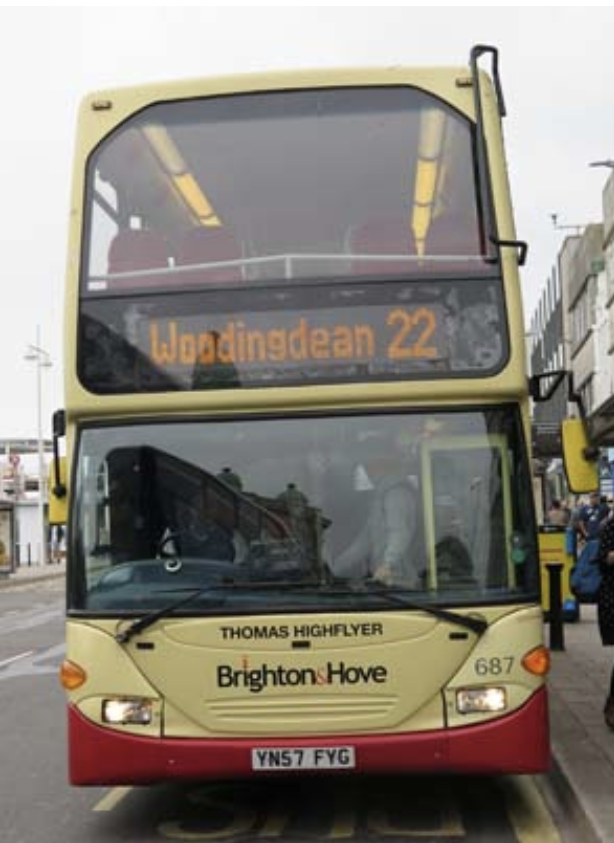
Thanks to the work of the Brighton & Hove Black History Group, Thomas Highflyer has at least left a marked legacy in the city to which he was brought. Thomas has a Brighton and Hove bus named after him and has been honoured by children from St Marks’ School (his old school) in a ceremony at his newly restored gravestone.
Sources:
The Thomas Highflyer Bus: https://history.buses.co.uk/history/fleethist/684th.htm
Primary Sources:
“Black Tommy’s Two Homes”, The Church Juvenile Instructor 6, no 6, (1870): 81-93. https://books.google.bi/books?id=gF0EAAAAQAAJ&printsec=frontcover&hl=fr#v=onepage&q=highflyer&f=false.
The British Newspaper Archives. “Naval Intelligence: Portsmouth”, Portsmouth Times and Naval Gazette, 5 September 1868.
The British Newspaper Archives. “Naval and military intelligence: naval appointments”, London Evening Standard, 1 September 1868.
The Keep. “Woodvale Cemetery burial registers”, 1857-2003, BH/L/3/1.
Secondary Sources:
Matthew S. Hopper, ‘East Africa and the End of the Indian Ocean Slave Trade’,
Journal of African Development, 13, 1-2, 2011, 39–66.
Alan Lester, ‘Missionaries and White Settlers in the Nineteenth Century’, in N. Etherington (ed) Missions and Empire, Oxford History of the British Empire Companion Volume, Oxford University Press, 2005, 64-85.
Moses D. E. Nwulia, Britain and Slavery in East Africa, Reiner, 1975.
Mary Wills, ‘A ‘most miserable business’: Naval officers’ experiences of slave-trade suppression’ in The suppression of the Atlantic slave trade, eds. R. Burroughs and R. Huzzey. Manchester University Press, 2016. https://doi-org.sussex.idm.oclc.org/10.7765/9781784992361.00011.
9. St Nicholas’ Church and The Great Indian Famine of 1876-78
By the 1870s, the East India Company was no longer governing India, having provoked the 1857 Uprising (often referred to in Britain as the Indian Mutiny) and been relieved of its governmental function by a new department of the British government. However, the colonial administrators of British India were still imposing taxes on Indian farmers to pay towards the British government’s costs. Direct revenue extraction was paired with the widespread forced cultivation of ‘cash crops’ like cotton, opium poppies and indigo, often at the cost of grain production.[146]
In 1876 a drought across the Deccan Plateau causing mass crop failure in south and southwestern India. With many rural Indians already impoverished, a famine set in during the following year.[147] The British government’s extractive policies made this famine far worse, just as they had in 1770, when Sake Dean Mohamed had witnessed similar events.
The British Raj had come under the newly appointed Viceroy of India, Edward Robert Bulwar, first earl of Lytton, a controversial conservative diplomat, known for being forceful, dictatorial and addicted to opium.[148] Lytton arrived in India promoting a new free trade agenda, in an attempt to deal with British India’s large debt. Overruling his executive council, he massively reformed systems of customs and law, all while banning the freedom of the press and shutting down any newspaper that reported on the famine.[149]
As shortages were affecting 59 million people, and with, ultimately, 5.5 million people dying of starvation, Lytton showcased his free trading success with a record 320,000 tons of wheat being exported to Britain.[150]
Sir Richard Temple, famine commissioner for the government and India and previously ridiculed for organising relief that was seen as too generous for an 1874 famine in Bihar, now shared Lytton’s views on famine response. With encouragement from Lytton, he reduced the rations for those working in government work camps, while restricting charity support to children, elderly and the poor.[151] ‘Everything must be subordinated to the financial consideration of disbursing the smallest sum of money’[152], with Lytton complaining of ‘humanitarian humbugs’.[153] By the time Temple claimed in 1877 that the famine was under control, a British journalist pointed out that this was because a quarter of those affected had already died. It seems that little had been learned about effective government famine response measures from the Great Irish Famine of 1845-52 when similar British laissez faire polices contributed to the deaths of around a million and the emigration of two million Irish people.[154]
Given the British Indian government’s failure to support those affected by the famine, many other groups in Britain and its colonies organised themselves to set up charitable funds. One of first photographic campaigns organised by the Colonial Office depicting starving Indian children began in Britain and the Australian colonies.[155]
1877 European and Indian citizens of Madras established a famine relief fund, open for donations, which was then shut down by Lytton. Once this information appeared in newspapers, public outrage forced Lytton to personally donate £1,000, around £100,000 today (2026), to the fund.[156]
The fund later reached £820,000, or £85 million today (2026), raised through thousands of contributions from individuals, schools, churches and regiments across the British empire.[157] Brighton’s St Nicholas Church and its members were amongst these donors. Records show the Mayor of Brighton thanking the church for the collection of around 262 pounds to the fund, around £27,000 today (2026) to the famine relief fund.[158] The same records also point to donations to the Society for the Propagation of the Gospel, the evangelical branch of the Church of England, of about £133 or just under £14,000 today (2026).[159]
Despite the range of voluntary relief agencies, involving thousands of Indian and European volunteers across India, the Famine Commissioners’ report in 1880 continued to support Lytton’s view on charity as a ‘grave evil’ that would likely render recipients poorer and dependent. As a result, the report strongly discouraged any future charitable relief efforts.[160]
Sources:
Primary sources:
The Keep. “Brighton St Nicholas; parish charities”, 1877, PAR 277/7/2/15/1.
Secondary sources:
Brewis, Georgina. “‘Fill Full the Mouth of Famine’: Voluntary Action in Famine Relief in India 1896-1901”, Modern Asian Studies 44, no 4 (2010): 887-918. https://www.jstor.org/stable/40664949
Lester, Alan, Boehme, Kate and Mitchell Peter. “Liberal Fathers and Sons” in Ruling the world: Freedom, Civilisation and Liberalism in the Nineteenth-Century British Empire. Cambridge University Press, 2021, https://doi.org/10.1017/9781108584227.013.
Sahu, A. C. “Diversion of arable lands from food-crops to exportable cash-crops: one of the causes of frequent famines in India between 1860-1900”, Proceedings of the Indian History Congress 41, (1980): 644-656. https://www.jstor.org/stable/44141891.
United Society Partners in Gospel. “History”. Accessed July 7, 2026. https://uspg.org.uk/history/.
Part 2: Brighton and the First World War (1914-1918)
- The South African Native Labour Corps in WW1 and the SS Mendi, 1916
Throughout the First World War, around 2,350,000 African men served with the European imperial forces, and 250,000 soldiers and carriers and 750,000 African civilians lost their lives.[161] While the British government and War Office were firmly against the involvement of Black African soldiers, believing that defence of the empire ‘must be borne by the white subjects of the King’, there was growing talk of using Africans to replace the Indian Army, as the India Office became increasingly reluctant to deploy them in defence of the wider empire, not least because resistance to the British rule of India was mounting.[162]
Many of the African soldiers were forcibly conscripted, sometimes involving threats or kidnappings.[163] For example, 75% of the 327,000 men recruited in Egypt to serve in the Great War were forcibly recruited.[164] Others volunteered willingly, hoping for comradeship, material rewards and the concession of greater equality with their colonial masters in return for their loyalty. However, inequality continued even in death as most African soldiers’ sacrifices were not remembered in the way that white soldiers’ were.[165]
Cooking in a labour camp, Western Front, during World War I. The men are probably members of the South African Native Labour Corps. National Library of Scotland, Public domain.
is also important to remember this war was not just between nations, but between colonial empires. While the usual focus is on the European Western Front as the main conflict area, Africa, the Middle East and Asia were a fronts in themselves, as British and French colonial empires expanded into captured German and Ottoman colonies. For many British colonies, the fighting continued until 1923 as the British empire violently repressed independence movements attempting to realise Britain’s promise of greater equality in return for support.[166]
Twenty one thousand 21,000 African men volunteered to serve the Empire from white-minority governed South Africa and were enlisted in the South African Native Labour Corps.[167] Although willing to fight, they were told that they would be serving as unarmed labourers, as the South African Prime Minister Louis Botha was worried about authorizing Black men to shoot white people.[168] Their work on the Western Front would include building and maintaining trenches, roads, railways, ports, and harbours – essential infrastructure for the war campaign. Despite being unarmed their work was very dangerous. Over 7,300 of the Corps would die on the Western front and in South West and East Africa.[169]
Nine hundred and thirteen new recruits of the South African Native Labour Corps had completed a 34-day voyage from Cape Town and were nearing France via the Isle of Wight in heavy fog on 21 February 1917 when they were struck by the SS Darro, a Royal Mail packet-boat travelling at full speed. The impact tore a 20ft (6m) hole in the Mendi’s starboard side, directly into the lower holds, where many men were asleep in tightly packed bunks. The Mendi sank rapidly, resulting in the deaths of at least 646 people. Only 267 survived, including 195 Black South African men, 2 of the 4 white officers and 10 of the 17 white non-commissioned officers (NCOs). Captain Harry Stump of the Darro did not assist in rescue efforts, despite the proximity of the sinking vessel.[170]
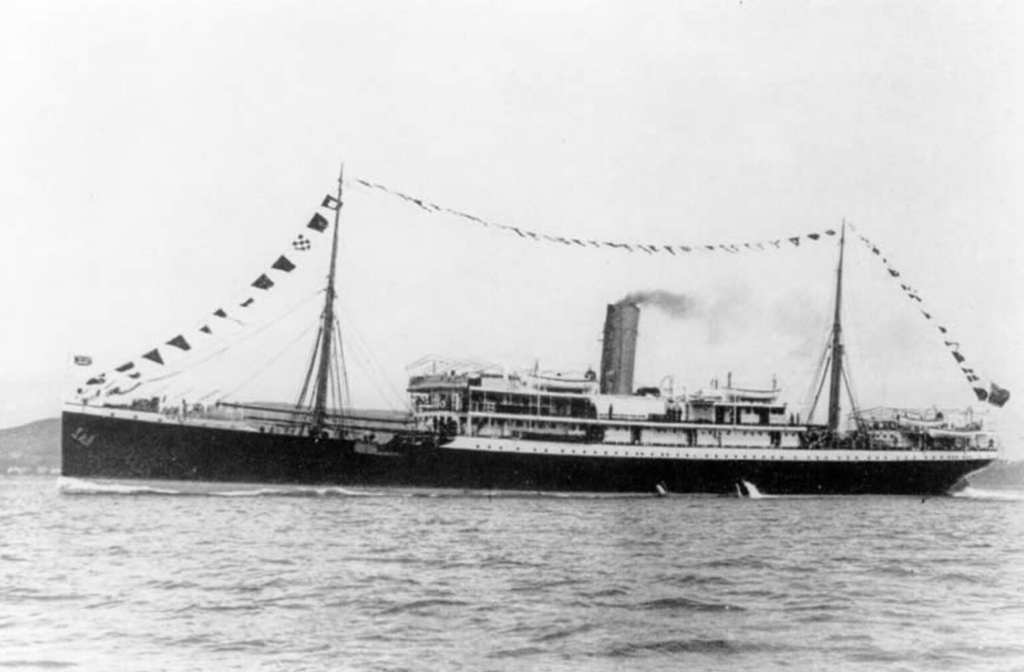
The SS Mendi: https://www.wessexarch.co.uk/our-work/wreck-ss-mendi
The Hollybrook Memorial in Southampton honours those who died in the sinking of the SS Mendi, along with others lost at sea during the war. But a specific memorial also stands at Newtimber Church near Pyecombe – fittingly, given the local landowner Sydney Buxton’s position as Governor-General of South Africa at the time.
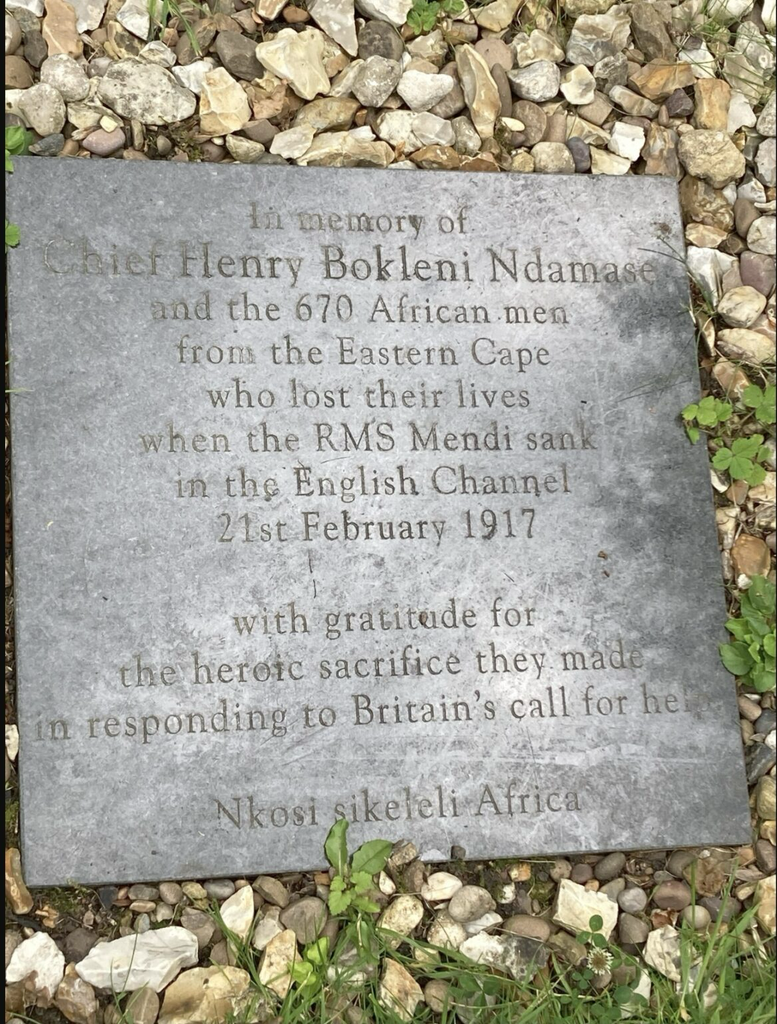
Memorial to the men of the SS Mendi who lost their lives in 1917 at Newtimber Church
As the ship sank, the Xhosa interpreter Isaac Williams, also known as Isaac Wauchope Dyobha, who had previously been a minister in the Congregational Native Church of Fort Beaufort and Blinkwater, is reputed to have said:
“Be quite and calm my countrymen, for what is taking place now is what you came here to do. We are all going to die, and that is what we came for. Brothers, we are drilling the death drill. I, a Zulu, say here and now that you are all my brothers… Xhosas, Swazis, Pondos, Basotho and all others, let us die like warriors. We are the sons of Africa. Raise your war cries my brothers, for though they made us leave our assegais back in the kraals, our voices are left with our bodies…”.[171]
There is a South African oral tradition of the so-called ‘Death Dance’ or ‘Death Drill’. It is said that a large number of SANLC men performed one last (barefooted) dance on the tilting deck of the Mendi before she plunged beneath the ocean surface and took the ‘death-dancers’ with her to the depths.[172]
The members of the South African Native Labour Corps are still remembered today for having made the ultimate sacrifice for Britain and its Empire.
Sources:
Booth, Robert. “How millions of black and Asian men were mobilised in first world war”. The Guardian, April 21, 2021. https://www.theguardian.com/world/2021/apr/21/how-millions-of-black-and-asian-men-were-mobilised-in-first-world-war.
Gerwarth, Robert and Manela, Erez. “The Great War as a Global War: Imperial Conflict and the Reconfiguration of World Order, 1911-1923”, Diplomatic History 38, no 4, (2014): 786-800. https://www.jstor.org/stable/26376604.
Killingray, David. “The idea of a British Imperial African Army”, The Journal African History 20, no 3 (1979): 421-436. https://www.jstor.org/stable/181123.
Killingray, David. “Labour exploitation for military campaigns in British colonial Africa 1870-1945”, Journal of Contemporary History 24, no 3, (1989): 483-501. https://doi.org/10.1177/002200948902400306.
Alan Lester. “Newtimber Church and the British Empire”. Last modified August 4, 2025. https://alanlester.co.uk/blog/newtimber-church-and-the-british-empire/.
Lunn, Joe Harris. “War Losses (Africa)”, International Encyclopaedia of the First World War. Last modified June 22, 2015. https://encyclopedia.1914-1918-online.net/article/war-losses-africa/.
Swinney, G.. “The Sinking Of The SS Mendi, 21 February 1917”,Military History Journal 10, no 1, (1995). https://samilitaryhistory.org/vol101gs.html.
The National Archives. “The sinking of SS Mendi: an avoidable tragedy”. Last modified February 21, 2017. https://webarchive.nationalarchives.gov.uk/ukgwa/20250613152251/https://blog.nationalarchives.gov.uk/sinking-ss-mendi-avoidable-tragedy/.
Willan, B. P.. “The South African Native Labour Contingent, 1916-1918”, The Journal of African History 19, no. 1, (1978): 61-86. https://web.archive.org/web/20110927075323/http://www.navy.mil.za/newnavy/mendi_history/mendi_hist.html.
2. The Royal Pavilion Indian Military Hospital (1915-1917)
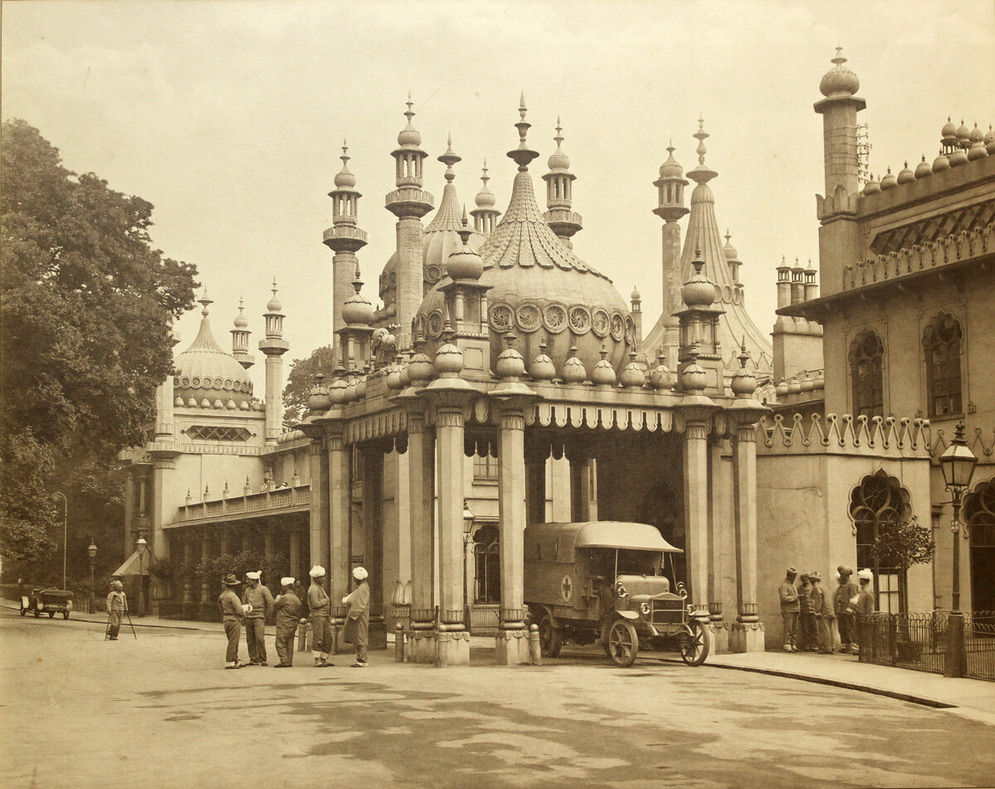
‘The Royal Pavilion, Brighton, as an Indian Military Hospital. Main Entrance, Western Front.’ Royal Pavilion & Museums, Brighton & Hove
During the First World War, 1.5 million men from the Indian sub-continent (modern-day India, Pakistan and Bangladesh) laboured and fought for Britain.
When Indian soldiers were brought to fight on the Western front in 1914, Lord Hardinge, Viceroy of India had insisted that the British government attempt to accommodate their religions practices – a lesson learned from the Indian Uprising of 1857.[173]
In 1915, Walter Lawrence, Commissioner for Sick and Wounded Indian Soldiers, requested that the Royal Pavilion, Brighton Dome and Corn exchange be turned into hospitals for Indians wounded in France, having decided that the Orientalist style of these buildings would make them feel at home.[174] In total the Pavilion complex held 724 beds.[175]
In the first two years of the First World War, 4,306 patients were treated in these three buildings.[176] Also in Brighton, York Place Hospital, holding 600 beds, and Kitchener Hospital, holding up to 2000 beds joined the effort, having originally being a school and a Poor Law institution.[177]
Each ward in the Pavilion complex had two taps, one for Hindus and one for Muslims. Those of lowest caste performed essential, ‘polluting’ tasks and were housed in a separate settlement on the lawn.[178] Nine kitchens were divided into three kinds: one for vegetarians, one for non-vegetarian Hindus and Sikhs and another for Muslims.[179]
Wards, baths, toilets and laundry services were also religiously segregated.[180] The whole project attempted to push a united feeling of brotherhood and imperial duty to serve the mother country and crown.[181]
The soldiers drew lots of attention from the Brighton public, who saw them as a curious attraction. An encouraging call to arms to the Indian Army Corps points to an interest in these ‘martial races’[182], building on stereotypes about ethnic groups who fought alongside British troops during the Indian Uprising, such as the Sikhs, or whose resistance against British rule was respected, like the Gurkhas.[183]
Despite the public interest, the Indian soldiers in Brighton remained highly surveilled and lacked certain freedoms. A sentiment of wanting to ‘keep the white race pure’ fuelled fears of racial mixing between Indians and white women, leading to the expulsion of all female nurses working in these hospitals.[184] Some doctors protested, as these nurses were key to successfully treating the injured, but their calls were ignored.
Most Indians were not allowed to leave the Kitchener hospital in particular unaccompanied, with some not able to leave at all.[185] The Pavilion hospital had softer regulations but the soldiers were still chaperoned when out and about.
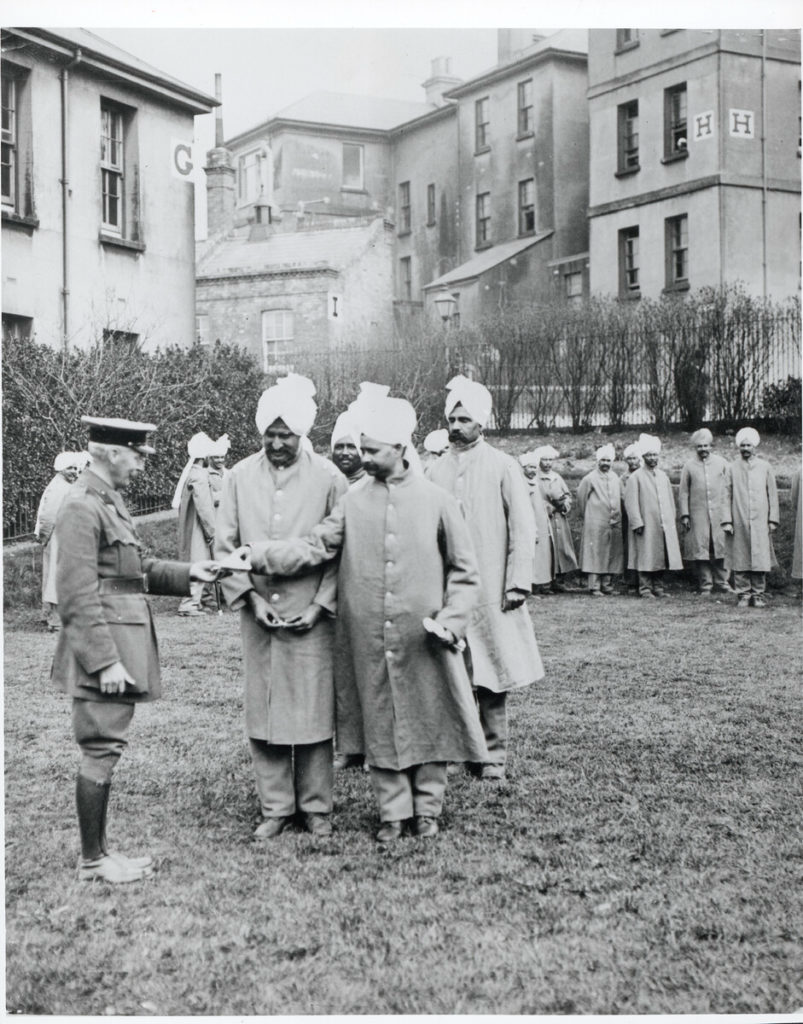
Indian soldiers receiving rations outside the Kitchener Military Hospital, in 1915. The British military officer is thought to be Sir Bruce Gordon Seton (1868-1932), Commanding Officer at the Kitchener Military Hospital. Royal Pavilion & Museums, Brighton & Hove
The soldiers wrote letters home during their recovery in Brighton, which were censored by British officers. First to ensure no military secrets were being given away but also to stop them from writing anything too critical of the British Empire or undermining of morale and the ability to recruit more troops from their communities in India.[186] The British authorities also produced their own propaganda by underlining their benevolence and respect for Indians.[187]
Some soldiers wrote genuinely about their gratitude and respect for British hospitality, thankful for the treatment they received.[188] The censor would very often black out any statement the British authorities wouldn’t allow, but some did slip through as the Indian soldiers became aware of the censoring. A secret code was developed amongst themselves to get the message across as casualties mounted on the Western front. ‘Pepper’ meant troops with red ones being British and black ones being Indian:
‘Please let me know what is the condition of the market for black pepper. That which I bought with me has all been finished and some more has been sent […]. You probably know that there is lots of red pepper but they want black.’[189]
Many of these letters showed how expendable Indian troops felt, treated as second-class soldiers instead of equals. While the overall feeling seems to have been one of pride in 1914, by March 1915 Indian troops were already writing back describing war as ‘hellish’, pleading to God for the war to end and convincing family members in India to not join the army.[190]
Another code was the use of fruits, such as pears and apples, to refer to local white women. This next letter was stopped by British surveillance:
‘Here there are many pears of the kind you have in your garden. They encounter our people on our walks and we sit down and enjoy them. Then we are put in jail.’[191]
A surviving letter from Nabi Bukhah from the Kitchener Hospital does show that censorship checks sometimes failed:
‘I wish we should have come here in our young age to pass several examinations free of charge. English girls are very free in their nature and they love Indians very much. Love making and breaking in Europe is nothing but a matter of choice, friends are plenty when purse is full.’[192]
The King and Queen made multiple visits to the Pavilion Hospital show their support for the recovering Indian troops and show that their service was invaluable. Many pictures were taken of their visits and sent to India, to ensure they had the desirable ‘political effects’. A short film showing King George V presenting the Victoria Cross to Indian soldier Jemadar Mir Dast was also made. These various moments were complied in Henry Roberts’ book A short history in English, Gurmukhi and Urdu of the Royal Pavilion, Brighton and a Description of it as a Hospital for Indian Soldiers, which continued to push the government’s pro-imperial narrative, exaggerating the King’s generosity in donating his palace whilst failing to mention the Pavilion was now owned by the council.[193]
By the end of 1915, reports of low morale amongst the Indian troops, the German targeting of their white officers and continuing fears of mixing between Indians and white Britons led to the redeployment of most Indian troops from the Western Front to Egypt and Mesopotamia. All the Brighton hospitals had closed by March 1916.[194]
During the war, German leaflets were printed and shared with Indian soldiers, encouraging them to rise up against their British officers and ‘share the glory of being a free nation’. The Government of India countered this with their own production of 4 million leaflets, 331,000 posters, 2,500,000 war journals and 275 communiqués over the course of the war.[195] The nationalist Congress movement in India campaigned in support of the war effort in the hopes of being given Home Rule – the right to form their own government whist remaining part of the British empire – at the end of the war. The British government appeared to support this in 1917, as then-Secretary of State for India Edwin Montagu announced that British policy in India now aimed at ‘increasing association of Indians in every branch of the administration, and the gradual development of self-governing institutions, with a view to the progressive realisation of responsible government in India as integral part of the British Empire.’[196] Instead though, the Rowlatt Act of March 1919 extended wartime restrictions on basic freedoms and Indian nationalist leaders were rounded up and imprisoned with great violence.
In protest, Mahatma Gandhi began his first peaceful civil disobedience movement.
A peaceful unarmed crowd gathered in Jallianwala Bagh, Amritsar on 13 April 1919 in reaction to the government’s crackdown, as well as to celebrate a Sikh religious event. They were shot without provocation, under the orders of Brigadier General Reginald Dyer, ‘to produce a moral effect’. The massacre led to nationwide unrest that had not been seen since the Indian Uprising of 1857 and in many ways marked the beginning of the end of British rule in India.[197] India officially gained independence from Britain in 1947, when the Indian sub-continent was partitioned by British officials into India and Pakistan.
Sources:
Primary sources:
The British Newspaper Archives. “Indian Troops in France”, Brighton Gazette, 4 November 1914.
Secondary sources:
Alan Lester. “When the Raj came to Brighton”, last modified March 22, 2024 https://alanlester.co.uk/blog/when-the-raj-came-to-brighton-2/.
LSE Blogs. “India and WWI: Piecing together the impact of the Great War on the subcontinent”. Last modified September 24, 2014. https://blogs.lse.ac.uk/southasia/2014/09/24/piecing-together-the-impact-of-the-great-war-on-india/.
Hyson, Samuel and Lester, Alan. “‘British India on trial: Brighton Military Hospitals and the politics of empire in World War I”. Journal of Historical Geography 38, no 1 (2012): 18-34. https://doi.org/10.1016/j.jhg.2011.09.002.
Robinson, Catherine. “Neither East nor West: Some Aspects of Religion and Ritual in the Indian Army of the Raj”. Religion 26, no 1 (1996): 37-47. https://doi.org/10.1006/reli.1996.0003.
Sanghera, Sathnam. “Imperialism and Me” in Empireland. Penguin Random House, 2021.
3. The Chattri memorial (1921)
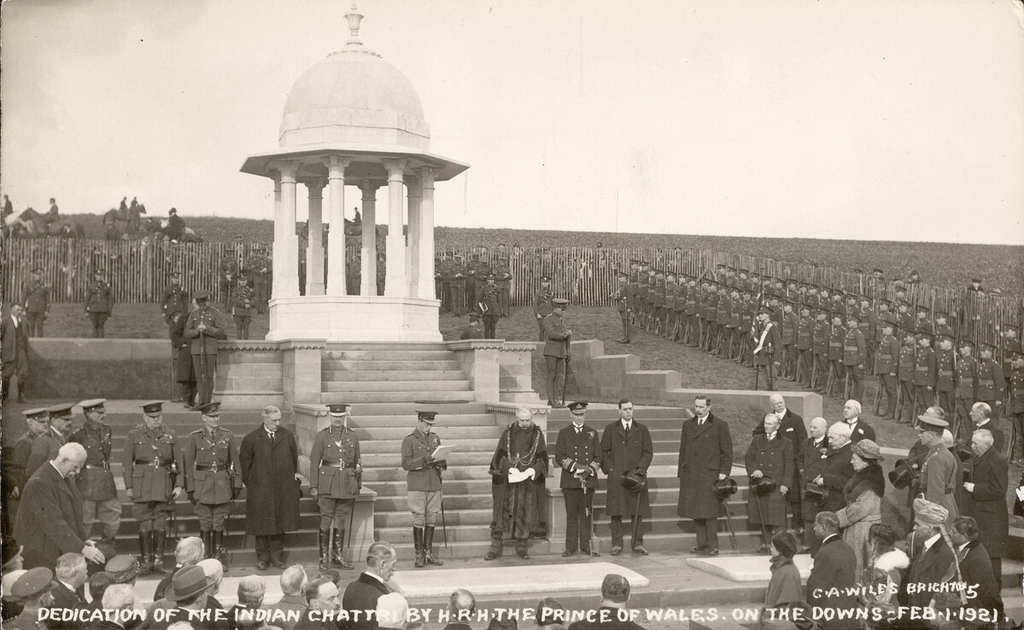
Unveiling of Chattri memorial, 1 February 1921, Royal Pavilion & Museums, Brighton & Hove
As part of the effort to accommodate the Indian soldiers’ religious practices in the Brighton military hospitals (see above), the appropriate funeral rites were also undertaken to honour Indian losses. Fallen Muslim soldiers were driven in a hearse to the Shah Jehan Mosque in Woking, the only mosque Britain at the time.[198] They were buried in Brookwood Military Cemetery, Surrey with religious and military ceremonies.[199]
Fallen Sikh and Hindu soldiers were cremated at a religious open-air religious site of cremation, known as a burning ghat. Their ashes were sent back to the soldiers’ families in India for them to scatter in an Indian river,[200] or scattered across the British sea, in accordance with Sikh and Hindu burial rites.[201] Three burning ghats were setup in Patcham, intentionally a ‘safe’ distance from Brighton due to the health concerns around open-air cremations, but also to keep these prominent rituals out of the public eye.[202]
The Chattri itself was designed by E. C. Henriques, from Mumbai. Henriques created the design to symbolise the protection of the memory of the dead – Chattri means ‘umbrella’ in Hindi, Punjabi and Urdu.[203] Three granite slabs lie over the original concrete crematory bases, commemorating the 53 Indian men who died from their wounds on the Western front and are cremated at the Patcham Down ghat.[204]
Written in Urdu, Hindi and English, the inscription reads:
‘To the memory of all Indian soldiers who gave their lives for their King-Emperor in the Great War, this monument, erected on the site of the funeral pyre where the Hindus and Sikhs who died in hospital at Brighton passed through the fire, is in grateful admiration and brotherly affection dedicated.’
While the project faced organisational complications, it was finally unveiled on 1 February 1921 by the Prince of Wales and stands on the edge of the Downs to this day. Every June, an annual memorial service is held at the Chattri to commemorate these soldiers.[205]
Sources:
Arnold, David. “The Global Dead” in Burning the Dead: Hindi Nationhood and the Global Construction of Indian Tradition. University of Cambridge Press, 2021, https://www.jstor.org/stable/j.ctv1h1vbqk.10.
Brighton and Hove City Council. “The Chattri Memorial”. Accessed July 8, 2026. https://www.brighton-hove.gov.uk/libraries-leisure-and-arts/parks-and-green-spaces/chattri-memorial.
Brighton and Hove Museums. “Unveiling the Chattri”. Accessed July 8, 2026. https://brightonmuseums.org.uk/discovery/history-stories/unveiling-of-the-chattri-memorial-1-february-1921/.
Robinson, Catherine. “Neither East nor West: Some Aspects of Religion and Ritual in the Indian Army of the Raj”. Religion 26, no 1 (1996): 37-47. https://doi.org/10.1006/reli.1996.0003.
4. The Indian Memorial Gateway (1921)
Though many believe the Memorial Gateway was originally part of the Pavilion, it was added much later on 26 October 1921, unveiled by the Maharaja of Patiala, Bhupinder Singh. Patiala was one of India’s Princely States, loosely overseen by the British Raj but with a degree of internal self-governance. The Gateway was officially opened once the Maharaja unlocked its front gate using a golden key. Its designer Thomas Tyrwhitt replicated the architectural style of the state of Gujarat, India. In attendance were also notable local British political figures, including the Mayor of Brighton.[206]
Funded by the individuals from India, the gateway was a symbol of gratitude for the care of wounded Indian soldiers and for Brightonians’ hospitality towards them.[207] During his speech, the Maharaja spoke of the 28 000 men from his state who had contributed to the war effort.[208] The speech took place in the context of rising tension in India after the Jallianwala Bagh (Amritsar) Massacre of 1919 (see abive). The nationalist independence movement was attracting more support and placating the Princely rulers like the Maharaja was a diplomatic necessity.[209]
Sources:
The British Newspaper Archives. “India’s Gift to Brighton: ceremony by the Maharaja of Patiala”, Civil and Military Gazette, 18 November 1921.
Bacon, Kevin. “Unveiling the Indian Gate”, Brighton and Hove and Museums, accessed July 16, 2026. https://brightonmu
5. The British West Indies Regiment in Seaford (1914- 1918)
Between 1915 and 1918, 15,205 mainly Black soldiers of the British West Indies Regiment served in Palestine, Egypt, Mesopotamia, East Africa, France, Italy, Belgium and England.[210]
The first West Indies contingent arrived in England in October 1915 to train in Seaford, Sussex, with many fueled by patriotic British imperial feeling, as well as a hope for greater rights and freedoms for their islands in reward for their military contributions.[211]
However there had been a tense buildup to their inclusion, as some British administrators shared the South African Prime Minister Louis Botha’s view (see SS Mendi entry above) that Black troops should not fight white forces. The War Office repeatedly declined requests made from the Colonial Office for their military involvement. Despite this, many West Indians voluntarily came to Britain at their own expense, about £25 (about £2,500 in 2026), to enlist in Kitchener’s army. Upon arrival, only ‘lighter coloured’ volunteers were accepted. Even after the War Office declined all offers of West Indian military support, potentially due to mismanagement, Secretary of War Kitchener claimed the War Office never refused the offer. Only after the intervention of King George V, who recognised the political consequences of refusing a loyal offer from the West Indies, was the contingent brought into the First World War.[212]
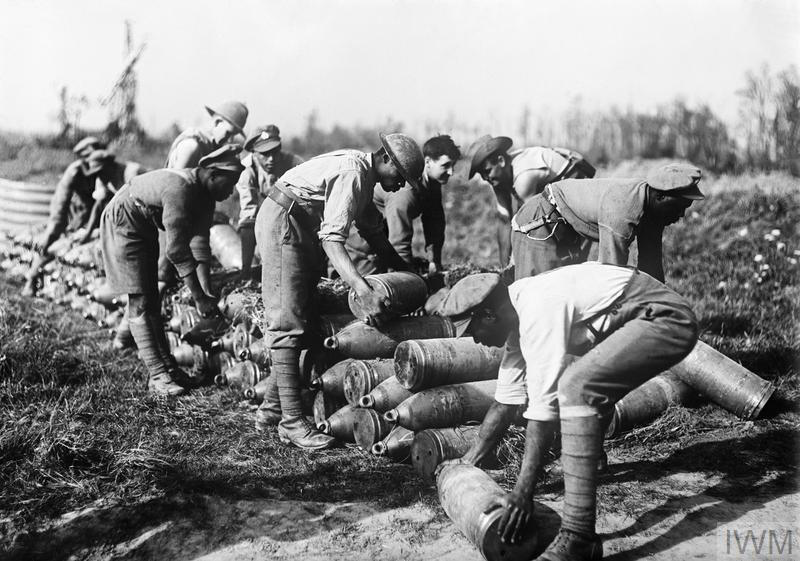
West Indians in the First World War: Image: IWM (E(AUS) 2078)
Upon completing their training in Seaford, the British government was still insisting that Black soldiers could not fight in ‘a white man’s war’. But when the British Indian Army was sent to the Western front in 1914, there was an expectation that people from other colonies and white dominions could fight. Some West Indian volunteers were sent to ammunition dumps in France, working under heavy shellfire. However, like the South African Native Labour contingent (see abive) they were now more labourers than soldiers.[213]
Seaford remained the main encampment for West Indies troops before their depot was transferred to Egypt in 1916.[214] There and in Palestine, West Indian soldiers from across the Caribbean were encouraged to fight against the non-white soldiers of the Ottoman Empire. White supremacy was reinforced within the Army through ideas of Black soldiers being inherently irrational, lacking discipline and having ‘limited intellect’. Black men fighting equally alongside white men would have been seen as a threat to the imperial order.[215]
Private Nabtar Forbes, 3rd British West Indies Regiment Battalion, wrote home of his time in France, describing his proximity to the frontline as a way of highlighting his involvement:
‘I am longing to see this terrible war over, nevertheless I know I am not a coward, for what I have passed and am still passing through is enough to kill hundreds of cowards. I am now in the firing line, as you will see by my address. I am away over in France. I am just where the shells are bursting all around.’[216]
Nineteen members of the British West Indies Regiment died as a result of diseases caught upon arrival in Britain and are buried at Seaford Cemetery. An annual Remembrance Day commemoration, organised by the West Indian Association of Service Personnel, recognises the soldiers’ sacrifice as part of the war effort and reaffirms their British citizenship.[217]
The fallen are still commemorated by the Commonwealth War Graves organization,[218] and a Blue Plaque was set up up by the Nubian Jak Community Trust with Lewes District Council, honouring the loss of the regiment’s soldiers from Jamaica, Trinidad and Tobago, Barbados, Bermuda, the Bahamas, Belize, Grenada, Guyana, the Leeward Islands, Saint Lucia and Saint Vincent[219].
Sources:
Commonwealth War Graves. “Seaford Cemetery”, accessed July 9, 2026. https://www.cwgc.org/visit-us/find-cemeteries-memorials/cemetery-details/73204/seaford-cemetery/.
Imperial War Museums. “British West Indies Regiment”, accessed July 9, 2026. https://memorials.iwm.org.uk/memorial/98722.
Joseph, C. L.. “The British West Indies Regiment 1914-1918”, The Journal of Caribbean History, no 2, (1971): 94.
Smith, Richard. “The multicultural First World War: Memories of the West Indian contribution in contemporary Britain”, Journal of European Studies 45, no 4, (2015): 347-363. https://doi-org.sussex.idm.oclc.org/10.1177/0047244115599147.
6. The Chinese Labour Corps (1914 – 1918)
It was not just men form Britain’s African, Caribbean and Indian colonies who served with imperial forces. The British enclave in China, Wei-hai Wei, established after the nineteenth century Opium Wars, allowed for mass ‘enrolment’ of Chinese labourers to support struggling British forces in France.
The War Office wanted to avoid using the word ‘enrolment’ for these men, as this would make the British government responsible for their welfare and that of their families[220]. Weihaiwei only returned to Chinese rule on 1 October 1930, though the British lease over the Chinese territory had expired in 1905.[221]
Around 96,000 labourers of the Chinese Labour Corps played key roles in supporting troops, performing tasks such as unloading military supplies, handling ammunitions and digging trenches to support Britain.[222] They were provided with incentives including a higher rate of pay than they were used to, food, clothing, housing, medical support and a family separation payment. Over three months, they travelled across the Pacific, Canada, the Atlantic, to Liverpool and finally to France.
By late 1917, 54,000 Chinese labourers were working in France and Belgium where they were known for their hard work, ingenuity and improvisation. While the Chinese Labour Corps undertook important roles ranging from building railways to airfields, they also worked on the traumatic task of battlefield clearance.[223]
The Chinese men also handled the train-ferry which shipped supplies from Newhaven to Dieppe. Over 2,000 Chinese men died during World War I and as a result of the following Spanish Influenza epidemic. Their graves can be found in cemeteries in both France and England.[224]
Sources:
Calvo, Alex and Quiani, Bao. “Forgotten voices from the Great War: the Chinese Labour Corps”. Asia-Pacific Journal 13, no 51 (2015):1-13. https://doi.org/10.1017/S1557466015024298.
Commonwealth War Graves. “Commemorating the Chinese Labour Corps”, last modified January 23, 2023. https://www.cwgc.org/our-work/news/commemorating-the-chinese-labour-corps/.
Davis, Clarence B. and Gowen, Robert, J.. “The British at Weihaiwei: a case study in the irrationality of empire”, The Historian 63, no 1, (2000): 87-104. https://doi.org/10.1111/j.1540-6563.2000.tb01509.x.
Griffin, Nicholas, J.. “Britain’s Chinese Labor Corps in World War 1”, Military Affairs 40, no 3, (1976): 102-108. https://www.jstor.org/stable/1986523.
Part 3: WWII and Post-War Brighton
- Haile Selassie in Brighton, 1936-1942
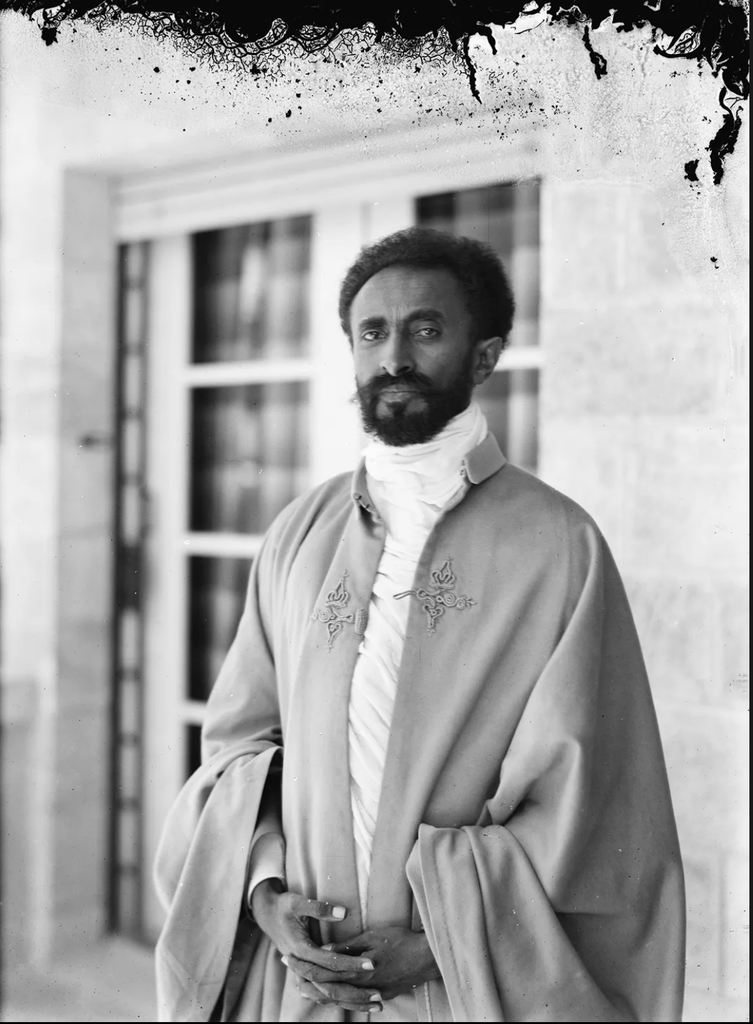
Ras Tafari (later Haile Selassie I), c. 1924, Library of Congress, Washington, D.C. (LC-DIG-matpc-10374)
Haile Selassie was the Emperor of Ethiopia from 1930 to 1974 and is recognised as the second coming of Christ by the Rastafarian religion.
Living mostly in Bath, the Emperor of the only African state to resist colonisation visited Brighton & Hove whilst exiled in Britain. Italy had first tried to invade Ethiopia in the 1890s but been defeated. Musolini’s fascist government launched the second campaign with the tacit approval of France and and attempt by Britain to reconcile its act of aggression with the League of Nations’ system of mandates, like the ones Britain had Mesopotamia and Palestine.
British officials had also been discussing whether to take Ethiopia within the British Empire as a Protectorate, and were happy to offer Haile Selassie sanctuary once Mussolini’s armies were at his doorstep. Haile Salassie lived in Britain from 1936 until Italy was expelled from Ethiopia during WWII, in 1941.[225] During this time, he made several visits to Brighton and Hove.[226]
Famous for his struggle against fascism and the colonization, Haile Selassie was named man of the year in Time magazine in 1935.[227] In 1936 he delivered a key speech in Geneva to the League of Nations to request their support against the Italian invasion, although he later ruled over human rights abuses such as famines and the mass killings of civilians.[228] His anti-imperialist cause gained much greater sympathy within Britain after Italy joined the Axis powers in 1940.[229]
In 1947, Haile Selassie’s made a donation to St Paul’s Church on West Street, where a plaque commemorates his presence. It reads:
‘This plaque commemorates a generous gift towards the repair to the tower of this church in 1947 by H.I.M Haile Selassie Emperor of Ethiopia as a mark of appreciation for the five years spent in England.’
Sources:
Bacon, Kevin. “Emperor Haile Selassie on the pier”, Brighton and Hove Museums, accessed June 15, 2026. https://brightonmuseums.org.uk/discovery/history-stories/emperor-haile-selassie-on-the-pier/.
Encyclopedia Britannica. “Haile Selassie I, emperor of Ethiopia”. Last modified January 12, 2026. https://www.britannica.com/biography/Haile-Selassie-I.
Human Rights Watch. “Evil Days: 30 years of war and famine in Ethiopia”. Last modified September 1, 1991. https://www.hrw.org/report/1991/09/01/evil-days/30-years-war-and-famine-ethiopia.
Marcus, Harold G.. “The rise and reign of Haile Selassie I (1916-74)”, Encyclopedia Britannica, last modified March 23, 2026. https://www.britannica.com/topic/history-of-Ethiopia/The-rise-and-reign-of-Haile-Selassie-I-1916-74.
Time. “Ethiopia: Man of the Year: Haile Selassie”. January 6, 1936. https://time.com/archive/6754802/ethiopia-man-of-the-year-haile-selassie/.
Sbacchi, Alberto. “Italian mandate or protectorate over Ethiopia in 1935-1936”. Rivista di Studi Politici Internazionali 42, no 4 (1975): 559-592. https://www.jstor.org/stable/43785561.
2. The Recruitment of Nurses to the NHS in Brighton (1948-1960s)
After the Second World War, there was a shortage of nurses in the NHS so Britain looked to its colonies recruit primarily young women, as well as some men, to fill these vacancies. The NHS was highly dependent on imported labour in the 1950s, with immigration from British colonies becoming essential.[230] Yet many faced widespread racism from institutions, newspapers and the British public speaking of the ‘colour problem’.[231]
In spite of this, many of the nurses took up the call, provided invaluable services to the NHS and showed great bravery. For many this was the first time they were travelling abroad, often with no social connections in Britain. Upon arrival, nurses from across the British empire persevered through explicit racism, working in the NHS when it needed it most. They laid foundations for others too. Of the 1.3 million people working in the NHS in 2022, over a quarter were from ethnic minority groups.[232]
In the context of rising independence movements across the British empire after World War Two, there were attempts at unifying the empire to hold it together. One of these was the Labour post-war government’s British National Act 1948, which made any ‘citizen of the UK and Colonies’ a British citizen with the right to live in work in the UK.[233] Though the Windrush Generation is often referred to as one of immigrants, under this law they were already British citizens before arrival.[234] Workers were in such high demand to rebuild post-war Britain that agencies were set up across the empire to recruit and train people as nurses for the NHS.[235] When some colonies gained independence in the 1950s, they kept the right to live in Britain though revisions to the Act through the 1960s and 1970s. Commonwealth Citizens’ rights, however, were increasingly restricted for all but white -descended immigrants until the 1948 Act was fully abolished in 1982 under Margaret Thatcher.
For Brighton, these nurses came from as far afield as Trinidad, Barbados, Dominica, British Guyana, St Lucia, St Kitts, St Vincent, Grenada and Jamaica. The NHS recruitment drive was not just restricted to nurses. It also included auxiliary staff from cooks to cleaners. The majority of the nurses found the UK a hospitable place to live and work, but some encountered racial prejudice that continued into the 1960s.
For many coming from countries with education systems modelled off Britain, they were motivated by a desire to serve the ‘mother country’.[236] Many were shocked upon arriving though, to encounter an official ‘colour bar’: many companies would not employ Black people, some trade unions and pubs did not accept Black people, many landlords would not rent to Black people.[237] Conservative MP Peter Griffiths ran a successful electoral campaign in Smethwick, West Midlands in 1959 with the slogan ‘if you want a n****r for a neighbour, vote labour’.[238] Nurses from the Caribbean were referred to as ‘coloured’ or ‘colonial’ and there was little in the way of ethnic diversity in Brighton in the 1960s.
Most of the student nurses came to England through word of mouth. Their travel was often paid for by their families. Sometimes their families accompanied them to England but in some cases they did not tell anyone they had applied to study in England until they were sure their application had been successful. Most of these young women knew nothing about Brighton and this journey was their first time away from their homes and loved ones. It’s not surprising that one nurse said she cried all the way to Brighton!
Fashions and especially hair styles were important to the young Brighton women, one of whom experimented with a ‘Twiggy’ haircut. If they couldn’t get to an Afro-Caribbean hairdresser in London, the nurses would try straightening their heir themselves on the stove. Miniskirts were just coming into fashion, and some nurses tried to shorten their uniforms by tucking a fold under their belt – much to the matron’s disapproval.
Despite their often being more qualified than their British counterparts, the nurses found pay was according to age. The nursing hierarchy was very strict and accompanied by starched uniforms, stern matrons and a lot of cleaning. Accommodation was dark and prison-like with strict curfews. But the nurses enjoyed the high status accorded to nursing – for example, by being treated very well on the buses. Many of the nurses recruited stayed permanently in the UK, some marrying into English families.
A nurse from then British Guyana described her experience of arriving into Brighton to become an NHS nurse:
‘First of all, the taxi going up the hill. Elm Grove, my first encounter with the hill.
My little heart, even now I’m talking about it, I could feel the churning in my stomach and my heart was pumping. The closer we got, the faster my heart raced. Everything seemed so much bigger, so much busier, so much nosier than what I had been accustomed to. The excitement was still there but there was a lot of fear. The walls around the building, it was ominous, it was a beautiful day. It was sunshiny.’
Sources:
Primary Sources:
National Archives. “Changes to British Nationality Act with Immigration Act 1971”, accessed 16 July 2026. https://www.nationalarchives.gov.uk/education/resources/commonwealth-migration-since-1945/changes-to-british-nationality-act-with-immigration-act-1971/.
Secondary Sources:
Bivins, Roberta. “Picturing Race in the British National Health Service, 1948-1988”, Twentieth Century British History 28, no 1, (2017): 83-109. https://doi-org.sussex.idm.oclc.org/10.1093/tcbh/hww059.
GOV.UK. “NHS workforce”. Last modified 13 April, 2023. https://www.ethnicity-facts-figures.service.gov.uk/workforce-and-business/workforce-diversity/nhs-workforce/latest/#main-facts-and-figures.
Street, Joe. “Malcolm X, Smethwick, and the Influence of the African American Freedom Struggle on British Race Relations in the 1960s”, Journal of Black Studies 38, no 6, (2008): 932-950. https://www.jstor.org/stable/40035032.
The Economist, “Britain’s generous post-war immigration policy”. August 24, 2017. https://www.economist.com/books-and-arts/2017/08/24/britains-generous-post-war-immigration-policy?utm_medium=cpc.adword.pd&utm_source=google&ppccampaignID=18156330227&ppcadID=&utm_campaign=a.22brand_pmax&utm_content=conversion.direct-response.anonymous&gclsrc=aw.ds&gad_source=5&gad_campaignid=18156330848&gclid=EAIaIQobChMIscDGmrbXlQMVQoKDBx2T3SKFEAAYASAAEgKwtfD_BwE.
[1] John Ingledew, “Samuel Johnson’s Jamaican Connections”, Caribbean Quarterly 30, no 2 (1984): 1-17. https://www.jstor.org/stable/40653532.
[2] Michael Bundock, “A New Name”, in The Fortunes of Francis Barber: The True Story of the Jamaican Slave Who Became Samuel Johnson’s Heir (Yale University Press, 2015),39-48.
[3] William R. Jones, “Barber, Francis (c. 1745-1801), servant”, Oxford Dictionary of National Biography. 23 September 2004. https://doi.org/10.1093/ref:odnb/59398.
[4] Michael Bundock, “Servant or Slave”, in The Fortunes of Francis Barber: The True Story of the Jamaican Slave Who Became Samuel Johnson’s Heir (Yale University Press, 2015),63-77.
[5] Bundock, “Servant or Slave”,63-77.
[6] Michael Bundock, “An Apothecary in Cheapside”, in The Fortunes of Francis Barber: The True Story of the Jamaican Slave Who Became Samuel Johnson’s Heir (Yale University Press, 2015),78-86.
[7] Bundock, “An Apothecary in Cheapside”, 78-86.
[8] Michael Bundock, “The Stag”, in The Fortunes of Francis Barber: The True Story of the Jamaican Slave Who Became Samuel Johnson’s Heir (Yale University Press, 2015),87-106.
[9] Bundock, “The Stag”,87-106.
[10] Bundock, “The Stag”,87-106.
[11] Olaudah Equiano (Author), David Olusoga (Foreword), The Interesting Narrative of the Life of Olaudah Equiano, Hodder, 2021
[12] Bundock, “The Stag”,87-106.
[13] Bundock, “The Stag”,87-106.
[14] Michael Bundock, “A Race Naturally Inferior”, in The Fortunes of Francis Barber: The True Story of the Jamaican Slave Who Became Samuel Johnson’s Heir (Yale University Press, 2015),107-126.
[15] Michael Bundock, “This Is Your Scholar!”, in The Fortunes of Francis Barber: The True Story of the Jamaican Slave Who Became Samuel Johnson’s Heir (Yale University Press, 2015),127-137.
[16] Michael Bundock, “Lichfield”, in The Fortunes of Francis Barber: The True Story of the Jamaican Slave Who Became Samuel Johnson’s Heir (Yale University Press, 2015),194-215.
[17] James Boswell, The correspondence and other papers of James Boswell relating to the making of The Life of Johnson, Volume 2, ed M. Waingrow (William Heinemann Ltd., 1969), 226.
[18] James Boswell, The correspondence and other papers of James Boswell relating to the making of The Life of Johnson, Volume 2, ed M. Waingrow (William Heinemann Ltd., 1969), 335.
[19] James Boswell, The correspondence and other papers of James Boswell relating to the making of The Life of Johnson, Volume 2, ed M. Waingrow (William Heinemann Ltd., 1969), 339.
[20] Samuel Johnson, The letters of Samuel Johnson, with Mrs Thrale’s genuine letters to him, ed R. W. Chapman (Clarendon Press, 1952), 227-233.
[21] Hester Thrale, Thraliana: the Diary of Mrs. Hester Lynch Thrale (later Mrs Piozzi) 1776-1809. Volume 1, 1776-1784, eds K. Canby Balderston (Clarendon Press, 1951), 175.
[22] Michael H. Fisher, “The World of Eighteenth-Century India” in The Travels of Dean Mahomet, ed Michael H. Fisher (University of California Press, 1997), 1-30, https://www.jstor.org/stable/jj.8501294.6.
[23] Sathnam Sanghera, “We Are Here Because You Were There” in Empireland, (Penguin Random House, 2021): 67-87.
[24] “Newtimber Church and the British Empire”, Alan Lester, last modified August 4 2025, https://alanlester.co.uk/blog/newtimber-church-and-the-british-empire/.
[25] “Newtimber Church and the British Empire”, Alan Lester, last modified August 4 2025, https://alanlester.co.uk/blog/newtimber-church-and-the-british-empire/.
[26] William Dalrymple, The Anarchy: the relentless rise of the East India Company’ (Bloomsbury, 2019).
[27] Gurminder K. Bhambra, “Colonial global economy: towards a theoretical reorientation of political economy”, Review of International Political Economy 28, no 2, (2021): 307-322. https://doi.org/10.1080/09692290.2020.1830831.
[28] Utsa Patnaik, “Revisiting the “drain”, or transfer from India to Britain in the context of the global diffusion of capitalism” in Agrarian and other histories: Essays for Binay Bhushan Chauduri, eds Shubhra Chakrabarti and Utsa Patnaik (Tulika Books, 2017), 277-317.
[29] Michael H. Fisher, “The World of Eighteenth-Century India” in The Travels of Dean Mahomet, ed Michael H. Fisher (University of California Press, 1997), 1-30, https://www.jstor.org/stable/jj.8501294.6.
[30] Michael H. Fisher, “The World of Eighteenth-Century India”, 1-30, https://www.jstor.org/stable/jj.8501294.6.
[31] John Hobbs, “United Irishmen: Seamus Heaney and the Rebellion of 1798”, The Canadian Journal of Irish Studies 21, no 2, (1995): 38-43. https://www.jstor.org/stable/25513030.
[32] Marianne Elliot, Wolf Tone (Liverpool University Press, 2012).
[33] Susan B. Egenolf, “Maria Edgeworth in Blackface: Castle Rackrent and the Irish Rebellion of 1798”, ELH 72, no 4, (2005): 845-869. https://www.jstor.org/stable/30029992.
[34] Michael H. Fisher, “Cork’s Dean Mahomet”, Journal of the Cork Historical and Archaeological Society 101, (1996): 81-93. https://corkhist.ie/wp-content/uploads/jfiles/1996/b1996-007.pdf.
[35] Humayun Ansari, ‘The infidel within’: Muslims in Britain since 1800 (C. Hurst, 2004).
[36] Daniel Sanjiv Roberts, “‘In Service of the Honourable East India Company’: Politics and Identity in Dean Mahomet’s Travels (1794)”, Eighteenth-Century Ireland 24, (2009): 115-134. https://www.jstor.org/stable/27806958.
[37] Sathnam Sanghera, “We Are Here Because You Were There” in Empireland, (Penguin Random House, 2021): 67-87.
[38] Michael H. Fisher, The First Indian Author in English (Oxford University Press, 1996).
[39] Mona Narain, “Dean Mahomet’s “Travels”, Border Crossings, and the Narrative of Alterity”, Studies in English Literature, 1500-1900 49, no 3, (2009): 693-716.
[40] Senjuti Mallik, “The British East India Company and the Great Bengal Famine of 1770: Towards a Corporate Colonial Biopolitics”, Geographical Review 114, no 4, (2024): 464-488. https://doi-org.sussex.idm.oclc.org/10.1080/00167428.2024.2325977.
[41] Dean Mahomet, “The Travels of Dean Mahomet, A Native of Patna in Bengal, Through Several Parts of India, While in the Service of the Honourable The East India Company Written By Himself, In a Series of Letters to a Friend” in The Travels of Dean Mahomet, ed. Michael H. Fisher (University of California Press, 1997), 41, https://www.jstor.org/stable/jj.8501294.7.
[42] Sathnam Sanghera, “We Are Here Because You Were There” in Empireland, (Penguin Random House, 2021): 67-87.
[43] Michael H. Fisher, The First Indian Author in English (Oxford University Press, 1996).
[44] Michael H. Fisher, The First Indian Author in English(Oxford University Press, 1996).
[45] Michael H. Fisher, The First Indian Author in English(Oxford University Press, 1996).
[46] Sathnam Sanghera, “We Are Here Because You Were There” in Empireland, (Penguin Random House, 2021): 67-87.
[47] Michael H. Fisher, The First Indian Author in English (Oxford University Press, 1996).
[48] Michael H. Fisher, The First Indian Author in English (Oxford University Press, 1996).
[49] Michael H. Fisher, The First Indian Author in English(Oxford University Press, 1996).
[50] Michael H. Fisher, The First Indian Author in English(Oxford University Press, 1996).
[51] “Letter to the wife of Sake Dean Mohamed from Hannah Neave of 14 Wells Row, Islington, London”, 24 November 1822, The Keep, DB/H/3/3/3/4.
[52] “Sake Dean Mohamed asking for permission to install a foot crossing on his road”, 1 January 1840, The Keep, AMS6432/1/106.
[53] Michael H. Fisher, The First Indian Author in English(Oxford University Press, 1996).
[54] Michael H. Fisher, The First Indian Author in English(Oxford University Press, 1996).
[55] Charles Preston, “List of English Words from India”, Encyclopedia Britannica, last modified March 31, 2026, https://www.britannica.com/topic/List-of-English-Words-from-India#ref476514.
[56] Sanghera, “We Are Here Because You Were There”, 67-87.
[57] William Hart, “New light on George Bridgetower”, The Musical Times 158, no 1940 (2017): 95-106, https://www.jstor.org/stable/44862826.
[58] William Hart, “New light on George Bridgetower”, The Musical Times 158, no 1940 (2017): 95-106, https://www.jstor.org/stable/44862826.
[59] W. B. Squire and David J. Golby, “Bridgetower [Bridgtower], George Polgreen”. Oxford Dictionary of National Biography. 8 August 2024. https://doi.org/10.1093/ref:odnb/3398.
[60] Josephine, R. B. Wright, “George Polgreen Bridgetower: An African Prodigy in England 1789-99”, The Musical Quarterly 66, no 1 (1980): 65-82. https://www.jstor.org/stable/742137.
[61] William Hart, “New light on George Bridgetower”, The Musical Times 158, no 1940 (2017): 95-106, https://www.jstor.org/stable/44862826.
[62] William Hart, “New light on George Bridgetower”, The Musical Times 158, no 1940 (2017): 95-106, https://www.jstor.org/stable/44862826.
[63] Peter Fryer, “Appendix G. Eighteenth-century biographies” in Staying Power: the History of Black People in Britain (Pluto Press, 2018), 427-437, https://www.jstor.org/stable/j.ctv69tgjn.24.
[64] Natricia Duncan, “New research reveals King George IV profited from slavery in Grenada”, The Guardian, August 7, 2025, https://www.theguardian.com/world/2025/aug/07/king-george-iv-profited-slavery-grenada.
[65] Josephine, R. B. Wright, “George Polgreen Bridgetower: An African Prodigy in England 1789-99”, The Musical Quarterly 66, no 1 (1980): 65-82. https://www.jstor.org/stable/742137.
[66] Janet Schmalfeldt, “Beethoven’s “Bridgetower” sonata, OP. 47” in New Paths: Aspects of Music Theory and Aesthetics in the Age of Romanticism (Leuven University Press, 2009), 37-68. https://www.jstor.org/stable/j.ctt9qdwfw.5.
[67] Peter Fryer, “Appendix G. Eighteenth-century biographies” in Staying Power: the History of Black People in Britain (Pluto Press, 2018), 427-437, https://www.jstor.org/stable/j.ctv69tgjn.24.
[68] Ludwig van Beethoven, The Letters of Beethoven, ed E. Anderson, Volume 1, (Macmillan, 1961), 91-92.
[69] “Tuning fork said to have been given by Beethoven to the violinist George Augustus Polgreen Bridgetower”, British Library, Add MS 71148 A.
[70] W. B. Squire and David J. Golby, “Bridgetower [Bridgtower], George Polgreen”. Oxford Dictionary of National Biography. 8 August 2024. https://doi.org/10.1093/ref:odnb/3398.
[71] W. B. Squire and David J. Golby, “Bridgetower [Bridgtower], George Polgreen”. Oxford Dictionary of National Biography. 8 August 2024. https://doi.org/10.1093/ref:odnb/3398.
[72] W. B. Squire and David J. Golby, “Bridgetower [Bridgtower], George Polgreen”. Oxford Dictionary of National Biography. 8 August 2024. https://doi.org/10.1093/ref:odnb/3398.
[73] W. B. Squire and David J. Golby, “Bridgetower [Bridgtower], George Polgreen”. Oxford Dictionary of National Biography. 8 August 2024. https://doi.org/10.1093/ref:odnb/3398.
[74] J. A. H. Evans, “Wells, Nathanial”. Oxford Dictionary of National Biography. 11 March 2021. https://doi.org/10.1093/ref:odnb/74450.
[75] Anne Rainsbury, “Nathanial Wells: the making of a Black Country Gentlemen”, in Britain’s Black Past, ed. Gretchen H. Gerzina (Liverpool University Press, 2020), 253-274. https://www.jstor.org/stable/j.ctvz937c0.19.
[76] “Nathanial Wells: Profile and Legacies Summary”, UCL Centre for the Study of the Legacies of British Slavery, accessed June 22, 2026, https://www.ucl.ac.uk/lbs/person/view/25474.
[77] Anne Rainsbury, “Nathanial Wells: the making of a Black Country Gentlemen”, in Britain’s Black Past, ed. Gretchen H. Gerzina (Liverpool University Press, 2020), 253-274. https://www.jstor.org/stable/j.ctvz937c0.19.
[78] Anne Rainsbury, “Nathanial Wells: the making of a Black Country Gentlemen”, in Britain’s Black Past, ed. Gretchen H. Gerzina (Liverpool University Press, 2020), 253-274. https://www.jstor.org/stable/j.ctvz937c0.19.
[79] “Nathanial Wells: Profile and Legacies Summary”, UCL Centre for the Study of the Legacies of British Slavery, accessed June 22, 2026, https://www.ucl.ac.uk/lbs/person/view/25474.
[80] “Inflation Calculator”, Bank of England, accessed June 22, 2026, https://www.bankofengland.co.uk/monetary-policy/inflation/inflation-calculator.
[81] Anne Rainsbury, “Nathanial Wells: the making of a Black Country Gentlemen”, in Britain’s Black Past, ed. Gretchen H. Gerzina (Liverpool University Press, 2020), 253-274. https://www.jstor.org/stable/j.ctvz937c0.19.
[82] Anne Rainsbury, “Nathanial Wells: the making of a Black Country Gentlemen”, in Britain’s Black Past, ed. Gretchen H. Gerzina (Liverpool University Press, 2020), 253-274. https://www.jstor.org/stable/j.ctvz937c0.19.
[83] “Nathanial Wells: Profile and Legacies Summary”, UCL Centre for the Study of the Legacies of British Slavery, accessed June 22, 2026, https://www.ucl.ac.uk/lbs/person/view/25474.
[84] Frances Bailey, Rachel Conroy, Sophie Chessumet al., Interim Report on the Connections between Colonialism and Properties now in the care of the National Trust, Including links with Historic Slavery (National Trust, 2020), 1-115, https://nt.global.ssl.fastly.net/binaries/content/assets/website/national/pdf/colonialism-and-historic-slavery-report.pdf.
[85] Anne Rainsbury, “Nathanial Wells: the making of a Black Country Gentlemen”, in Britain’s Black Past, ed. Gretchen H. Gerzina (Liverpool University Press, 2020), 253-274. https://www.jstor.org/stable/j.ctvz937c0.19.
[86] Anne Rainsbury, “Nathanial Wells: the making of a Black Country Gentlemen”, in Britain’s Black Past, ed. Gretchen H. Gerzina (Liverpool University Press, 2020), 253-274. https://www.jstor.org/stable/j.ctvz937c0.19.
[87] Brooke N. Newman, A Dark Inheritance: Blood, Race, and Sex in Colonial Jamaica (Yale University Press, 2018), https://doi-org.sussex.idm.oclc.org/10.2307/j.ctv47wfjk.
[88] “Nathanial Wells: Profile and Legacies Summary”, UCL Centre for the Study of the Legacies of British Slavery, accessed June 22, 2026, https://www.ucl.ac.uk/lbs/person/view/25474.
[89] “First Black Sheriff”, National Archives, accessed 3 July 2026. https://www.nationalarchives.gov.uk/education/resources/georgian-britain-age-modernity/first-black-sheriff/.
[90] Anne Rainsbury, “Nathanial Wells: the making of a Black Country Gentlemen”, in Britain’s Black Past, ed. Gretchen H. Gerzina (Liverpool University Press, 2020), 253-274. https://www.jstor.org/stable/j.ctvz937c0.19.
[91] Joseph Farington, The Diary of Joseph Farington, Volume VI April 1803-December 1804, eds. K. Garlick and A. Macintyre(Yale University Press, 1979), 2017.
[92] Anne Rainsbury, “Nathanial Wells: the making of a Black Country Gentlemen”, in Britain’s Black Past, ed. Gretchen H. Gerzina (Liverpool University Press, 2020), 253-274. https://www.jstor.org/stable/j.ctvz937c0.19.
[93] James Stephen, “Appendix, case no. 4 – Account of the treatment of the Slaves on two united Estates, called Fahie’s and Orton’s, in the Island of St. Christopher, and the fatal effects that followed”, in The Slavery of the British West India colonies delineated, as it exists both in law and practice, and compared with the slavery of other countries, ancient and modern (Butterworth and son, 1830), 442-452, https://go-gale-com.sussex.idm.oclc.org/ps/i.dop=MOME&u=sussex&id=GALE|U0104577717&v=2.1&it=r.
[94] “Inflation Calculator”, Bank of England, accessed June 22, 2026, https://www.bankofengland.co.uk/monetary-policy/inflation/inflation-calculator.
[95] “St Kitts 685 (Fahies and Ortons): Claim Details, Associated Individuals and Estates”, UCL Centre for the Study of the Legacies of British Slavery, accessed June 22, 2026, https://www.ucl.ac.uk/lbs/claim/view/25396.
[96] William A.Pettigrew, Britain’s Slave Traders: A Forgotten History, The Bodley Head, London, 2026, cover.
[97] Olaudah Equiano (Author), David Olusoga (Foreword), The Interesting Narrative of the Life of Olaudah Equiano, Hodder, 2021.
[98] “The 1833 Abolition of Slavery Act and compensation claims”, The National Archives, accessed June 22, 2026. https://www.nationalarchives.gov.uk/explore-the-collection/explore-by-time-period/georgians/1833-abolition-of-slavery-act-and-compensation-claims/.
[99] Alan Lester, Kate Boehme and Peter Mitchell, “Setting the scene for emancipation” in Ruling the World: freedom, civilisation and liberalism in the nineteenth-century British Empire (Cambridge University Press, 2021), 35-60. https://doi.org/10.1017/9781108584227.002.
[100] Alan Lester, Kate Boehme and Peter Mitchell, “Setting the scene for emancipation” in Ruling the World: freedom, civilisation and liberalism in the nineteenth-century British Empire (Cambridge University Press, 2021), 35-60. https://doi.org/10.1017/9781108584227.002.
[101] “The 1833 Abolition of Slavery Act and compensation claims”, The National Archives, accessed June 22, 2026. https://www.nationalarchives.gov.uk/explore-the-collection/explore-by-time-period/georgians/1833-abolition-of-slavery-act-and-compensation-claims/.
[102] “Inflation Calculator”, Bank of England, accessed June 22, 2026, https://www.bankofengland.co.uk/monetary-policy/inflation/inflation-calculator.
[103] Alan Lester, Kate Boehme and Peter Mitchell, “Setting the scene for emancipation” in Ruling the World: freedom, civilisation and liberalism in the nineteenth-century British Empire (Cambridge University Press, 2021), 35-60. https://doi.org/10.1017/9781108584227.002.
[104] “The 1833 Abolition of Slavery Act and compensation claims”, The National Archives, accessed June 22, 2026. https://www.nationalarchives.gov.uk/explore-the-collection/explore-by-time-period/georgians/1833-abolition-of-slavery-act-and-compensation-claims/.
[105] “The Centre for the Study of the Legacies of British Slavery”, UCL, accessed July 20, 2026, https://www.ucl.ac.uk/lbs/project/centre.
[106] “The Centre for the Study of the Legacies of British Slavery”, UCL, accessed July 20, 2026, https://www.ucl.ac.uk/lbs/project/centre.
[107] https://www.ucl.ac.uk/lbs/person/view/25302
[108] Sophia Decherney, “Sarah Forbes Bonetta”, Encyclopedia Britannica, last modified August 11, 2025, https://www.britannica.com/biography/Sarah-Forbes-Bonetta/additional-info.
[109] Joan Anim-Addo, “Bonetta [married name Davies], (Ina) Sarah Forbes [Sally] (c. 1843-1880), Queen Victoria’s ward”. Oxford Dictionary of National Biography. 17 September 2015. https://doi.org/10.1093/ref:odnb/75453.
[110] Alan Lester, “Antislavery and the Original ‘Scramble for Africa’, 1807-1879”,
[111] Caroline Bressey, “Of Africa’s brightest ornaments: a short biography of Sarah Forbes Bonetta”, Social and Cultural Geography 6, no 4 (2005): 253-266.
[112] Sandra Gunning, “Sarah Forbes Bonetta and Travel as Social Capital”, in Moving Home: Gender, Place, and Travel Writing in the Early Black Atlantic. Duke University Press, 2021, https://www.jstor.org/stable/j.ctv2k0580g.10.
[113] Bressey, 253-266.
[114] “A marriage with an ante-nuptial romance”, Brighton Guardian, 20 August 1862, The Keep, NEW/30/1862.
[115] Nancy Stepan, The Idea of Race In Science: Great Britain, 1800-1960, Macmillan, 1982, 1.
[116] Henry, B. Lovejoy, “Queen Victoria’s ‘Liberated African’: Sarah ‘Sally’ Forbes Bonetta and Her Extraordinary Apprenticeship by the British Royal Family, 1850-1862, Slavery and Abolition (2024): 911-934. https://doi.org/10.1080/0144039X.2024.2349147.
[117]Lovejoy, 911-934.
[118] Sandra Gunning, “Sarah Forbes Bonetta and Travel as Social Capital”, in Moving Home: Gender, Place, and Travel Writing in the Early Black Atlantic. Duke University Press, 2021, https://www.jstor.org/stable/j.ctv2k0580g.10.
[119]Lovejoy, 911-934.
[120]Lovejoy, 911-934.
[121] “Marriage Register”, 1862, The Keep, PAR 255/1/3/35.
[122] Megan Orr, “Ladylike in the Extreme: the propagandism of Sarah Forbes Bonetta, Britain’s “African Princess”, Student Works 307. https://scholarsarchive.byu.edu/studentpub/307.
[123] “An interesting marriage at Brighton”, Sainsbury’s Weekly Register and Advertising Journal, 23 August 1862, The British Newspaper Archive.
[124] “An interesting marriage at Brighton”, Sainsbury’s Weekly Register and Advertising Journal, 23 August 1862, The British Newspaper Archive.
[125] “A marriage with an ante-nuptial romance”, Brighton Guardian, 20 August 1862, The Keep, NEW/30/1862.
[126] “From enslavement to Royal Court: the Remarkable Journey of Sara Forbes Bonetta”, Black History Month, last modified 2 October 2024, https://www.blackhistorymonth.org.uk/article/section/women-in-history/from-enslavement-to-royal-court-the-remarkable-journey-of-sara-forbes-bonetta/. For an interview with Ina’s descendant see https://www.theguardian.com/world/2026/oct/18/sarah-forbes-bonetta-biography-queen-victoria
[127] Michael F. O’Rourke, “Frederick Akbar Mahomed”, Hypertension 19, (1992): 212-217. https://doi.org/10.1161/01.HYP.19.2.21.
[128] Norman Moore and Rachel E. Davies, “Mahomed, Frederick Henry Horatio Akbar”, Oxford Dictionary of National Biography. 23 September 2004. https://doi.org/10.1093/ref:odnb/17797.
[129] Moore and Davies, “Mahomed, Frederick Henry Horatio Akbar”, Oxford Dictionary of National Biography.
[130] O’Rourke, “Frederick Akbar Mahomed”, 212-217.
[131] J. Stewart Cameron and Jackie Hicks, “Frederick Akbar Mahomed and his role in the description of hypertension at Guy’s Hospital”, Kidney International 49, (1996): 1488-1506. https://doi.org/10.1038/ki.1996.209.
[132] Cameron and Hicks, “Frederick Akbar Mahomed and his role in the description of hypertension at Guy’s Hospital”, 1488-1506.
[133] Cameron and Hicks, “Frederick Akbar Mahomed and his role in the description of hypertension at Guy’s Hospital”, 1488-1506.
[134] “Naval and military intelligence: naval appointments”, London Evening Standard, 1 September 1868, The British Newspaper Archives.
[135] “Naval Intelligence: Portsmouth”, Portsmouth Times and Naval Gazette, 5 September 1868, The British Newspaper Archives.
[136] Mary Wills, “A ‘most miserable business’: Naval officers’ experiences of slave-trade suppression” in The suppression of the Atlantic slave trade, edsR. Burroughs and R. Huzzey (Manchester University Press, 2016), 73-94, https://doi-org.sussex.idm.oclc.org/10.7765/9781784992361.00011.
[137] “Naval Intelligence: Portsmouth”, Portsmouth Times and Naval Gazette, 5 September 1868, The British Newspaper Archives.
[138] “Black Tommy’s Two Homes”, The Church Missionary Juvenile Instructor 6, no 6, (1870): 84. https://books.google.bi/books?id=gF0EAAAAQAAJ&printsec=frontcover&hl=fr#v=onepage&q=highflyer&f=false.
[139] Alan Lester, ‘Missionaries and White Settlers in the Nineteenth Century’, in N. Etherington (ed) Missions and Empire, Oxford History of the British Empire Companion Volume, Oxford University Press, 2005, 64-85.
[140] “Black Tommy’s Two Homes”, The Church Missionary Juvenile Instructor 6, no 6, (1870): 84. https://books.google.bi/books?id=gF0EAAAAQAAJ&printsec=frontcover&hl=fr#v=onepage&q=highflyer&f=false.
[141] “Black Tommy’s Two Homes”, The Church Missionary Juvenile Instructor 6, no 6, (1870): 81. https://books.google.bi/books?id=gF0EAAAAQAAJ&printsec=frontcover&hl=fr#v=onepage&q=highflyer&f=false.
[142] Matthew S. Hopper, ‘East Africa and the End of the Indian Ocean Slave Trade’,
Journal of African Development, 13, 1-2, 2011, 39–66.
[143] Moses D. E. Nwulia, Britain and Slavery in East Africa, Reiner, 1975.
[144] “Black Tommy’s Two Homes”, The Church Missionary Juvenile Instructor 6, no 6, (1870): 92. https://books.google.bi/books?id=gF0EAAAAQAAJ&printsec=frontcover&hl=fr#v=onepage&q=highflyer&f=false.
[145] The Keep, “Woodvale Cemetery burial registers”, 1857-2003, BH/L/3/1.
[146] A. C. Sahu, “Diversion of arable lands from food-crops to exportable cash-crops: one of the causes of frequent famines in India between 1860-1900”, Proceedings of the Indian History Congress 41, (1980): 644-656. https://www.jstor.org/stable/44141891.
[147] Alan Lester, Kate Boehme and Peter Mitchell, “Liberal Fathers and Sons” in Ruling the world: freedom, civilisation and liberalism in the nineteenth-century British Empire (Cambridge University Press, 2021), 282-286, https://doi.org/10.1017/9781108584227.013.
[148] Alan Lester, Kate Boehme and Peter Mitchell, “Liberal Fathers and Sons” in Ruling the world: freedom, civilisation and liberalism in the nineteenth-century British Empire (Cambridge University Press, 2021), 282-286, https://doi.org/10.1017/9781108584227.013.
[149] Alan Lester, Kate Boehme and Peter Mitchell, “Liberal Fathers and Sons” in Ruling the world: freedom, civilisation and liberalism in the nineteenth-century British Empire (Cambridge University Press, 2021), 282-286, https://doi.org/10.1017/9781108584227.013.
[150] Alan Lester, Kate Boehme and Peter Mitchell, “Liberal Fathers and Sons” in Ruling the world: freedom, civilisation and liberalism in the nineteenth-century British Empire (Cambridge University Press, 2021), 282-286, https://doi.org/10.1017/9781108584227.013.
[151] Alan Lester, Kate Boehme and Peter Mitchell, “Liberal Fathers and Sons” in Ruling the world: freedom, civilisation and liberalism in the nineteenth-century British Empire (Cambridge University Press, 2021), 282-286, https://doi.org/10.1017/9781108584227.013.
[152] Alan Lester, Kate Boehme and Peter Mitchell, “Liberal Fathers and Sons” in Ruling the world: freedom, civilisation and liberalism in the nineteenth-century British Empire (Cambridge University Press, 2021), 282-286, https://doi.org/10.1017/9781108584227.013.
[153] Georgina Brewis, “‘Fill Full the Mouth of Famine’: Voluntary Action in Famine Relief in India 1896-1901”, Modern Asian Studies 44, no 4 (2010): 887-918. https://www.jstor.org/stable/40664949.
[154] Alan Lester, Kate Boehme and Peter Mitchell, “Liberal Fathers and Sons” in Ruling the world: freedom, civilisation and liberalism in the nineteenth-century British Empire (Cambridge University Press, 2021), 282-286, https://doi.org/10.1017/9781108584227.013.
[155] Alan Lester, Kate Boehme and Peter Mitchell, “Liberal Fathers and Sons” in Ruling the world: freedom, civilisation and liberalism in the nineteenth-century British Empire (Cambridge University Press, 2021), 282-286, https://doi.org/10.1017/9781108584227.013.
[156] Georgina Brewis, “‘Fill Full the Mouth of Famine’: Voluntary Action in Famine Relief in India 1896-1901”, Modern Asian Studies 44, no 4 (2010): 887-918. https://www.jstor.org/stable/40664949.
[157] Georgina Brewis, “‘Fill Full the Mouth of Famine’: Voluntary Action in Famine Relief in India 1896-1901”, Modern Asian Studies 44, no 4 (2010): 887-918. https://www.jstor.org/stable/40664949.
[158] “Brighton St Nicholas; parish charities”, 1877, PAR 277/7/2/15/1.
[159] The Keep, “Brighton St Nicholas; parish charities”, 1877, PAR 277/7/2/15/1.
[160] Georgina Brewis, “‘Fill Full the Mouth of Famine’: Voluntary Action in Famine Relief in India 1896-1901”, Modern Asian Studies 44, no 4 (2010): 887-918. https://www.jstor.org/stable/40664949.
[161] Joe Harris Lunn, “War Losses (Africa)”, International Encyclopedia of the First World War, last modified June 22, 2015. https://encyclopedia.1914-1918-online.net/article/war-losses-africa/.
[162] David Killingray, “The Idea of a British Imperial African Army”, The Journal of African History 20, no 3, (1979): 421-436. https://www.jstor.org/stable/181123.
[163] Robert Booth, “How millions of black and Asian men were mobilised in first world war”, The Guardian, April 21, 2021, https://www.theguardian.com/world/2021/apr/21/how-millions-of-black-and-asian-men-were-mobilised-in-first-world-war.
[164] David Killingray, “Labour exploitation for military campaigns in British colonial Africa 1870-1945”, Journal of Contemporary History 24, no 3, (1989): 483-501. https://doi.org/10.1177/002200948902400306.
[165] Robert Booth, “How millions of black and Asian men were mobilised in first world war”, The Guardian, April 21, 2021, https://www.theguardian.com/world/2021/apr/21/how-millions-of-black-and-asian-men-were-mobilised-in-first-world-war.
[166] Robert Gerwarth and Erez Manela, “The Great War as a Global War: Imperial Conflict and the Reconfiguration of World Order, 1911-1923”, Diplomatic History 38, no 4, (2014): 786-800. https://www.jstor.org/stable/26376604.
[167] “Newtimber Church and the British Empire”, Alan Lester, last modified August 4, 2025, https://alanlester.co.uk/blog/newtimber-church-and-the-british-empire/.
[168] “Newtimber Church and the British Empire”, Alan Lester, last modified August 4, 2025, https://alanlester.co.uk/blog/newtimber-church-and-the-british-empire/.
[169] Davenport, R. and Saunders, C. 2000, South Africa: A Modern History, fifth edition, Macmillan: London, p. 286.
[170] Wessex Archaeology, 2007. SS Mendi Archaeological Desk-based Assessment, Salisbury: Wessex Archaeology. Ref: 64441.01.
[171] B. P. Willan, “The South African Native Labour Contingent, 1916-1918”, The Journal of African History 19, no 1, (1978): 61-86. https://web.archive.org/web/20110927075323/http://www.navy.mil.za/newnavy/mendi_history/mendi_hist.html.
[172] G. Swinney, “The Sinking Of The SS Mendi, 21 February 1917”, Military History 10, no 1, (1995). https://samilitaryhistory.org/vol101gs.html.
[173] Samuel Hyson and Alan Lester, “‘British India on trial’: Brighton Military Hospitals and the politics of empire in World War I”, Journal of Historical Geography 38, no 1 (2012): 18-34, https://doi.org/10.1016/j.jhg.2011.09.002.
[174] “When the Raj came to Brighton”, Alan Lester, last modified 22 March, 2024, https://alanlester.co.uk/blog/when-the-raj-came-to-brighton-2/.
[175] Samuel Hyson and Alan Lester, “‘British India on trial’: Brighton Military Hospitals and the politics of empire in World War I”, Journal of Historical Geography 38, no 1 (2012): 18-34, https://doi.org/10.1016/j.jhg.2011.09.002.
[176] Samuel Hyson and Alan Lester, “‘British India on trial’: Brighton Military Hospitals and the politics of empire in World War I”, Journal of Historical Geography 38, no 1 (2012): 18-34, https://doi.org/10.1016/j.jhg.2011.09.002.
[177] Samuel Hyson and Alan Lester, “‘British India on trial’: Brighton Military Hospitals and the politics of empire in World War I”, Journal of Historical Geography 38, no 1 (2012): 18-34, https://doi.org/10.1016/j.jhg.2011.09.002.
[178] Catherine Robinson, “Neither East nor West: Some Aspects of Religion and Ritual in the Indian Army of the Raj”, Religion 26, no 1(1996): 37-47, https://doi.org/10.1006/reli.1996.0003.
[179] Catherine Robinson, “Neither East nor West: Some Aspects of Religion and Ritual in the Indian Army of the Raj”, Religion 26, no 1(1996): 37-47, https://doi.org/10.1006/reli.1996.0003.
[180] “When the Raj came to Brighton”, Alan Lester, last modified 22 March, 2024, https://alanlester.co.uk/blog/when-the-raj-came-to-brighton-2/.
[181] Catherine Robinson, “Neither East nor West: Some Aspects of Religion and Ritual in the Indian Army of the Raj”, Religion 26, no 1(1996): 37-47, https://doi.org/10.1006/reli.1996.0003.
[182] “Indian Troops in France”, Brighton Gazette, November 4, 1914, The British Newspaper Archive.
[183] Sathnam Sanghera, “Imperialism and Me” in Empireland (Penguin Random House, 2021), 15-30.
[184] Samuel Hyson and Alan Lester, “‘British India on trial’: Brighton Military Hospitals and the politics of empire in World War I”, Journal of Historical Geography 38, no 1 (2012): 18-34, https://doi.org/10.1016/j.jhg.2011.09.002.
[185] Samuel Hyson and Alan Lester, “‘British India on trial’: Brighton Military Hospitals and the politics of empire in World War I”, Journal of Historical Geography 38, no 1 (2012): 18-34, https://doi.org/10.1016/j.jhg.2011.09.002.
[186] Samuel Hyson and Alan Lester, “‘British India on trial’: Brighton Military Hospitals and the politics of empire in World War I”, Journal of Historical Geography 38, no 1 (2012): 18-34, https://doi.org/10.1016/j.jhg.2011.09.002.
[187] Samuel Hyson and Alan Lester, “‘British India on trial’: Brighton Military Hospitals and the politics of empire in World War I”, Journal of Historical Geography 38, no 1 (2012): 18-34, https://doi.org/10.1016/j.jhg.2011.09.002.
[188] Samuel Hyson and Alan Lester, “‘British India on trial’: Brighton Military Hospitals and the politics of empire in World War I”, Journal of Historical Geography 38, no 1 (2012): 18-34, https://doi.org/10.1016/j.jhg.2011.09.002.
[189] Samuel Hyson and Alan Lester, “‘British India on trial’: Brighton Military Hospitals and the politics of empire in World War I”, Journal of Historical Geography 38, no 1 (2012): 18-34, https://doi.org/10.1016/j.jhg.2011.09.002.
[190] Samuel Hyson and Alan Lester, “‘British India on trial’: Brighton Military Hospitals and the politics of empire in World War I”, Journal of Historical Geography 38, no 1 (2012): 18-34, https://doi.org/10.1016/j.jhg.2011.09.002.
[191] Samuel Hyson and Alan Lester, “‘British India on trial’: Brighton Military Hospitals and the politics of empire in World War I”, Journal of Historical Geography 38, no 1 (2012): 18-34, https://doi.org/10.1016/j.jhg.2011.09.002.
[192] Samuel Hyson and Alan Lester, “‘British India on trial’: Brighton Military Hospitals and the politics of empire in World War I”, Journal of Historical Geography 38, no 1 (2012): 18-34, https://doi.org/10.1016/j.jhg.2011.09.002.
[193] Samuel Hyson and Alan Lester, “‘British India on trial’: Brighton Military Hospitals and the politics of empire in World War I”, Journal of Historical Geography 38, no 1 (2012): 18-34, https://doi.org/10.1016/j.jhg.2011.09.002.
[194] Samuel Hyson and Alan Lester, “‘British India on trial’: Brighton Military Hospitals and the politics of empire in World War I”, Journal of Historical Geography 38, no 1 (2012): 18-34, https://doi.org/10.1016/j.jhg.2011.09.002.
[195] Samuel Hyson and Alan Lester, “‘British India on trial’: Brighton Military Hospitals and the politics of empire in World War I”, Journal of Historical Geography 38, no 1 (2012): 18-34, https://doi.org/10.1016/j.jhg.2011.09.002.
[196] “India and WWI: Piecing together the impact of the Great War on the subcontinent”, LSE Blogs, last modified September 24, 2014, https://blogs.lse.ac.uk/southasia/2014/09/24/piecing-together-the-impact-of-the-great-war-on-india/.
[197] “India and WWI: Piecing together the impact of the Great War on the subcontinent”, LSE Blogs, last modified September 24, 2014, https://blogs.lse.ac.uk/southasia/2014/09/24/piecing-together-the-impact-of-the-great-war-on-india/.
[198] Catherine Robinson, “Neither East nor West: Some Aspects of Religion and Ritual in the Indian Army of the Raj”, Religion 26, no 1(1996): 37-47, https://doi.org/10.1006/reli.1996.0003.
[199] “The Chattri Memorial”, Brighton and Hove City Council, accessed July 8, 2026, https://www.brighton-hove.gov.uk/libraries-leisure-and-arts/parks-and-green-spaces/chattri-memorial.
[200] David Arnold, “The Global Dead” in Burning the Dead: Hindu Nationhood and the Global Construction of Indian Tradition”, (University of Cambridge Press, 2021), 98-120, https://www.jstor.org/stable/j.ctv1h1vbqk.10.
[201] Catherine Robinson, “Neither East nor West: Some Aspects of Religion and Ritual in the Indian Army of the Raj”, Religion 26, no 1(1996): 37-47, https://doi.org/10.1006/reli.1996.0003.
[202] David Arnold, “The Global Dead” in Burning the Dead: Hindu Nationhood and the Global Construction of Indian Tradition”, (University of Cambridge Press, 2021), 98-120, https://www.jstor.org/stable/j.ctv1h1vbqk.10.
[203] “The Chattri Memorial”, Brighton and Hove City Council, accessed July 8, 2026, https://www.brighton-hove.gov.uk/libraries-leisure-and-arts/parks-and-green-spaces/chattri-memorial.
[204] Catherine Robinson, “Neither East nor West: Some Aspects of Religion and Ritual in the Indian Army of the Raj”, Religion 26, no 1(1996): 37-47, https://doi.org/10.1006/reli.1996.0003.
[205] “Unveiling of the Chattri”, Brighton and Hove Museums, accessed July 8, 2026, https://brightonmuseums.org.uk/discovery/history-stories/unveiling-of-the-chattri-memorial-1-february-1921/.
[206] Kevin Bacon, “Unveiling the Indian Gate”, Brighton and Hove Museums, accessed July 16, 2026. https://brightonmuseums.org.uk/discovery/history-stories/unveiling-the-indian-gate/.
[207] Kevin Bacon, “Unveiling the Indian Gate”, Brighton and Hove Museums, accessed July 16, 2026. https://brightonmuseums.org.uk/discovery/history-stories/unveiling-the-indian-gate/.
[208] “India’s Gift to Brighton: ceremony by the Maharaja of Patiala”, Civil and Military Gazette, 18 November 1921, The British Newspaper Archive.
[209] Kevin Bacon, “Unveiling the Indian Gate”, Brighton and Hove Museums, accessed July 16, 2026. https://brightonmuseums.org.uk/discovery/history-stories/unveiling-the-indian-gate/.
[210] Anna Maguire, “‘I felt like a man’: West Indian troops under fire during the First World War”, Slavery and Abolition 39, no 3, (2018): 602-621. https://doi.org/10.1080/0144039X.2018.1489944.
[211] C. L. Joseph, “The British West Indies Regiment 1914-1918”, The Journal of Caribbean History, no 2, (1971): 94.
[212] C. L. Joseph, “The British West Indies Regiment 1914-1918”, The Journal of Caribbean History, no 2, (1971): 94.
[213] Anna Maguire, “‘I felt like a man’: West Indian troops under fire during the First World War”, Slavery and Abolition 39, no 3, (2018): 602-621. https://doi.org/10.1080/0144039X.2018.1489944.
[214] Richard Smith, “The multicultural First World War: Memories of the West Indian contribution in contemporary Britain”, Journal of European Studies 45, no 4, (2015): 347-363. https://doi-org.sussex.idm.oclc.org/10.1177/0047244115599147.
[215] Anna Maguire, “‘I felt like a man’: West Indian troops under fire during the First World War”, Slavery and Abolition 39, no 3, (2018): 602-621. https://doi.org/10.1080/0144039X.2018.1489944.
[216] Anna Maguire, “‘I felt like a man’: West Indian troops under fire during the First World War”, Slavery and Abolition 39, no 3, (2018): 602-621. https://doi.org/10.1080/0144039X.2018.1489944.
[217] Richard Smith, “The multicultural First World War: Memories of the West Indian contribution in contemporary Britain”, Journal of European Studies 45, no 4, (2015): 347-363. https://doi-org.sussex.idm.oclc.org/10.1177/0047244115599147.
[218] “Seaford Cemetery”, Commonwealth War Graves, accessed July 9, 2026. https://www.cwgc.org/visit-us/find-cemeteries-memorials/cemetery-details/73204/seaford-cemetery/.
[219] “British West Indies Regiment”, Imperial War Museums, War Memorials Register, accessed July 9, 2026. https://memorials.iwm.org.uk/memorial/98722.
[220] Nicholas J. Griffin, “Britain’s Chinese Labor Corps in World War 1”, Military Affairs 40, no 3, (1976): 102-108, https://www.jstor.org/stable/1986523.
[221] Clarence B. Davis and Robert J. Gowen, “The British at Weihaiwei: a case study in the irrationality of empire”, The Historian 63, no 1, (2000): 87-104. https://doi.org/10.1111/j.1540-6563.2000.tb01509.x.
[222] Alex Calvo and Bao Qiaoni, “Forgotton voices from the Great War: the Chinese Labour Corps”, Asia-Pacific Journal 13, no 51, (2015): 1-13, https://doi.org/10.1017/S1557466015024298.
[223] “Commemorating the Chinese Labour Corps”, Commonwealth War Graves, last modified January 23, 2023, https://www.cwgc.org/our-work/news/commemorating-the-chinese-labour-corps/; Alex Calvo and Bao Qiaoni, “Forgotton voices from the Great War: the Chinese Labour Corps”, Asia-Pacific Journal 13, no 51, (2015): 1-13, https://doi.org/10.1017/S1557466015024298.
[223] Alex Calvo and Bao Qiaoni, “Forgotton voices from the Great War: the Chinese Labour Corps”,
[224] Alex Calvo and Bao Qiaoni, “Forgotton voices from the Great War: the Chinese Labour Corps”, Asia-Pacific Journal 13, no 51, (2015): 1-13, https://doi.org/10.1017/S1557466015024298.
[225] Alberto Sbacchi, “Italian mandate or protectorate over Ethiopia in 1935-1936”, Rivista di Studi Politici Internazionali 42, no 4 (1975): 559-592. https://www.jstor.org/stable/43785561.
[226] Kevin Bacon, “Emperor Haile Selassie on the pier”, Brighton and Hove Museums, accessed June 15, 2026, https://brightonmuseums.org.uk/discovery/history-stories/emperor-haile-selassie-on-the-pier/.
[227] Ethiopia: Man of the year: Haile Selassie”, Time, 6 January 1936. https://time.com/archive/6754802/ethiopia-man-of-the-year-haile-selassie/.
[228] “Evil Days: 30 years of war and famine in Ethiopia”, Human Rights Watch, last modified September 1, 1991, https://www.hrw.org/report/1991/09/01/evil-days/30-years-war-and-famine-ethiopia; “Haile Selassie I, emperor of Ethiopia”, Encyclopedia Britannica, last modified January 12, 2026, https://www.britannica.com/biography/Haile-Selassie-I.
[229] Harold G. Marcus, “The rise and reign of Haile Selassie I (1916-74)”, Encyclopedia Britannica, last modified March 23, 2026. https://www.britannica.com/topic/history-of-Ethiopia/The-rise-and-reign-of-Haile-Selassie-I-1916-74.
[230] Roberta Bivins, “Picturing Race in the British National Health Service, 1948-1988”, Twentieth Century British History 28, no 1, (2017): 83-109. https://doi-org.sussex.idm.oclc.org/10.1093/tcbh/hww059.
[231] Roberta Bivins, “Picturing Race in the British National Health Service, 1948-1988”, Twentieth Century British History 28, no 1, (2017): 83-109. https://doi-org.sussex.idm.oclc.org/10.1093/tcbh/hww059.
[232] “NHS workforce”, GOV.UK, last modified 13 April, 2023. https://www.ethnicity-facts-figures.service.gov.uk/workforce-and-business/workforce-diversity/nhs-workforce/latest/#by-ethnicity.
[233] “Changes to to British Nationality Act with Immigration Act 1971”, National Archives, accessed 16 July 2026. https://www.nationalarchives.gov.uk/education/resources/commonwealth-migration-since-1945/changes-to-british-nationality-act-with-immigration-act-1971/.
[234] Kojo Karam, “The Border” in Uncommon Wealth (John Murray, 2022), 85-118.
[235] Kojo Karam, “The Border” in Uncommon Wealth (John Murray, 2022), 85-118.
[236] “Britain’s generous post-war immigration policy”, The Economist, August 24, 2017, https://www.economist.com/books-and-arts/2017/08/24/britains-generous-post-war-immigration-policy?utm_medium=cpc.adword.pd&utm_source=google&ppccampaignID=18156330227&ppcadID=&utm_campaign=a.22brand_pmax&utm_content=conversion.direct-response.anonymous&gclsrc=aw.ds&gad_source=5&gad_campaignid=18156330848&gclid=EAIaIQobChMIscDGmrbXlQMVQoKDBx2T3SKFEAAYASAAEgKwtfD_BwE.
[237] Kojo Karam, “The Border” in Uncommon Wealth (John Murray, 2022), 85-118.
[238] Joe Street, “Malcolm X, Smethwick, and the Influence of the African American Freedom Struggle on British Race Relations in the 1960s”, Journal of Black Studies 38, no 6, (2008): 932-950. https://www.jstor.org/stable/40035032.
