Alan Lester
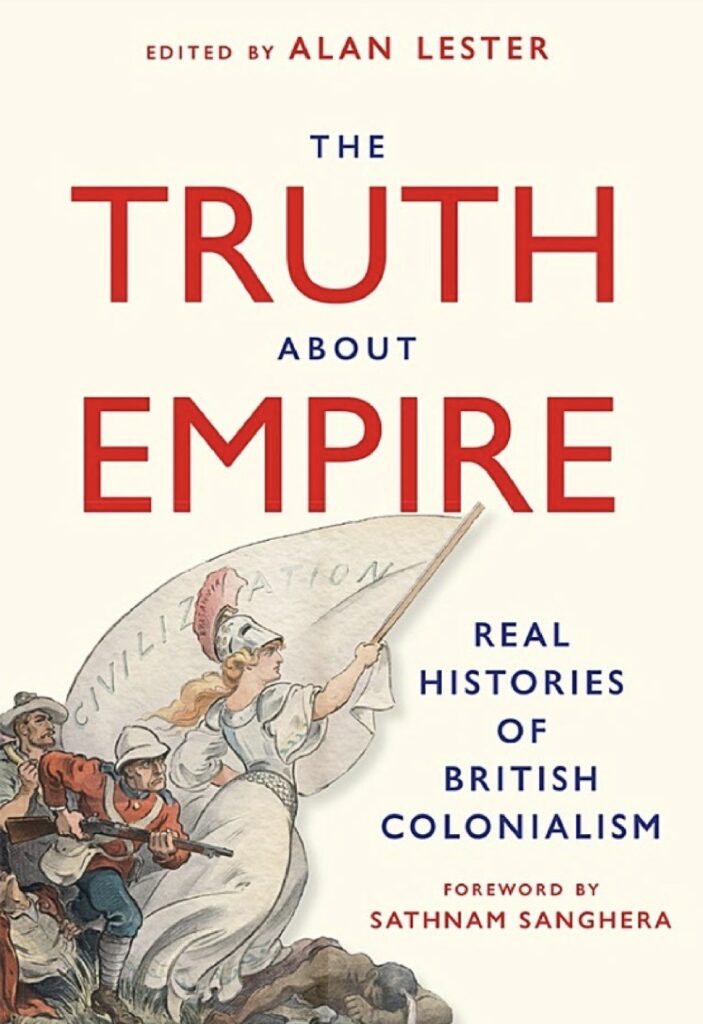
The Truth About Empire, a collection of essays for a public readership by fourteen leading historians of British colonialism that I edited and introduced, was the subject of Alexander Morrison’s review essay in the last issue of the Russian studies journal Ab Imperio. In that essay, Morrison drew a false equivalence between the curiosity-led approach to Britain’s imperial past adopted by the specialists in The Truth About Empire and Nigel Biggar’s attempt to develop a moral legitimation of the British Empire in Colonialism: A Moral Reckoning. The Truth About Empire was not simply a political counterblast to Biggar’s nationalistic, right-wing manipulation of history. It was a defence of the epistemology underpinning historical research, a guide to how expert researchers now understand certain controversial episodes in British imperial history and an attempt to identity the difference between history writing and propaganda.[1]
Given that The Truth About Empire was confronting not just Conservative peer Lord Biggar’s best-selling book, but the network of allied right wing think tanks, politicians, funders and media that now resist critical analysis of the British Empire, I expected that it would be countered with accusation in the mirror in parts of the right wing press, but I did not expect a serious scholarly journal like Ab Imperio to echo the tactic.
In this response I want to draw attention to profound differences between British colonial historians’ work and the project of providing moral legitimacy for British colonialism that Morrison defends. These are not just political, but epistemological. The contributors to The Truth About Empire are positioned at various points along the political spectrum but all agree that there is a certain philosophy of History that needs defending in this time of populist right wing historical disinformation. Making these epistemological distinctions is urgent, since morally evaluating empires is not the same enterprise as researching them.
Morrison believes that critiques of Biggar’s work have been driven by political hostility to the British Empire and a failure to engage with the real intent of his project of ethical evaluation. Biggar’s and his political allies’ project seeks, however, not to understand the empire, but to engender its more positive moral evaluation. That project has been pursued through the Ethics and Empire seminars at Oxford and Biggar’s Colonialism: A Moral Reckoning; through History Reclaimed, the right-wing lobbying group and obscurely funded private company that Biggar co-founded, and in the pages of the UK’s right-wing press, where History Reclaimed campaigns are well supported. Together they have regularly attacked ‘woke’ antiracist activists, politicians and popular writers, and also academic specialists simply getting on with their work on verifiable but discomfiting, aspects of British colonialism, often deliberately conflating these constituencies to undermine academics’ integrity. According to the supportive Daily Mail, History Reclaimed was established to battle Black Lives Matter’s ‘woke war on our great leaders’. It shares personnel and platforms with a network of other right wing think tanks including Restore Trust, Policy Exchange, the Institute of Economic Affairs and the Legatum Institute.
To portray Biggar’s overtly political programme of ethical legitimation for Britain’s past as sharing the same epistemology as scholars who have pursued curiosity-driven research on colonialism for decades is naïve at best. Yet Morrison, a friend and colleague of Biggar who participated in the Ethics and Empire seminars, presents the historical material that these organisations publish as if it is the epistemological equivalent of scholarly historical research. He portrays an explicitly political project, the publications from which are not generally subject to expert peer review, as equivalent merely to unacknowledged authorial bias. This is a false and, to my mind, dangerous, equivalence. There is a critical epistemological issue at stake: what is History and what is propaganda?
Ethics and History
Morrison states that ‘there are at least three key elements of Biggar’s arguments about the British Empire that his academic critics have failed to engage with seriously’. I will take each of these in turn, since each helps us distinguish curiosity-led research from politically-led manipulation. The first is the most serious. Morrison believes that Biggar’s critics have failed to appreciate ‘that Biggar’s own discipline of Ethics has something to offer the history of empire, and that despite their denials many British imperial historians are in fact making ethical judgements all the time without acknowledging them or explaining their basis’. I will take the first and second parts of this claim in turn. Does Ethics offer something to History, and do historians’ unacknowledged ethical judgements amount to the same thing as Biggar’s acknowledged ones?
It is not the discipline of Ethics to which British imperial historians object, nor necessarily its application to the history of imperialism. It is specifically Biggar’s project of setting out to apply a positive ethical judgement on the British Empire. These are not the same thing at all. A useful ethical analysis of empire might centre on the ethical debates among those who pursued, resisted and called for adaptations to various imperial projects. This is something that some of the chapters in The Truth About Empire do, including those by Liam Liburd and Saul Dubow. An ethicist attuned to the historical scholarship or undertaking their own primary research could no doubt shed interesting new light on these debates. But this is not what Biggar does.
In Colonialism: A Moral Reckoning, as Dubow points out most explicitly, there is no consideration of imperial ethics in historical context. There is simply Biggar’s own curation of a narrative of the British Empire upon which he casts an unsurprisingly positive overall judgement. Biggar does not engage with the rich historiography on debates among Britons over the morality of their empire. Since he first sought to defend not only Rhodes the statue but Rhodes the man during the Rhodes Must Fall movement, Biggar has sought overall moral sanction for British colonialism. Morrison assures us that the discussions in the Ethics and Empire programme in which he took part, ‘did not produce the kind of predetermined consensus about the ethical purity of any empire – British or otherwise – that its pre-emptive critics anticipated’. Of course not, since asserting moral ‘purity’ would not convince anyone. Moral legitimation was the more credible objective. Morrison admits that Biggar fails to ‘lay out clearly the framework for any ethical judgement about the past’ due to his tendency to ‘retreat from the colonies back to Britain’, and to ‘excuse episodes of violence, displacement and dispossession which were considered reprehensible even in their own time’.
Yet he still insists that this enterprise of Biggar’s be taken seriously by imperial historians.
There are good reasons why philosophers of history have long objected to making explicit judgements about the past, even as they contend with historians’ implicit judgmentalism in selection and interpretation. Historians’ concern is the consideration of innumerable and often indeterminate interactions among the people who shaped the past and discussion of the socially structuring forces that have conditioned them. This is an ongoing pursuit, driven by debate over newly unearthed and reinterpreted sources and perspectives, rather than a comprehensive summation allowing a moral verdict. If we agree that historians are not neutral arbiters, all the more reason to resist a project like Biggar’s that cherry-picks from some of their narratives a version of the ‘British Empire’ that is definitive and ready for moral judgement.
The False Equivalence
Which brings me to the second part of Morrison’s most significant accusation – that historians critical of Biggar’s project make ‘ethical judgements all the time without acknowledging them or explaining their basis.’ Of course we do. All historians do this all the time. Differences of historians’ positionality are a fact of life, discussed endlessly by philosophers of history and in the methodology classes we hold for our students. But Morrison presents us with a false dichotomy. If we refuse to accept the validity of Biggar’s moral evaluation, then historians like those contributing to The Truth About Empire must be engaging in woke ‘rhetorical denunciations of all violence and war, or … parading … virtuousness in relation to the depravity of the past’. This, of course, is nonsense. While we have, and we acknowledge, our situatedness, our starting point is a desire to understand the past. Biggar’s is a desire to defend a particular politics in the present.
Morrison’s second and third arguments against The Truth About Empire echo those of History Reclaimed and serve only to reinforce the fundamental epistemological differences at play. They betray a lack of familiarity with the historiography of the British Empire and the same tendency to conflate rigorous scholarly research and political denunciation.
The Straw Man
The second claim is that ‘the last two decades have seen criticism take new and disproportionate forms, in which the British Empire stands forth as a peculiarly malevolent historical phenomenon’. This may be true of certain leftist polemics, but it is manifestly not true of the academic imperial historiography. Conflating the two has been the persistent preoccupation of the populist Right as they attack academics and universities in general as bastions of ‘cultural Marxism’, ‘anticolonialism’ and general ‘wokeness’. The academic historians in The Truth About Empire may have engaged in comparative historical research but they have not made any comparative moral judgements between the British and other empires because that is not in keeping with their epistemology. To accuse them of indulging in disproportionate condemnation of the British Empire is to create a straw man.
For example, Morrison seems keen to accuse historians such as Kim Wagner and me of promoting the Indian politician Sashi Tharoor’s crude denunciation of the British Empire in Inglorious Empire. However, finding that Wagner describes the book as problematic and that I am ‘rightly sceptical’ about it, he falls back on a claim that it appears on many undergraduate curricula and is cited uncritically elsewhere. He provides no evidence for the claim. Echoing a previous History Reclaimed criticism, Morrison also targets the popular Empire podcast co-host, William Dalrymple (the podcast is the best source for anyone using this medium to learn about British colonial history by the way). Right wing activists have accused Dalrymple of holding the East India Company ‘to be uniquely rapacious even by 18th-century standards – but somehow Nader Shah or the Maratha confederacy are not subject to the same kinds of moralising judgement’. In the very pages of The Anarchy that Morrison cites Dalrymple actually quotes a contemporary on Nader Shah’s ‘sordid avarice’, his ‘unheard of cruelties’ and the ‘excesses and horrors to which his violent and barbarous character led him’ and which ‘made Persia weep and bleed’. Of the Maratha Confederacy, he writes, ‘The ruthlessness and cruelty of ’their ‘guerilla raids were legendary’, provides a first-hand account of the aftermath of such a raid with lengthy and horrific descriptions of burnt bodies, and makes it clear that the East India Company was seen by many Indians as offering a protective shield. What more would Morrison like?
Quite simply, the History Reclaimed-generated criticisms of the scholarly literature that Morrison deploys are not to be trusted. They are not motivated by a quest for historical truthfulness, but by a determination to conjure up the spectre of ‘wokeness’ that only right-wing populists can hold at bay. They are propaganda, not history.
The Giveaway
Having disavowed any overt political motive in his first two defences of Biggar’s project, Morrison finally admits that his third is ‘a strictly political one.’ Contradicting all that has been said about its historiographical nature, we learn that the Ethics and Empire project was motivated by the idea that a more positive appreciation of Empire’s ethical merits would help bolster the ‘West’ against Russian and Chinese threats – a very contemporary political position associated with a resurgent Christian Nationalism, which explains Biggar’s participation in the 2023 National Conservatism conference, rather than one emanating from detached curiosity about the past.
Biggar, and it seems Morrison, believe that a critical analytical approach to British imperial history – one that includes attention to truths that are uncomfortable for nationalists – presents Putin’s regime with anti-British and anti-Western propaganda opportunities. I happen to disagree, recognising that Putin’s leverage in the West comes not from its own self-critique, but from alignment with populist, authoritarian, nationalist movements of the kind with which Biggar’s self-congratulatory history is itself associated. But even if I agreed, my position on the issue would not drive my historical writing. That is the product of 35 years of curiosity-driven, archival inquiry and the reading of other specialists’ work.
Casting around vainly for an equivalence with Biggar’s political intent, Morrison claims that my introduction to The Truth About Empire engages as partially and partisanly with the historiography on the British Empire as Biggar. However, along with the members of History Reclaimed he seems to have only a limited acquaintance with this historiography. He depends mainly on History Reclaimed’s ‘anti-woke’ talking points, most of which have found their way onto the pages of the British right-wing press. Their key characteristic is discrediting discomfiting veins of legitimate historical enquiry by suggesting that ‘proper’ historians discounted them long ago. The inference is that it is only the ‘woke’ and not serious historians who are now reviving them.
Eric Williams’ insights into the role that slavery played in Britain’s development of industrial modernity are the primary target. History Reclaimed and the allied Institute of Economic Affairs have both attempted to blunt the effect of Wiliams’ legacy. Following their lead, Morrison writes that ‘there has been a revival of the Williams thesis from Capitalism and Slavery … not because there is any new evidence to support it but because the political climate seems to demand it.’ But Wiliams’ thesis was never neglected and never in need of revival as far as specialists in the field (many of them Black) were concerned. It initiated a strand of historical enquiry that has been continuous since its publication in the 1940s. Sidney Mintz drew upon it in his influential Sweetness and Power, Joseph Inikori updated and qualified it in his Africans and the Industrial Revolution in England, and Christopher Leslie Brown engaged with it critically and constructively in his seminal Moral Capital. History Reclaimed speak of a ‘revival’ only because they are unaware of, or perhaps just uninterested, in the intervening historiography.
There has also been plenty of new evidence with which both to affirm some of Williams’ insights and to reject or qualify others. Not only have huge databases like Voyages, which tracks the volume of slave ships, and UCL’s Legacies of British Slavery, which records slave owners in Britain, been developed, but an enormously rich body of new archival research on trans-Atlantic slavery and its role in Britain has been marshalled, especially as institutions up and down the country commissioned research on their own entanglements with slavery immediately before and after the Black Lives Matter demonstrations in 2020. Broadly, subsequent literature tends to have undermined Williams’ claim that the slave trade was abolished because the profitability of plantation slavery was declining but to have supported his assertion that the plantation slave system played an important role in stimulating Britain’s Industrial Revolution. It has certainly affirmed his and CLR James’ insistence that we need to look beyond white abolitionists and encompass enslaved people’s efforts to secure their own freedom.
Allied with other right-wing organisations and media, History Reclaimed have done their best to undermine these findings, especially in respect of the Church of England, but have yet to make a convincing case that they are empirically flawed. Berg and Hudson’s Capitalism, Slavery and the Industrial Revolution, cited by Morrison, is far more than just a ‘revival of parts of the [Williams] thesis’. It provides a partial synopsis of this continuity of scholarly research, and an examination of its significance for our understanding of the Industrial Revolution. The issue is not the research itself; it is that History Reclaimed and, it seems, Morrison, do not like what it has found. Furthermore, History Reclaimed’s founders have waged a propaganda war in the national press to undermine the credentials and damage the reputation of some of the early career researchers undertaking this research. I am surprised that Morrison has not objected to this.
I will not go on here to rebut all the other History Reclaimed-inspired, culture war-oriented talking points in Morrison’s critique, since they have all been aired in the right-wing British media and I have responded to most of them in blog form. This is perhaps why Morrison resorts to the ad hominem accusation that I am ‘almost obsessive’ in my criticism of Biggar. I have responded to a steady stream of articles and reports from Biggar and History Reclaimed because they publicly misrepresent a historiography in which I have acquired some expertise and malign historians for doing their job. None of their targets has been selected in order to contribute to the historiography or even to the public’s understanding of Empire. They are all focal points for right wing political mobilisation.
Rather than rehearse these culture war debates all over again, I want finally to come to Morrison’s ‘prescription.’ Morrison advocates that ‘Historians of the British empire need to engage much more fully with the historiographies of the other European and Eurasian empires which were the British Empire’s contemporaries’. At first glance, this might seem like a call for more of the comparative history and history of interconnections between different empires that historians already write. But it soon becomes clear what Morrison really intends. We should not write about the British empire unless we refer to ‘what Biggar calls the “ocean of injustice” that exists throughout human history’. The prescription, then, is nothing more than ‘whataboutery’. Historians of the British Empire writing about other empires will not help us to understand British colonialism better, but it will enable its apologists to deflect from it.
Morrison uses the example of Robert Bickers’ chapter in The Truth About Empire, on British imperial violence in China. Bickers is admonished since he should also have covered ‘not just Mao’s Great Leap Forward and the Cultural Revolution, but the Taiping Rebellion, the Muslim revolts in Ili, Kashgar and Gansu and their suppression by the Qing, Japan’s wars of aggression in China and Rape of Nanjing, or the Chinese Communist invasion of Tibet in 1950, to say nothing of what the CCP is currently doing to its Uyghur and other Muslim minorities’. British colonial history should once again then claim the relative moral high ground for Britain. To me such an agenda seems more compatible with certain authoritarian regimes’ propaganda than it does with academic freedom.
Biggar’s followers cannot have it both ways. They cannot continue to excuse his historiographical cherry picking by saying he is doing Ethics not history, and yet at the same time want his work of propagandist ethical justification for British colonialism to be taken seriously as a contribution to historiography.
[1] Before proceeding any further I must address Morrison’s unfortunate insinuation that I had something to do with a new editor of The Journal of Commonwealth and Imperial History requesting revisions after the outgoing editor had accepted his essay without peer review. Neither editor informed me of the submission’s existence and I had nothing to do with the journal’s handling of the essay. As a result of personal correspondence, I believe that Dr Morrison now accepts that I was not involved and I am grateful to him for that.
