Alan Lester
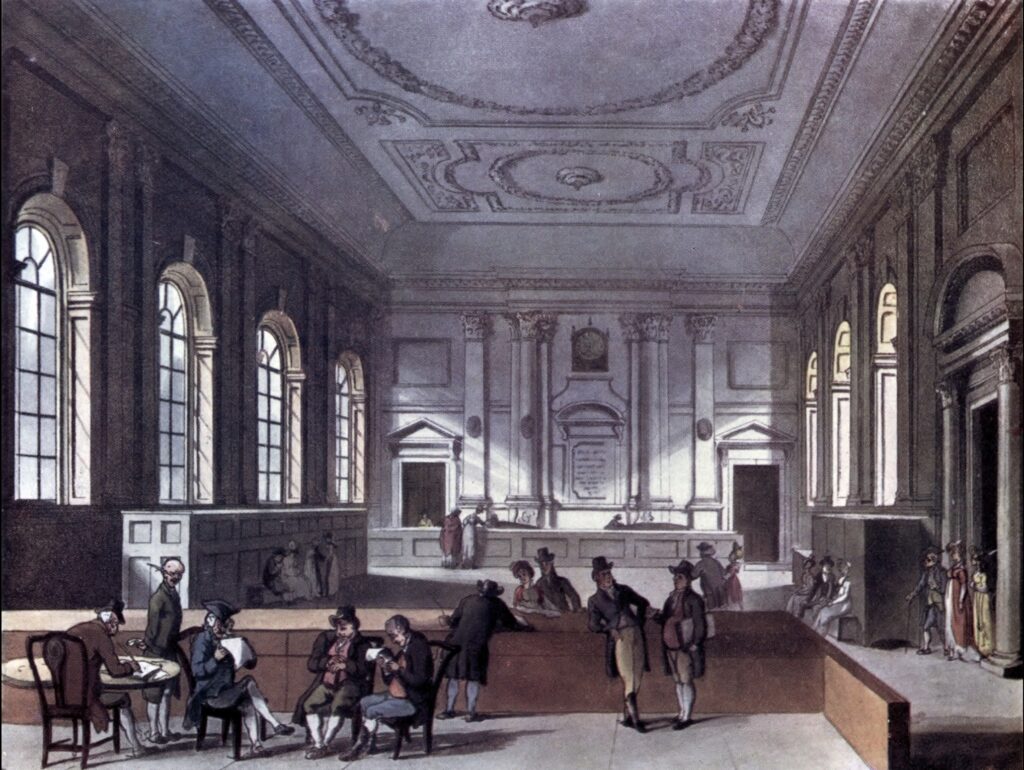
The Dividend Hall of South Sea House, 1810
Robert Tombs has a new essay in the TLS disparaging the historians who helped the Church of England uncover its historical complicity in slave trading. They “did not appear to understand what they were reading”, apparently. He blames their historical illiteracy for “probably the most expensive historical error in modern British history” and charges them with inflicting “severe reputational damage” on the Church.
Tombs wants us to believe that the Church Commissioners were persuaded to establish a £100 million reparations scheme because of their failure to grasp the difference between South Sea Company stock and South Sea Annuities. In a nutshell his argument is this:
Only the Company stock was tainted by the company’s slave trading and the annuities were completely separate, paid solely through government debt repayment. Since the church fund, Queen Anne’s Bounty, was invested mainly in the latter, it had nothing to do with slavery and therefore the Church need make no such financial atonement.
The argument has already been aired by History Reclaimed, which has long been campaigning against the reparation scheme. The right wing think tank Policy Exchange helped them out with a ‘Report’ repeating their message in February. This time though, Tombs thinks he has a ‘Gotcha’ moment. He has support from two financial historians who have confirmed that stock and annuities were separate.
These are the problems with Tomb’s latest gambit though:
- It comes as no surprise to the historians who worked for the commissioners that shares and annuities were different and that the latter were linked to government debt. They said so in their report: “During 1723, ‘old’ South Sea Company shares … were split into two: for each original share that they owned, South Sea Company investors received a South Sea Company annuity. This was essentially a bond that paid a regular income in perpetuity … that was derived from the interest payments received from the Treasury on government debt; in addition, investors received a “new” South Sea Company share in the trading side of the company’. Surprising though it may seem, these professional historians did understand the documents they were reading.
- Tombs deflects from the shares that Queen Anne’s Bounty retained in the slave-trading company after 1723, even as it invested thereafter mainly in annuities. He writes only that “Queen Anne’s Bounty did own trading stock in the South Sea Company, acquired in 1720 … when no slave trading was happening. It disposed of the stock between 1728 and 1730”. This makes it seem like no slave trading ever took place while the Church’s fund held shares in the company. In fact the slave trade picked up again in 1721 and between 1721 and 1727, the company trafficked 20,000 African captives to South America. The trade in captives may not have been as profitable as investors hoped, but it took place nonetheless.
- Tombs seems to dismiss Queen Anne’s Bounty’s other clear-cut association with slave trading. He writes that “the Commissioners assumed that they must also have received benefactions from people involved in some way with slavery, but apart from one or two famous cases, they could not be precise, and could not quantify the supposed gains.” In fact there is no doubt that Edward Colston and other slave traders and slave owners granted benefactions to the fund, although definitive calculations of their worth are impossible.
- When the commissioners decided to set up the reparative justice fund, they did not do so on the basis of any mistaken historical understanding about annuities. They made their rationale quite clear: “Queen Anne’s Bounty had links with African chattel enslavement. In the 18th century, it invested significant amounts of its funds in the South Sea Company, a company that traded in enslaved people. It also received numerous benefactions, many of which are likely to have come from individuals linked to, or who profited from, transatlantic chattel slavery and the plantation economy.” All true, and no mention of annuities.
- Most importantly, Tombs is wrong to presume that the Church Commissioners’ reparative fund rests upon a calculation of slave-trading profitability. His belief that “not much slavery, not much money” absolves the Church of responsibility for participation in the trade sits uneasily with the Commissioners’ ethics. What seems to matter for them is that any part of Queen Anne’s Bounty was invested in, or derived from, human trafficking. As the Church Commissioners’ chief executive, Gareth Mostyn noted, “the degree of ‘profiting’ is not the issue: any financial involvement in this vile practice would be too much.” The only “reputational damage” being done to the Church is that inflicted by those who object to the principle of atoning on this kind of scale for its participation in a crime against humanity. This is not a dispute over history, but one over morality. Far be it for me to judge who is right on such terrain, but I think it important at least to salvage the reputation of the historians whom Tombs has disparaged.
