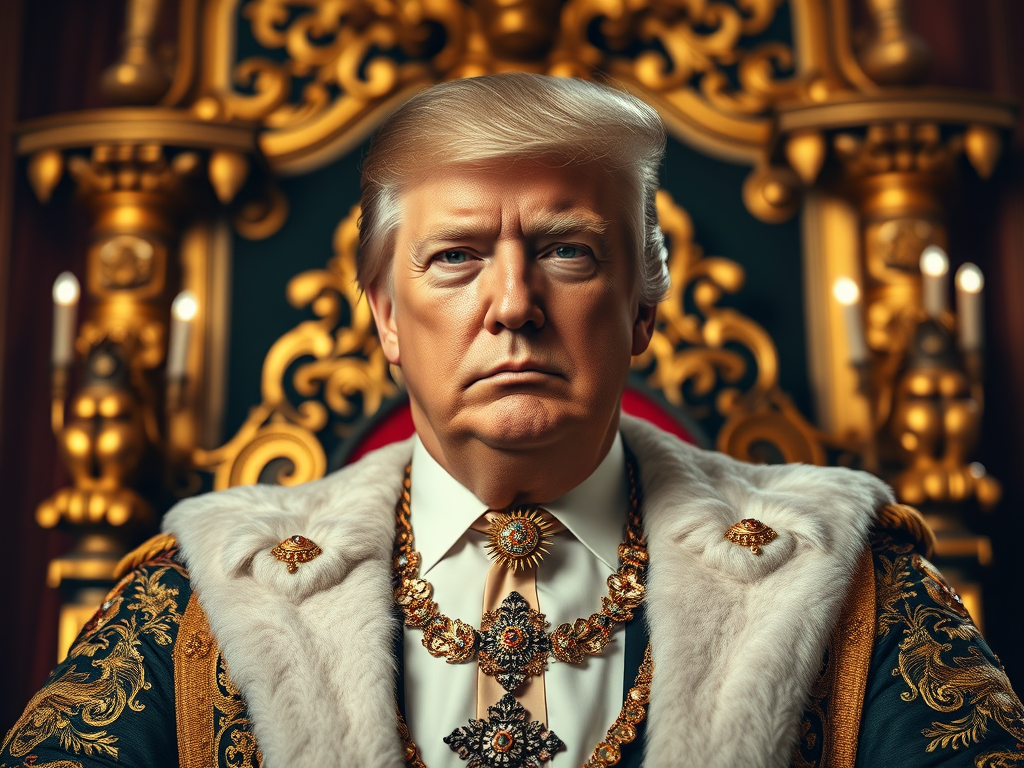
Donald Trump has imperialist intentions, but no idea of what it took for Empires like Britain’s to sustain their hegemony. He is trying to recreate the kind of trade dominance that the British Empire established in the nineteenth century, whilst at the same time withdrawing the USA from overseas ‘forever wars’, and finding that these are incompatible objectives.
When Trump held up his bookies board announcing arbitrary tariffs on every country in the world and some places that weren’t even countries, economists saw a contradiction between his idea of tariffs as short-term leverage forcing trading partners to lower protections against US imports and his promise that, as much longer-term fixtures, they would allow US industry to thrive in a protected bubble. These ideas were incompatible only as long as one accepts that trade agreements should be broadly reciprocal though. As an imperialist, Trump did not.
He wanted something like the British Empire was able to attain between around 1840 and 1900: free trade where the globally dominant power has comparative advantage, and controlled or manipulated production and trade where it does not. The best of both worlds. We know that, for around forty years, Trump has been thinking of ‘beautiful’ tariffs as a kind of magic wand. At a stroke, they can restore a positive US balance of trade after decades of American hyper-consumption of goods manufactured cheaply in Asia, repatriate lost American manufacturing, and make other countries respect US geopolitical power again. He is convinced that the reluctance to enact sweeping tariffs on trade partners has been one of the most persistent failures of previous American governments.
Where many economists have gone wrong in gauging his motives and mindset is assuming that trade deals must involve some element of negotiation. This was something that the British and most other empires recognised only in certain cases, despite free trade supposedly being Britain’s dominant Victorian philosophy. If you think like an imperialist, trade is about power; not quite reduced to a zero-sum game as mercantilists believed in the eighteenth century, but not too far off it. It is only now that the reality of the USA’s limitations as global hegemon have become clearer that Trump is appreciating the need to negotiate.
Britain’s Imperialist Model
The conventional understanding is that Britain and its Empire moved away from mercantilism, adopting the ideology of free trade wholeheartedly after the abolition of the Corn Laws. These were tariffs that raised the price of imported food to protect England’s landowners at the expense of everyone else. They were removed in the early 1840s as a result of ‘monster’ rallies and intellectual critique. The latter came from Adam Smith and David Ricardo among others, who argued that mercantilist protections enriched a small, politically powerful group of elites at the expense of general prosperity. The popular consensus is that ‘after 1846 the free trade that British political and intellectual elites espoused and promoted benefitted not only Britain but the international trading system as a whole’ (O’Brien, 1992).
However, most historians now see eighteenth-century mercantilism as a stepping stone, rather than an impediment, to Britain’s subsequent dominance of a ‘free trade’ regime that was only ever partial. The almost incessant wars of that century were wars of trade as much as of geopolitics. To all intents and purposes geopolitical power was trade dominance. Britain’s invasion and capture of colonies in North America, the Caribbean and India during the War of Spanish Succession (1701-14), the Seven Years War (1756-63) and the French Revolutionary and Napoleonic Wars (1792-1815), gave it an enlarged share of the world’s productive capacity that made its shift to free trade a matter of national interest. Its willingness to intervene militarily within regions it did not control, arising from its naval dominance, gave it further leverage, with ‘gunboat diplomacy’ first tested during South America’s anti-colonial wars against Spain in the 1810s and 1820s.
The British emigrants fanning out to the newly acquired colonies were seen as integral to the British economy in a way that subsequent generations of economic historians have overlooked when they debate international terms of trade. Britain’s and its empire’s economy were one and the same as long as production was in the hands of Britons. Ceylon’s coastal coffee, indigo, sisal and cotton plantations, wrote William Huskisson, President of the Board of Trade wrote, could well become a ‘small spearhead of the imperial economy’, supplying primary produce that British manufacturers could turn into profitable exports, if only ‘our ancient colonial system’ of trade regulations could be reformed (Lester, Boehme and Mitchell, 2021, 144-50).
While imports sent by British planters, using first enslaved and then Indian indentured workers became tariff-free, the Board of Trade retained them on timber imports, for example, to boost British Canadian settlers’ enterprise over that of French-speaking colonists. When Britain impressed free trade upon European rivals, there were conditions according to Britain’s comparative advantage. French wine, for instance, continued to be met with tariffs. With British control over land, labour, and cheap calico production in North America, the Caribbean and India, British labour was freed to work in urban manufactures, where Britain had a particular advantage, and it was here that free trade was promoted most aggressively (Esteban, 2009).
For all their judicious implementation, tariffs were never as important in protecting British industry as the colonial control of land and labour overseas. Long after Britian’s supposed shift to free trade and free labour, the East India Company and then the British Raj maintained a monopoly on the production of opium that was key in maintaining the balance of trade with China, and which motivated the First and Second Opium Wars. That monopoly was sustained by coercing Indian peasant farmers to grow opium through a taxation and credit-extension regime that tied them to the company as bonded labour. Colonial rule enabled Britain to impose tariffs of 85% on Indian hand-woven calico and 44% on Indian muslin imported into Britain, whilst at the same time allowing unfinished cloth in fr manufacture and levying a 5% import tax on British textiles imported into India. Thus the Indian-dominated textile industry was destroyed and replaced with a British-centred one (Nakatomi, 1993). Before British rule India was manufacturing 25% of the world’s textiles. At independence in 1947, the figure was 2% (Das 2002).
Similalry, through colonialism Britons could access ‘the surplus-producing and taxable capacity of the peasants and artisans’ of tropical regions. As Utsa Patnaik and Prabhat Patnaik (2021) explain, these colonised subjects ‘could be set’ by their British rulers ‘to produce … crops like cane sugar, rice, tapioca, and spices; stimulants like coffee, tea, cacao, and tobacco; vegetable oils like groundnut, linseed, and palm oil; drugs like opium; raw materials like indigo, jute, sisal, and cotton [and rubber in Malaya]; and cut more tropical hardwoods (teak, mahogany, rosewood, ebony) from the forest or from timber plantations—all goods that could never be produced in cold temperate lands’. When these goods were ‘free-traded’ into Britain, they were not seen as foreign imports, but as intra-imperial resources.
At various stages in the nineteenth century, British investors gained preferential access to diamonds and gold in South Africa once the African kingdoms and Boer republics had been conquered; rubber and tin in Malaya once the colonial government had subsumed Chinese secret societies’ control of indentured workers and palm oil in Nigeria once the military had overthrown African kings who wanted to tax it. After WWI, they accessed oil in the Middle East through mandated British authority.
Even the costs of maintaining such preferential resource access were met in large part through colonialism. Indian troops under British command, paid for by Indian and not British taxpayers, served in China in 1839, 1856, 1859 and 1909, Persia in 1856, Ethiopia and Singapore in 1867, Hong Kong in 1868, Malaya in 1875, Malta in 1878, Afghanistan in 1838 and 1878, Egypt in 1882, Burma in 1885, Nayasa in 1893, the Sudan and Uganda in 1896, South Africa in 1899 and Tibet in 1903. The enforcement of opium trading in China alone enabled import duty revenue from Chinese tea equivalent to two-thirds of the UK government’s average annual expenditure on the navy or about half of the average annual expenditure on “Army and ordnance” between 1835 and 1858 (Bhattacharya, 2020).
Trump’s Startegic Error
Donald Trump seemed to believe that the USA’s economic preponderance gave him the same kind of leverage that British imperial officials had obtained after a century of warfare against European rivals and through the control, without their populations’ consent, of some forty five colonies. He believed that he, too, could have the best of both worlds, to have his cake and to eat it, when it comes to global production and trade.
What he and his historically illiterate advisors did not get, though, is how integral the continual projection and renewal of imperial violence was to the British precedent. They thought they could repeat the British trick of pricing out others’ cheaper and often better commodities, supplanting them with their own, but without taking over political control to integrate them within an imperial economy that works for the benefit of the metropole.
With their commitment to withdrawing US troops from ‘forever wars’ overseas, they seem to think they can engage in gunboat diplomacy without the use of gunboats. With the rollbacks, exemptions and negotiations now underway, Trump is perhaps beginning to appreciate that, to achieve the kind of imperialist economic leverage he promised his MAGA fans, he would also have to achieve imperialist sovereignty. That would take far more than just the annexations and ocupations of Greenland, Canada, Mexico and Panama, and the construction of a Trump-themed resort in ethnically cleansed Gaza.
At some point Trump’s administration will have to choose. Will it engage in neo-imperial ‘forever wars’, at the cost of millions more lives, to maintain its global economic ascendancy, or will it settle for some redistribution of the unprecedented prosperity already contained within its own borders and a negotiated new world order?
References
Auerbach, S. (2025) The overseer state: slavery, indenture and governance in the British Empire, 1812-1916, Cambridge: Cambridge University Press.
Das, G. (2002) India unbound, Penguin Books: New Delhi.
O’Brien PK., Pigman GA. (1992) Free trade, British hegemony and the international economic order in the nineteenth century. Review of International Studies, 18(2), 89-113. Available from: https://doi:10.1017/S0260210500118807.
Lester, A., Boehme, K. and Mitchell, P. (2021). Ruling the world: freedom, civilisation and liberalism in the nineteenth century British Empire. Cambridge: Cambridge University Press.
Esteban JC. (2004). Comparative patterns of colonial trade: Britain and its rivals. In: LP. de la Escosura (Ed). Exceptionalism and Industrialisation: Britain and Its European Rivals, 1688–1815. Cambridge: Cambridge University Press, pp. 35-66.
Bhattacharya, P. (2020). India in the Rise of Britain and Europe: a contribution to the convergence and Great Divergence debates. Journal of Interdisciplinary Economics, 33(1), pp. 24-53. Available from: https://doi.org/10.1177/0260107920907196.
Patnaik, U. and Patnaik, P. (2021). The Drain of Wealth: Colonialism before the First World War, Monthly Review. Available from: https://monthlyreview.org/2021/02/01/the-drain-of-wealth/.
Nakatomi, K. (1993). History of Indian textiles. In: K. Hatanaka (Ed.) Textile Arts of India. San Francisco: Chronicle Books.
