Alan Lester
The Critic Magazine has printed a story about me called A Lester Man. Presumably a wordplay on A Lesser Man, the title sets its tone. The author, Herbert Anderson, has trawled through my social media posts attributing beliefs and motivations to me with which he disagrees. The hit piece is intended to be a warning: ‘We ignore Lester and his kind at our peril’.
Occasionally he gets my beliefs and motivations right. We clearly have contrasting political viewpoints and he’s entitled to object to mine. More often though, the claims he makes about me are false. They reflect a tendency in today’s Christian nationalist, libertarian – aligned, right-wing media to craft straw men, supposedly on the radical Left, from whom they need to protect society with ever more radical interventions from the extreme Right.
I’ll take each of Anderson’s claims in turn, noting what he says I believe and what I actually believe.
- I (and other colonial historians) propagate an ‘“Imperial miasma theory”, i.e. the viewpoint that the Empire poisoned everything’. I pounce ‘with pitbull-like ferocity upon those’ I see ‘as propagating the wrong-headed view that the British Empire was something more than a four-hundred-year-long atrocity’.
I have never used the word ‘miasma’ to describe imperialism and I would never defend the proposition that the Empire was ‘a four-hundred-year-long-atrocity’. I have written that, like all empires, Britain’s was premised on violence and that along with the other modern European empires, it was a vehicle of white supremacy. At the same time, I have written extensively about British colonial figures who objected to colonial violence, campaigned against slavery, sought to protect Indigenous peoples from elimination, and challenged racially discriminatory rule. Had Anderson read some of my books, for example Colonisation and the Origins of Humanitarian Governance, rather than merely foraging among tweets, he might have been aware that I view the British Empire as a far more complex entity.
To put arguments I have made over the last four decades in a nutshell, I see the British Empire as a dynamic set of projects pursued by Britons, sometimes in association and sometimes in contestation, which were continually deflected and deformed by colonised people’s co-optation, adaptation, negotiation and resistance.
The book of mine which encapsulates this complexity best is Ruling the World, described by the far-from-radical imperial historian John Darwin as ‘a major contribution to British imperial history’ for its analysis of British imperial governance everywhere and all at once.
- I am ‘particularly scathing about the History Reclaimed project and its executive editor Professor Lawrence Goldman, whom I have ‘accused of “not bother[ing] to check” evidence before making assertions, making “basic historical mistakes” and even commenting on books without reading them first’.
This is true and Anderson has attempted no refutation.
- I show ‘little concern for historical inaccuracies so long as they paint colonialists in a negative light. When UCL scholar Jenny Bulstrode’s article — which claimed that Henry Cort stole industrial processes from slaves — was debunked, Lester focused more on Bulstrode suffering from “highly personalised attacks” than her historical chicanery.’
As the post that Anderson links reveals, I was indeed exercised by the attacks on a fellow scholar, which included death threats. I think it is reasonable to believe that historians should not be subjected to such threats because of what they write.
As for the ‘historical chicanery’, this suggests a deliberate intention to deceive that I simply did not find in the article in question. Other academics who specialise in ironworking on slave plantations have challenged the article’s findings. I avoided commenting on them in any detail because I hadn’t done the relevant research. Such challenge is part of the to-and-fro of historical debate. Making death threats should not be.
- ‘Professor Lester garnered even more attention than usual in December last year when Yuan Yi Zhu authored a negative review of his book The Truth About Empire.’ He continues, ‘Zhu’s less-than-laudatory remarks prompted Lester to launch a two-week campaign against that reviewer. Eventually, Lester deleted his spiteful blog post about his critic, ostensibly because he wanted to do the reviewer a favour and not because the sordid saga made him look like a petty fool. Lester then dramatically announced his departure from Twitter, before quietly returning to regularly scheduled tweeting after about a month’.
I’ll have to break this passage down a bit.
The first thing to note is that if Zhu’s review had simply been ‘negative’, I would have ignored it. I responded to it for two reasons. First, because Zhu had fabricated parts of the book’s contents and misrepresented other parts to create a lightning rod for outraged objection. I believe that it is good and proper that reviewers critique books’ arguments and I have done so myself many times, but it is not OK to make up things about them.
Secondly, I objected because I felt a responsibility to the book’s contributors. The Truth About Empire is not a sole-authored book. It is a set of essays by fourteen other professional historians of empire along with a foreword by Sathnam Sanghera. I was the book’s editor and I wrote the Introduction. Zhu’s most damaging distortion did not concern me directly. It targeted a chapter by Liam Liburd. This focused on George Padmore and other Black intellectuals’ comparisons of imperialism and fascism in the 1930s, at the time of Mussolini’s invasion of Abyssinia.
In his conclusion, Liburd wrote that these Black anti-imperialist ‘comparisons … constitute much more than a simplistic or crude accusation that imperialism and fascism were both as bad as each other … To think about the history of imperialism and fascism relationally is not to engage in the crude ethics of comparative calculations, or working out how many Bengalis starved to death against how many Jews were gassed …’. This was the single mention of Bengal or the Holocaust.
This is how Zhu described the chapter:
“Liam Liburd, a professor of black British history, defends comparing the British Empire with Nazi Germany through a series of offensive parallels … At one point, Liburd compares the 1943 Bengal famine to the Nazi gas chambers, conveniently overlooking the possibility that the Imperial Japanese Army’s invasion of Burma’s rice paddies might have had something to do with the lack of rice in Bengal and absolving Imperial Japan from any blame. This is anti-imperial derangement at its peak. Not all of the book’s chapters are so self-discrediting and morally bankrupt.”
Zhu led his readers to believe two falsehoods: that Liburd had equated British imperialism and Nazism, and that he had analysed the Bengal famine without taking the war with Japan into account. In fact Liburd had rejected any such equation and had not analysed the Bengal Famine at all. Zhu’s review was not simply ‘less than laudatory’. Its description of Liburd’s chapter as ‘morally bankrupt’ was based on an egregious distortion.
This was why I wrote the blog. I withdrew it quickly, so I presume that Anderson’s description of it as ‘spiteful’ is taken solely from Zhu’s reaction, to which he links, rather than from his own reading. In it, I sought to explain Zhu’s hostility to the book, his egregious misrepresentation of Liburd’s chapter in particular, as the product of his work for the right wing think tank, Policy Exchange, whose interventions on the Church of England’s research on slavery and on a debate on Churchill I have previously criticised.
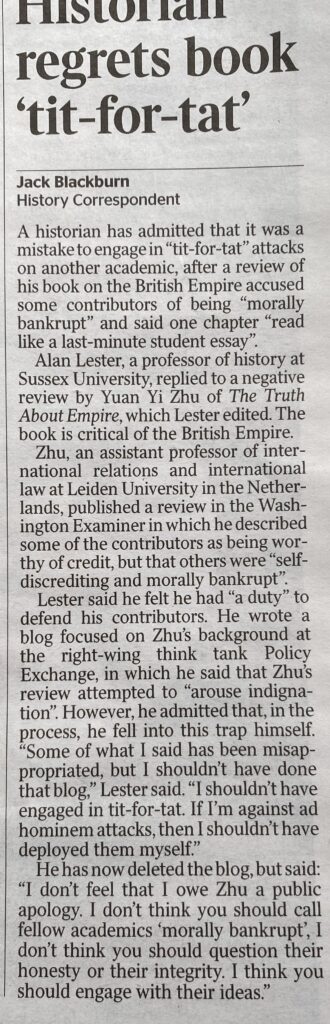
I regretted publishing the blog almost immediately, as an impulsive reaction that focused on the person rather than the ideas. Much to my surprise, The Times (in print only) interviewed both Zhu and me about the episode:
My withdrawal from X seems to me irrelevant but since Anderson uses it to indicate hypocrisy, I will admit that I was disillusioned by the stream of abuse and vitriol from far right, racist accounts. Support for Zhu was also being manifested in threats outside of X. After a while I reconsidered, feeling that I should not let myself be bullied off the platform.
- ‘Lester believes that Britain should submit to the reparations shakedown. He at least accepts that showering the Third World with British taxpayer gold is likely to be a non-starter. Instead, he supports Caricom’s 10-point plan for reparatory justice’.
Rather than arguing for Caricom’s or any other reparations demands, my interventions on this topic have consisted of objections to the falsification of history from those refusing even a conversation about reparations. This is made clear in the introduction to my blog on the subject:
“I’m an historian, not an activist for reparations. I get why the idea of them is galling to those who believe they’ll result in hard-pressed British taxpayers transferring cash to distant strangers who were never enslaved themselves. I think there’s a constructive conversation to be had about a form of reparative intervention that is in the UK’s national interest but pressing for that is not my primary concern as an historian. Correcting misinformation about the past is”
- On Black Lives Matter, ‘I’m not sure what society Lester inhabits which suffers from an over-policing problem as far as crime is concerned, but I wish I lived there.’
I do not know where Anderson lives, but I inhabit a country in which, according to His Majesty’s Inspectorate of Constabulary, ‘There is clear evidence of race disparity in police criminal justice decision-making … Government data shows Black people are three times as likely to be arrested as White people. And our analysis of cases examined in our fieldwork also found clear differences between the experiences of people subject to police criminal justice decisions, depending on their ethnicity’.
- My ‘end goal is to break down what it has meant to be British and replace it with a bland, centrist narrative of Britishness to enable the country to effortlessly assimilate new arrivals be they Pashtuns, Slavs or Yoruba.’
My comments on the need to rethink dominant historical narratives have not been directed at the integration of migrants from overseas. They are about the belonging of generations of Black British people. My book Deny and Disavow makes this clear.
- I see my ‘work as providing the ideological buttress to a process that online sociologist and anthropologist Kunley Drupka has described as “Yookayification” — the transformation of Britain into a cultural and political entity that is distinct from historical Britain’.
I have not encountered this ‘online sociologist and anthropologist’ before, nor the phrase they coined. As an historian it makes no sense to me to believe that one can hold back the transformation of any entity, let alone an always-contested social and cultural identity, over time. There would be no history if nothing changes. I wonder which moment in British history Anderson would like to freeze as the one when he feels that Britain was ‘right’. When was ‘historical Britain’?
- I think that ‘we have to obsess over real and imagined crimes committed by white people in distant lands long ago. More recent atrocities committed against white people in this land must be downplayed, lest it upset the applecart. In his few public remarks about the grooming gang scandal, Lester gave off the impression that he’s more annoyed that coverage of the issue will fuel Islamophobia’.
I need do no more here than copy the X post in question. Anderson seems to have linked to it without reading it:
“1. Child abuse is a horrific societal crisis. All its victims matter and all its perpetrators should be prosecuted. 2. There have been institutional failures to deal with systematic child abuse. One of these was the failure to tackle grooming gangs centred in Pakistani British communities. Others include the failure to address long-lasting and systemic abuse in the Catholic and Anglican churches and in residential settings. Reports have been commissioned on these failures, whether they stem from a misplaced desire to avoid accusations of racism or veneration for religious institutions, and it is up to governing parties to implement their recommendations. 3. Most child abuse in the UK is carried out in family settings. Data on perpetrators’ ethnicity is unreliable but this specialist research group assesses that White Britons are the only ethnic group over-represented in prosecution figures (that is compared to their proportion of the population), though this could be due to under-reporting in some communities. https://csacentre.org.uk/app/uploads/2024/02/Trends-in-Offical-Data-2022-23-FINAL.pdf… 4. All victims matter and the weaponisation of only one kind of child abuse for Islamophobic & racist propaganda should be resisted within any decent society. https://bbc.co.uk/news/articles/czkk41jxpx0o.amp…”
- ‘Right-wing think tanks, and those who work for them, should be excluded from the public conversation on the Empire, according to Lester’.
I have pointed out that right wing think-tanks intervene in historical debates to promote the interests of their funders. That’s their purpose. They cherry-pick their data accordingly. Unlike researchers working on their specialisms in universities, they do not have to comply with ethical research norms that require faithfulness to the full range of available sources, nor to undergo peer review. Accordingly, I have said that their ‘research’ should not be treated by the media as if it is impartial. Nowhere have I said they should be excluded from the public conversation. This would be a form of censorship to which I am opposed.
- I advocate that we ‘teach people that their ancestors were mainly thieves and murderers, or benefitted from theft and murder’, so that ‘then they will ‘stop being proud of their ancestors’.
This claim is based on an interview I gave to the Guardian about a social attitudes survey last year. Anderson does not link to the article itself, which says something quite different: “Prof Alan Lester, the editor of a new book on empire … described the results as an “encouraging sign” that the public were becoming more discerning about Britain’s past … It shows an awareness that history is complicated, that Britons have done both admirable things and deplorable things in the past, and we need to break down history into the kinds of things that we see as sources of pride and those which we need to move beyond.”
Conclusion
The heart of the matter, it seems to me, is this: Anderson is afraid of Britons losing an attachment to an ‘historical’ identity, but he is not willing to explicate that identity. ‘Lester’s writings’ he warns, ‘show the danger of conservatives ceding ground to historians cum progressive activists. Lester’s goal is to cultivate a degraded sense of Britishness, in which national identity amounts to little more than supporting the right sports teams and proclaiming loyalty to vague liberal-left values. As recent history has shown, such a society will not be cohesive’.
By conflating me with activists Anderson seeks to undermine the insights I have gleaned from over thirty years research, writing and teaching on the British Empire. He is trying to create a false equivalence with right-wing activists, who comment on the colonial past not through any interest or expertise, but to defend the degraded ‘historical’ identity that he can’t quite bring himself to specify.
For my own part, I suspect that the elusive ‘historical Britain’ that Anderson wants us to preserve in aspic is that of the pre-Windrush period, in which an overwhelmingly white-populated set of islands ruled over Black and Brown people far away. It’s a mythologised Britain of warm beers outside ivy-covered pubs, its soundtrack the gentle click of leather on willow. An ‘historical Britain’ untroubled by the decline of Empire and the mass immigration of its former subjects. As I argue in Deny and Disavow, the main impediment to a cohesive contemporary British society is precisely the determination to hold onto such an imagined ‘historical’ identity.

Peter Furtado
Fascinating to see in detail how nuanced and reasonable views can get distorted in order to be trashed – something we are now seeing daily from the most powerful people in the world. Though I can’t claim to being an expert on the details of the case, I can certainly say that I have read Prof Lester’s social media posts over several years and the way he represents them accords with what I’ve read, far more than Anderson’s do.