Paper given at Power, Slavery, and Culture in the Trans-Atlantic World: A Conference in Memory of Trevor Burnard, Institute of Historical Research, London, 30 June 2025
Alan Lester, University of Sussex
Despite being a friend of Trevor’s since his days at Sussex, we only ever collaborated on one project, brought together by a conference organised by Joy Damousi in Australia, where of course Trevor was HoD at Melbourne and I had a visiting post at La Trobe. The project resulted in an edited collection in the MUP Studies in Imperialism series, Humanitarianism, Empire and Transnationalism, 1760-1995: Selective Humanity in the Anglophone World. Together, Joy, Trevor and I wrote an introduction that sought to contextualise essays that ranged from the mid-C18 to the late C20 and from antislavery to Amnesty International. Trying to narrate the continuity of humane expression and action that threaded through the contributors’ various foci whilst being attentive to the very different situations that they explored was one of the most intellectually fulfilling moments of my career. I was astonished that Trevor could casually chuck insight after insight to this project whilst also juggling, as far as I could see, about twenty others!
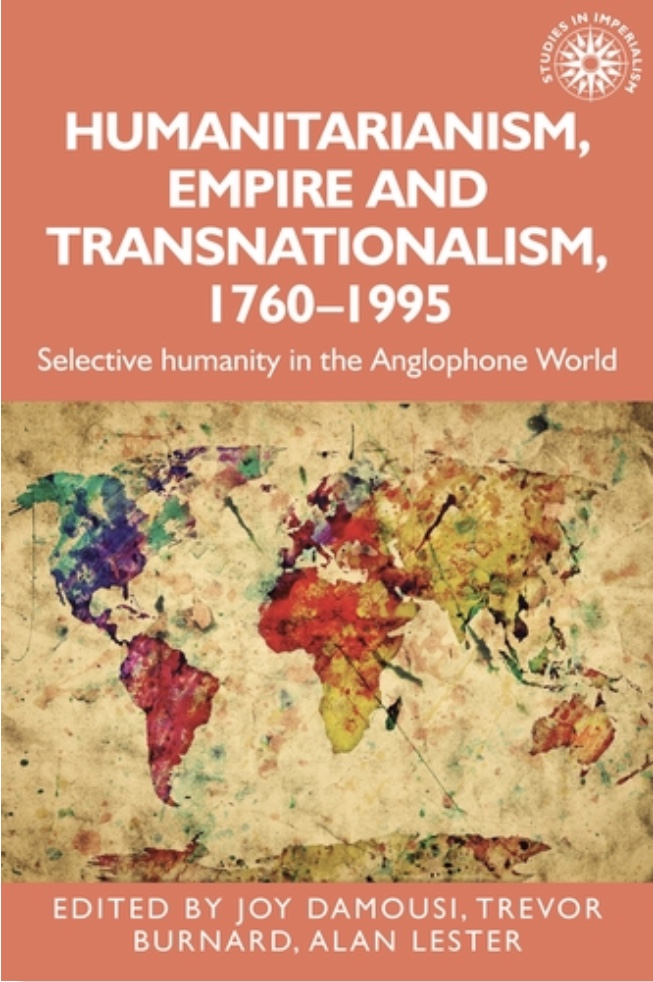
Of course I can’t do justice in the next 10 minutes or so to what we came up with – you’ll have to read the Introduction to the book – so I will just say a bit about our broad conceptual approach.
Humanitarianism is a belief in the fundamental value of human life which can but does not necessarily manifest as a more active commitment to the reduction of people’s suffering and to improving their lives. Trevor was keen to build in Adam Smith’s insights, which helped steer the framing of our starting point in antislavery. As Smith pointed out, humanitarian beliefs seem to be intrinsic to humanity, a product of its capacity for empathy. However, the translation of belief into action is necessarily selective, depending upon our communal and imaginative connections with other humans nearby and distant. British colonialism stretched the distances across which all sorts of activities took place in the 17th-19th centuries: trading, military, governmental, geostrategic and also empathetic. It was these kaleiodoscipally shifting patterns of empathetic geographical connection across the Anglophone world, over the ensuing three centuries, that we sought to outline.
We agreed that we would strive for a nuanced interpretation of colonial humanitarianism – one that lay in between the extremes that have become more pronounced in the context of the current culture war over Empire. Those of a cynical disposition might see colonial humanitarianism as nothing more than rhetorical justification for inherently self-interested behaviour. The most infamous colonial hypocrisy was King Leopold’s use of antislavery rhetoric to justify the rapacious exploitation of the Congo and its people, which glossed the mutilation and torture of thousands and the deaths of millions.[1] Joseph Conrad’s novel based on the atrocities saw a ‘heart of darkness’ not just in the jungles flanking the Congo River, but in the hearts and minds of European imperialists.[2]
Yet the expression of humanitarianism within Empire was more than mendacity. To dismiss it as pretext for exploitation is to overlook the ways in which participants in even the most violent and extractive social relations persuade not only others, but also themselves, of their good intentions. More importantly it disregards the very obvious tensions between humanitarian and other, often antithetical colonial projects. It also risks missing intended beneficiaries’ manipulation of the opportunities presented by humanitarians, often with outcomes entirely unanticipated or even unwanted by humanitarians themselves. Humanitarian projects were usually developed to challenge the most violent and most extractive colonising agendas. From the point of view of those they sought to help, they were preferable to extermination or unchecked abuse.
Today’s defenders of colonial morality go to the opposite extreme of the cynics, asserting that humanitarianism was a genuine motivation, perhaps even the overriding motivation for colonisation.[3] This line of argument has long been intrinsic to the popular British historiography of Empire.[4] British nationalists have contrasted Britain’s beneficence with the Black Legend of Spanish atrocities in the New World and the supposedly more cynical policies of Portuguese, French, Dutch and German imperial rivals, since at least the eighteenth century.[5] Apologists for the British Empire have updated and intensified their focus on its humanitarian elements in the light of the Black Lives Matter Movement’s challenge to a complacent public understanding of Empire that downplays the significance of slavery, colonial exploitation and racially discriminatory rule.[6]
British colonial humanitarianism was neither a disguise for ‘real’ colonial agendas nor the driving force of a peculiarly benevolent Empire. It was reflected in organisations, media and campaigns that periodically gained political purchase. Under certain circumstances, humanitarian campaigners were able to affect imperial policy, mitigating and deflecting more rapacious colonial projects. The most pertinent questions for historians are why and how humanitarianism became relatively powerful during these moments and not others; how humanitarian concern was traded off against other priorities, and what opportunities colonial humanitarians provided for their intended beneficiaries. Our introductory chapter focussed on these contingencies during certain key moments: the abolition of the slave trade; the attempt to police other nations’ slave trades; the amelioration and abolition of slavery; Aboriginal Protection, and the late nineteenth century revival of antislavery.
Although the book was focused on Anglophone humanitarianism, Trevor was keen to contextualise it more broadly and contributed both a chapter and part of the introduction comparing British and French antislavery movements. If the popular memory of British antislavery activities can be selective, he argued, so too is its focus on British agency. As J. R. Oldfield highlighted, late eighteenth-century antislavery was far more than a British national project. Rather, ‘the early abolitionist movement is best understood as an international movement that rested on dense networks that linked activists in large metropolitan centres such as Paris and London with those in more remote outposts such as Washington and Pennsylvania’, all of them interacting with those who had first-hand knowledge of slavery in the Caribbean and Americas.
As with most nationalist mythologies, there is a seed of truth from which British exceptionalist narratives are constructed. From the eighteenth century to the mid-twentieth century, as the essays collected in the volume demonstrate, the British Empire acted as a vast engine for the generation of new, long-distance relationships of all kinds. As a result of connections forged by imperial sail, steam ship, rail, telegraphic and airborne communications, and as a result of the circulation of newspapers, illustrations, photographs and film through these networks, humanitarian relationships, along with those of trade, governance, settlement and science, were stretched across the globe by the British Empire in unprecedented ways.

Furthermore, there is a reasonable claim that late eighteenth- and early nineteenth-century antislavery was specifically Anglophone, if not exclusively British. French humanitarianism started more slowly than in Britain and had a different focus. The northern colonies of British America and England were in the vanguard of the development of colonial humanitarianism while France lagged behind despite its centrality to Enlightenment thought and culture. French philosophes did not concentrate on humanitarian matters, notably antislavery, until relatively late in the eighteenth century. The most important antislavery initiative was the Amis des Noirs, founded in Paris in February 1788, led by Jacques-Pierre Brissot de Warville, an intimate of Anthony Brissot, upon whom Trevor’s chapter focuses. Nevertheless, Brissot’s ‘humanitarian and religious rationale could do little to shape the French antislavery argument, which was characterized by the prevalence of philosophical, administrative and economic arguments, together with moral indignation targeted at colonial planters’.
In contrast with the other European empires, Anglophone humanitarian networks connected those in Britain concerned about slavery, heathenism, dispossession, and a perceived lack of civilisation and poverty, to the British emigrant diaspora of some two million people and even larger Anglophone settler populations by the beginning of the twentieth century, and to further millions of subjects of humanitarian concern who were largely (but not exclusively) colonised people of colour. Anglophone humanitarianism was dispensed via intermediaries including missionaries and colonial activists (many of them also people of colour), official protectors of slaves and Aborigines, and concerned travellers, writers, colonists and government officials; an array of actors which morphed into newly entangled relationships between nation states and international and local NGOs as the largest and most dispersed of the modern empires fragmented from the mid-twentieth century.
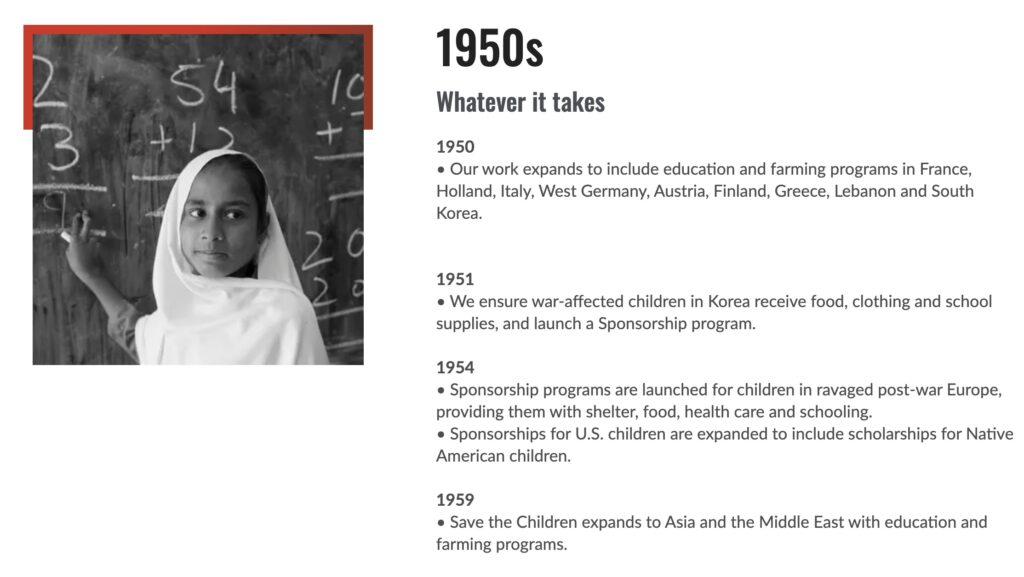
Save the Children: https://www.savethechildren.org/us/about-us/why-save-the-children/history
As Britain’s temperate colonies were consolidated through emigration and colonial population growth (and corresponding relative Indigenous demographic decline) and as British settlers there developed self-governing institutions, they became centres of humanitarian gravity in their own right, often eclipsing the efforts of the United Kingdom itself. Beginning with the USA, British settler colonial offshoots in North America, southern Africa and Australasia contended for global influence as donor nations, creating a modern global Anglophone humanitarian sphere.
Unprecedentedly wide-ranging and diverse Anglophone humanitarianism, we concluded was never merely a justification for other colonial projects and nor was it a rationale for colonisation. It was an inconsistent, selective and occasional corrective to colonialism’s worst excesses, and, as far as its intended ‘recipients’ were concerned, a double-edged sword. When humanitarian campaigns aligned with broad shifts in public culture, they could be remarkably effective, as when black activists who had long opposed slavery found the British public far more receptive in the wake of the loss of the American colonies. From being a threat to British interests, antislavery rapidly became an expression of Britishness and also a lever to generate public support for a range of colonising projects. On occasion in the ensuing century, humanitarians like the Protectors of Aborigines presented opportunities, however unwittingly, that colonised people were able to exploit to survive within the interstices of a destructive colonial system. We need, however, to know far more about what subjugated people have done with humanitarianism, in the past and indeed the present, as a recent UK government Humanitarian Emergency Response Review noted.
Humanitarian interventions in the British Empire were fickle, subject to the whims of an electorate swayed by selective reporting, celebrity culture and disparaging, ethnocentric representations of intended beneficiaries. Furthermore, what humanitarians in Britain believed about the Empire was often belied by the actions of colonists on the ground, as the records of amelioration, apprenticeship, liberated Africans, sati and Aboriginal Protection demonstrate. However sincerely it was expressed by many, humanitarian discourse could also be cynically appropriated for other ends, be they strategic as in the case of the Foreign Office’s intervention against the Zanzibari slave trade, avaricious in the Scramble for Africa or culturally genocidal in the case of the Stolen Generations and Residential Schools.
Aside from cautiousness about the difference between rhetoric and reality, and intent and outcome, we thought it important to consider humanitarianism’s more enduring, structural role in the nineteenth century British Empire. Overall, it had an ameliorative effect on colonial relations. It could constrain the worst excesses of violent exploitation, but it also helped colonial authorities to deflect more radical and revolutionary human rights demands. During the 1790s pro-slavery interests managed effectively to mute antislavery activism by associating it with the incendiarism of Revolutionary Terror in France and Haiti. Antislavery activists learned to act conservatively and defensively, articulating the differences between their project of national preservation through atonement and gradual reform, and the menace of Rights of Man fervour. They introduced an explicit rupture between the discourses of humanitarianism and human rights, which Samuel Moyn believes continued into the twentieth century, but which Trevor correctly insisted on qualifying, noting all the moments that paternalistic humanitarians too, had mobilised a discourse of innate human rights against colonial oppressors.[7]
‘The problem in all humanitarian interventions, as Richard Drayton notes, ‘is that those powers with the capacity to apply force at a distance for humanitarian or other ends are generally also those with economic and strategic interests overseas and are often also states which refuse any cosmopolitan restraint on their own military action’.[8] Humanitarians, as Jean Allman pointed out, were and are still ‘sowing seeds in ground they did not own, in a climate they could not predict and at intervals they did not determine’.[9]
[1] A. Hochschild, King Leopold’s Ghost: A Story of Greed, Terror, and Heroism in Colonial Africa (New York, Mariner, 1999).
[2] J. Conrad, Heart of Darkness (London, Penguin, 2007, originally 1899).
[3] A. Lester, ‘The British Empire in the culture War: Nigel Biggar’s Colonialism: A Moral Reckoning’, The Journal of Imperial and Commonwealth History, 51 4 (2023), 763–795.
[4] P. Satia, Time’s Monster: History, Conscience and Britain’s Empire (London, Penguin, 2022).
[5] M. R. Greer, W. D. Mignolo and M. Quilligan (eds), Rereading the Black Legend: The Discourses of Religious and Racial Difference in the Renaissance Empires (Berlin, De Gruyter Brill, 2008).
[6] Lester, ‘The British Empire in the Culture War’.
[7] S. Moyn, ‘Human rights and humanitarianism’, in M. Barnett (ed), Humanitarianism and Human Rights: A World of Differences?, (Cambridge, Cambridge University Press, 2020), p. 33.
[8] R. Drayton, ‘Beyond humanitarian imperialism: The dubious origins of “humanitarian intervention” and some rules for its future’, in B. Everill and J. Kaplan (eds), The History and Practice of Humanitarian Intervention and Aid in Africa (New York, Palgrave Macmillan, 2013), p.217.
[9] J. Allman, ‘Making mothers: Missionaries, medical officers and women’s work in colonial Asante, 1924-1945’, History Workshop Journal 38, 1994, 43.
