Alan Lester
Key points:
1. Trans-Atlantic slavery was unlike other forms of slavery. People were commodified and racialised as ‘objects’ for capital accumulation.
2. The Church of England invested in this system through ownership of a Barbados estate with high death rates and purchase of captives for it; donations from slave-traders; clergy who owned captives and investment in the slave-trading South Sea Company.
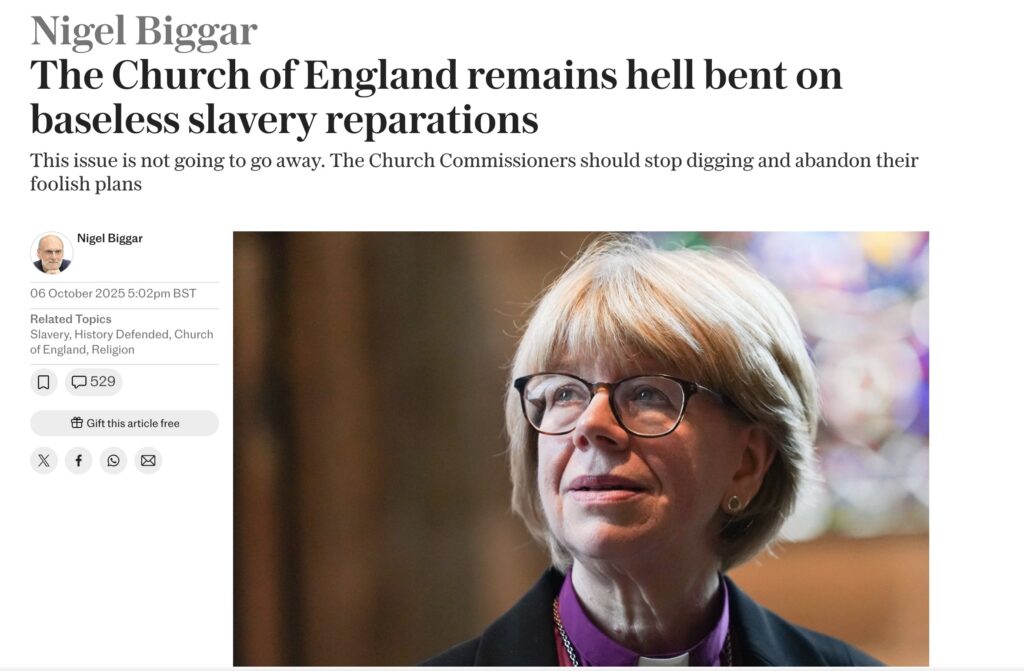
3. Right wing activists are campaigning against the Church’s reparative Project Spire in parliament and the right wing press.
4. They are claiming that the Church got its history wrong because it profited from South Sea annuities rather than shares in the company’s less ‘successful’ slave trading branch.
5. In fact it continued to hold shares too, even if they were less profitable than it had hoped. The Church knowingly invested in the trafficking of some 20,000 people, 3,000 of whom died on the way.
6. The right wing objections are really political rather than historical.
Introduction
Immediately before and after the Black Lives Matter protests in 2020, a number of prominent British organisations assessed their entanglements with slavery and its afterlives. They included the National Trust, Oxbridge colleges, the Bank of England, The Guardian, Greene King and Lloyds of London. But of all of them, the Church Commissioners for England has embarked on perhaps the most ambitious response with its Project Spire – a plan to invest £100 million over 9 years in measures for reparative racial justice on behalf of communities ‘which still bear the scars’ from slavery. [1] The intention is that the £100 million will act as a catalytic seed investment to encourage other investors to come alongside the Church Commissioners, with the goal of creating a new in-perpetuity fund of £1bn.
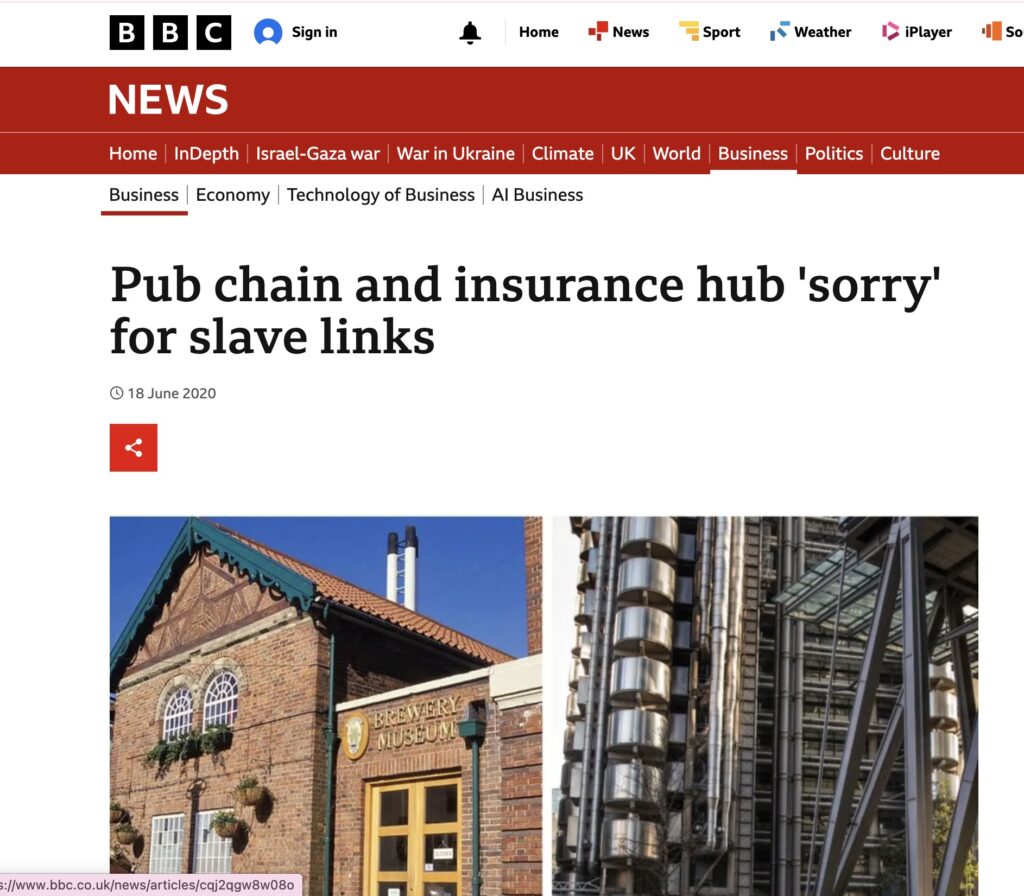
Because Project Spire is the most advanced of such schemes, it is also the main target for conservative groups opposing any reparative justice measures. The backlash against the plan has been intense, vocal, well-organised, and backed by some very powerful people. Clearly there is a great deal of fear that Project Spire will set a precedent for reparative justice measures elsewhere and a determination to prevent that happening at all costs. As the most hostile opponent of the scheme in the House of Commons, the Conservative MP Katie Lam fears, ‘the Church of England is a national institution. What it does, others may choose or feel forced to emulate’. Those opposing the scheme have found no shortage of allies in the British press. Much of their activity has been directed at trying to undermine its historical basis. They claim, as Lam puts it, that ‘Project Spire is ideological virtue signalling based on’ historical ‘ignorance’.[2]
In this talk I will address what made trans-Atlantic slavery different from other forms of enslavement, how the Church of England was involved in it, and how those opposed to Project Spire are misrepresenting the past and maligning the reputation of historians as collateral damage, in their campaign against it.
Trans-Atlantic Slavery
Slavery in one form or another has been a constant feature of human history on all inhabited continents. Slave trading from Africa predated the Europeans’ trans-Atlantic slave trade to the New World.[3] Although anti-reparations campaigners often present the very highest, implausible, estimate for the numbers of Africans trafficked into various parts of the Muslim world, it is reasonable to assume that this trafficking was on a scale roughly equivalent to the trans-Atlantic trade, albeit over a far longer duration.[4]
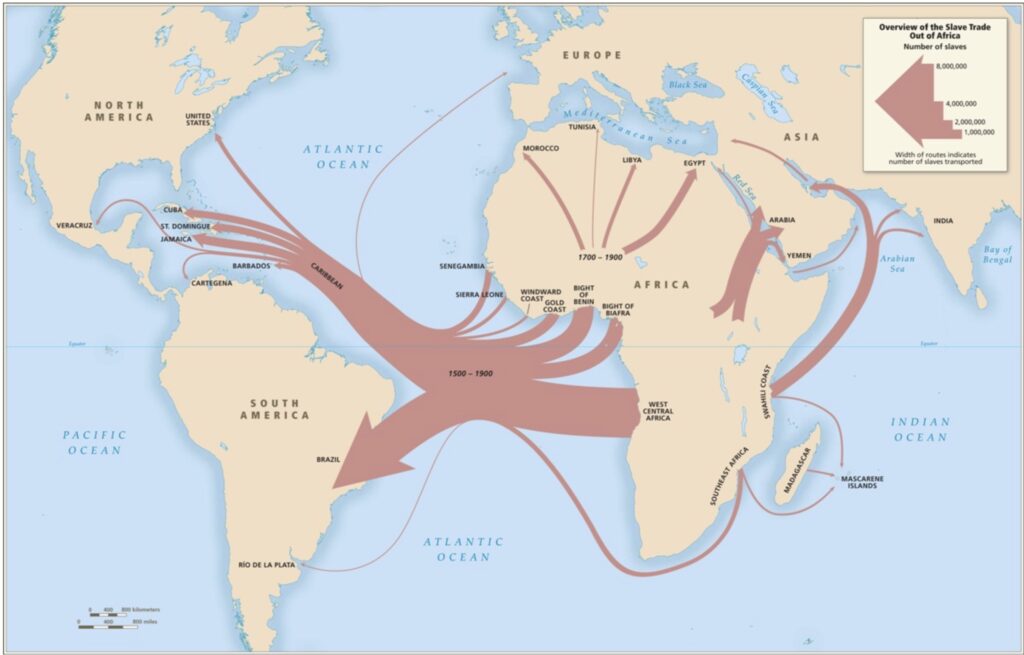
The Trans-Atlantic Slave Trade
Barbary, Ottoman, Omani and Sahelian slaveries are often all described alike as ‘Islamic’, although one does not often hear the description of the trans-Atlantic slave trade to the New World as ‘Christian’, which would be equally appropriate. Historians can pin down the numbers involved in this Christian slave trade far more accurately than they can identify the numbers falling prey to other slave trades. This was because the Europeans’ plantation agriculture was a novel system of capital accumulation requiring meticulous account books.
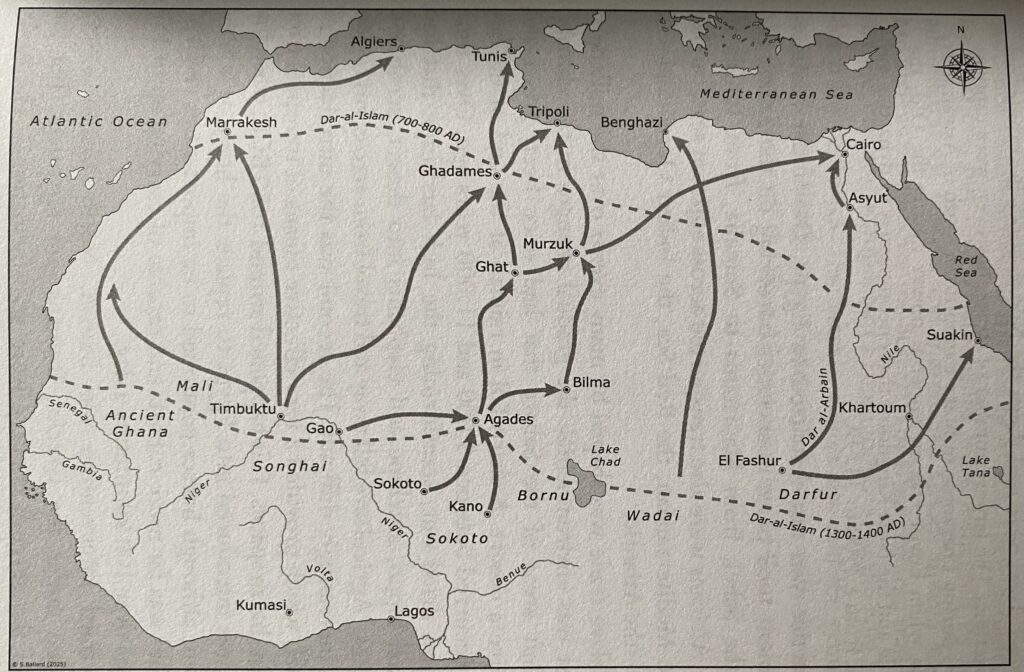
The Trans-Saharan Slave Trade
As well as being unpaid labour, each of the 12.7 million captives trafficked across the Atlantic was itemised as a unit of capital stock upon which credit could be leveraged, often on behalf of absentee investors living in Britain. Enslaved women’s babies were also units of capital that could could be sold off or retained as ‘stock’ on the plantation, making the rape of enslaved women a matter of their owner’s sexual gratification but also a means of generating further wealth. Stephanie Smallwood has written of an entire ‘commodifying Atlantic apparatus’, the purpose of which was to turn African people into objects ‘solely for the use of those who claimed to hold them as possessions’.[5]
The estimates of Africans as well as white people trafficked to Muslim-dominated lands for more intimate military, domestic, sexual and agricultural exploitation by contrast, tend to be based on very imprecise extrapolations from relatively scarce texts. Subsequent generations were not necessarily kept enslaved and captives themselves were often freed through conversion to Islam. Enslaved people rose to the top administrative ranks in many Muslim socities. Nothing like the accounting techniques or records that enabled British slave owners to be compensated for the precise capital value of each person they had owned and insured upon abolition existed in the Muslim world because, quite simply, slaves were not thought of in the same completely commercialised and dehumanised way.
Just as importantly for the shaping of modernity, the Christian system was also far more explicitly racialised. Trafficked people of sub-Saharan African descent never constituted a majority population of any destination in the Muslim world in the way that they came to in the plantation societies of the Caribbean. Enslaved people in the Islamic world could be white, brown or black, from Africa, Asia or Europe, their ethnicity not the defining characteristic of their status. Nor was ethnic exclusivity the main characteristic of their owners, who in the Muslim caliphates and empires of North and West Africa, were also Black.
In the slave codes of British American and Caribbean colonies however, the words ‘Negro’ and ‘slave’ were interchangeable because, uniquely, only Black people were held captive, overwhelmingly by white people. Some freed Black people and people of mixed heritage also owned enslaved people, but even their social status among the free was largely determined by colour. Becoming a slave owner was their way of becoming white, but never quite.
Trans-Atlantic slavery was one of the main motors driving the modern, global, capitalist world economy with its marked, racialised distinctions. It was transformational and foundational to the way we live now, in a way that Islamic and other, prior forms of enslavement were not. The historian who has done most to enumerate Atlantic slavery, David Eltis, draws attention to its implications: ‘by contrast’ with every other form of slavery, ancient or modern, ‘the enslavement of Africans in the Atlantic continues to feed into deep modern social inequities’. He anticipates that ‘the transatlantic slave trade’ will ‘come to be treated with the detachment that historians assume in evaluating, say, the slave trade generated by the Roman, Mongol, Islamic, and Latin empires’ only ‘when Black/White income differentials … disappear’.
The Church’s Role
So what role did the Church of England play in this all-encompassing system of explicitly racialised exploitation? It was implicated in four main ways: its mission society’s direct ownership of plantations and people; its receipt of funds from benefactors invested in slavery; the membership of slave-owning clergy, and investments in the South Sea Company, which traded in captives across the Atlantic. I will take each in turn.
The Society for the Propagation of the Gospel (SPG) was founded in 1701 by royal charter to convert colonial subjects to Christianity. The archbishops of Canterbury were the mission society’s presidents. In 1710 a colonial administrator in Barbados, Christopher Codrington left the SPG two sugar plantations in his will, stipulating that they be worked with 300 enslaved people, with a college also founded on the estate. The plantations are thought to have generated about £5m a year in today’s money, between 1710 and 1838. As the antislavery movement began, the SPG told Anthony Benezet, one of the early campaigners, that it ‘cannot condemn the Practice of keeping Slaves as unlawful, finding the contrary very plainly implied in the precepts given by the Apostle [Paul]’.[6]
The Church of England’s own archives reveal that archbishop of Canterbury Thomas Secker approved payments for the purchase of ‘new negroes’ for the plantations. In all the SPG bought some 450 people, ‘calculated for the future lasting advantages of the estates’. Secker explained that these purchases were necessary because of the high death rates on the plantations. He wrote, ‘I have long wondered and lamented that the negroes in our plantations decrease and new supplies become necessary, continuously. Surely this proceeds from some defect, both of humanity and good policy. But we must take things as they are at present.’ [7] Between 1712 and 1734, it has been estimated that over 71,500 captives died working on the Barbados sugar plantations, which global historians have seen as one of early capitalism’s most brutal and extractive sites of excess profit.[8] Frank Wesley Pitman observed that Barbados’ sugar industry was ‘an industrial progress based literally on the extermination of human life’.[9]
By 1781 there were 162 enslaved field workers at Codrington, 73 of them children, for whom special agricultural hoes, made ‘very small’ were manufactured in England. Until 1732 these captives were branded on the chest with hot irons to form the word ‘Society’, showing they belonged to the Church’s plantation. The SPG’s estate managers constantly complained that they needed more captives. Abel Alleyne tried to buy mainly 17 and 18 year olds direct from the slave ships as soon as they arrived in Barbados, reporting in 1743 ‘that the Society’s New bought Negroes were … the finest he had seen’, but that several died, ‘owing . . . to the evil Practice of mixing Sea Water with fresh, on Board the Guiney men [slave ships], to make it go further’.[10]
Despite buying more than one and one-half times the original ‘stock’ of 292 slaves, after fifty years the SPG’s Codrington population was smaller by more than one-third, the death rate exceeding the birth rate by six to one.[11] The low birth rate was not just the result of enslaved women’s reluctance to bring children into a condition of slavery in which up to two thirds were likely to die in infancy, but also a consequence of their owners’ calculation that a freshly trafficked African adult could be trained and put to work within three years, whereas someone born into slavery would take double that, and much more to accomplish the same workload.[12] It is no wonder that the abolitionist campaigner George Stephen described the SPG as ‘the Honourable Bench of Bishops and Slaveowners Incorporated’.[13]
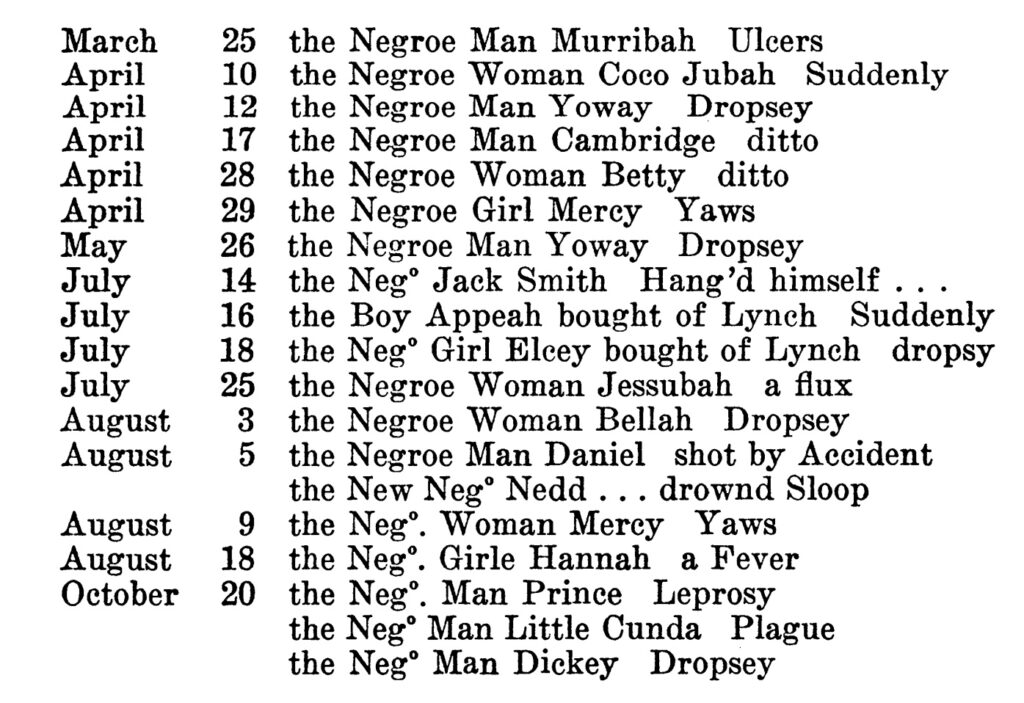
Enslaved People’s Deaths on the Codrington Estate, March-October 1746
As for for the college, local pressure soon led to its use only by white sons of the planters rather than for instruction of the enslaved, and it closed after financial difficulties in 1775. The SPG wanted to continue instructing its enslaved people on the plantation but the Codrington Trust’s attorneys declared that ‘with respect to the Instruction of the Negroes in the Principles of Religion and Mathematics, we are sorry that we are obliged to differ in opinion from the Society, being fully convinced that such a plan will never either answer the Intention of the Benefactor, Nor the wished for Desires of the Society.’ [14] Only as abolition loomed in 1824 did the SPG invest in a housing scheme to allow its enslaved people to marry and settle in some security, preparatory to their emancipation. In 1830, Codrington College reopened to train mainly white candidates for the ministry.[15] It remains there today and is the oldest Anglican college in the Americas. All Souls College, Oxford has bequeathed funds to the institution, now teaching mainly Black students, as part of its reparative measures, given that Codrington also donated to his former Oxford college.
As well as directly purchasing and owning enslaved people, the Church received donations from slave traders and slave owners. Since June 2020 the best known among them is Edward Colston, who left a bequest of £300 (equivalent to more than £54,000 in today’s money) ‘for the promotion and better carrying on that pious work and design’ of spreading Christianity, whilst he was invested the slave-trading Royal African Company.[16]
Slave owners and traders also donated to Queen Anne’s Bounty. This was the fund created initially from the ‘first fruits’ (the first year’s income of a cleric newly appointed to a benefice) and a tenth of the income in subsequent years, paid by English clergy to the Crown. It was invested to increase the income of poorer clergy livings, mainly through the purchase of land. But it was also invested in private and public enterprises to yield dividends and annuities. Currently administrated by the Church Commissioners, it now amounts to £11.1bn. In 2019 the Church Commissioners employed forensic accountants and specialist historians to research the fund’s links to slavery. They found that ‘roughly a third of benefactions to the fund came from individuals ‘thought likely to have had ties to African chattel enslavement’. The Church has refrained from naming them all.
After the 1833 Abolition Act abolished the formal institution of slavery (although not forced labour) in the British Empire, the government compensated 46,000 former slave owners for the loss of their human property with a sum of £20 million, equivalent to 40 per cent of annual Treasury revenue – about the same proportion that bailed out the UK banks during the 2008 financial crisis. Rather than increasing taxation to pay the slave owners, the Treasury raised a loan through the issue of new Government Securities which were finally paid off only in 2015.
Thanks to UCL’s Legacies of British Slavery project, investments of some of the £10 million compensation retained by absentee enslavers in Britian have been traced to the country’s railway and canal systems, merchant banks and insurance companies, urban developments in spa towns and country houses. The SPG was paid £8,558 (around £1m today) for the loss of its enslaved people on the Codrington estates. In addition though, 96 individual members of the Anglican clergy received compensation as absentee slave owners.
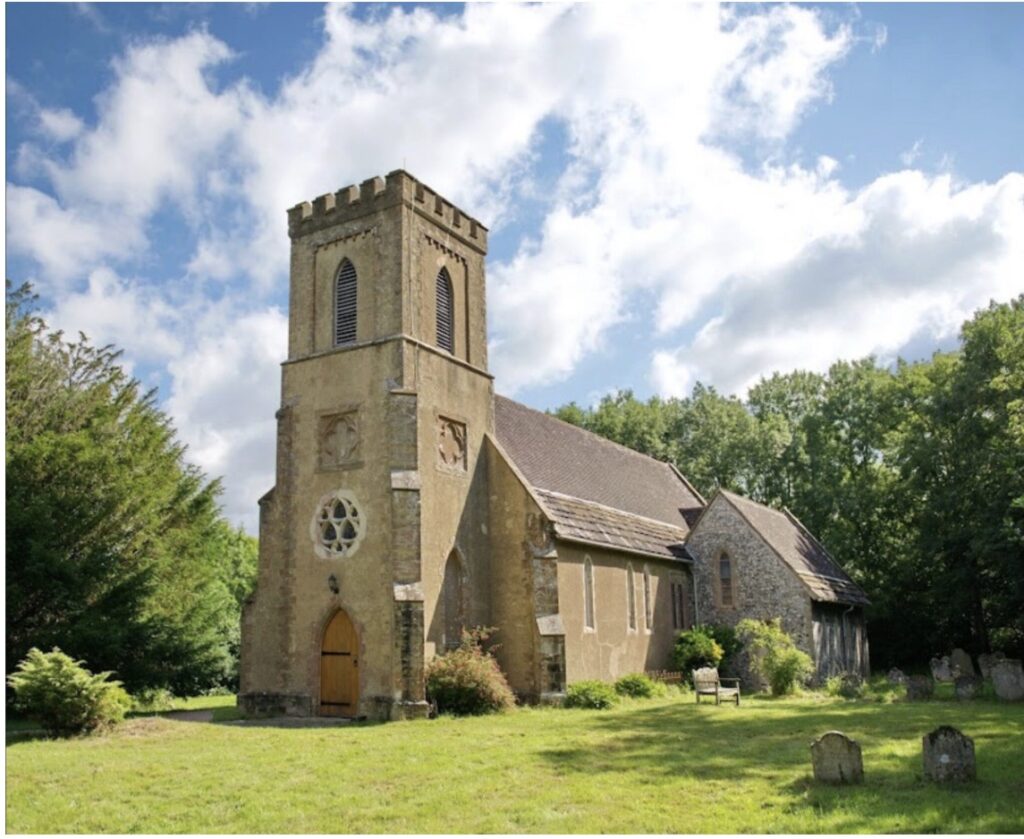
Newtimber Church , West Sussex
One of these beneficiaries was Charles Gordon, holder of the advowson (right to appoint the rector) at St John the Evangelist Church at Newtimber in West Sussex. Gordon had inherited plantations and around 400 enslaved people in Jamaica and was paid £1,145,000 in today’s terms as they were emancipated. Gordon was not alone among Sussex absentee slave owners who received compensation for the loss of their enslaved property. There were 191 in all, including Rev Robert Allen of Barcombe, who got £125,900 (in today’s value) for 123 people, Cecelia Blake of Brighton, who got £505,000 for 188 people and the brother of Henry Gage of Firle Place, who received £175,900 for 150 people.[17]
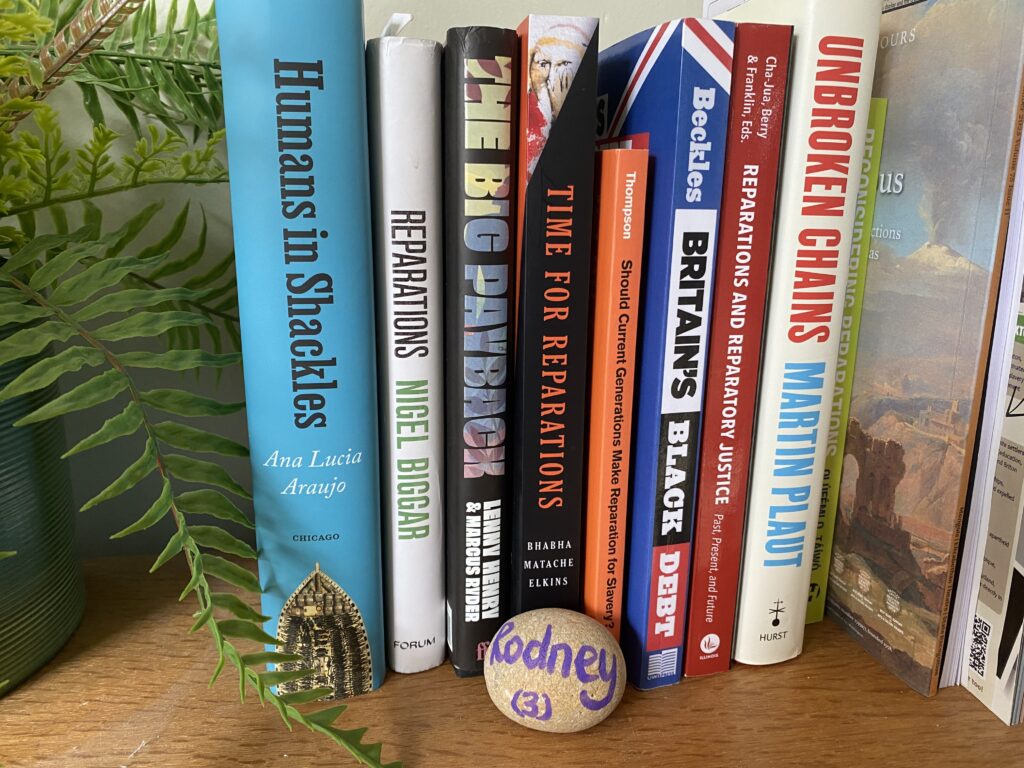
In his will, Gordon left £26,500 in today’s terms, specifically of this compensation money, to be spent in the building of the Newtimber Church tower. Seeking to raise funds for the restoration of this tower today, Ngaire Digby, Sheila Marshall and other parishioners have launched a remarkable project to find out more about the captives whose unpaid labour is embodied in the decaying stonework. Their efforts to turn Newtimber Church into a heritage centre marking not only slavery, but also another of its rectors’ antislavery traditions, along with the church’s East India Company and South African connections, included a moving ceremony a few months ago when the names and ages of Gordon’s captives in Jamaica were read aloud and participants took home with them pebbles inscribed with these minor details of people formerly erased from history. The pebble that sits on my desk at home memorialises Rodney, aged 3.
As slave-owning clergy received their compensation payments, their former captives in the Caribbean went uncompensated for their loss of liberty, trauma and unpaid wages and remained unable to accumulate any substantial amounts of wealth with which to buy land. The most detailed data on the intergenerational fate of those formerly enslaved has been found on the Danish island of St Croix where, unable to pass on wealth to their descendants, there was ‘no decrease in inequality’ after emancipation. Indeed, ‘a distribution of wealth shockingly close to perfect inequality’ has proven ‘highly persistent over the long run’.
Finally, the Church is implicated in slavery through its investments, via Queen Anne’s Bounty, in the South Sea Company. The British government prompted the creation of the joint stock South Sea Company to help manage the debt caused by the War of Spanish succession in 1711 by allowing the government to pay naval contractors in shares rather than in cash. The promise was that the company would be given the Asiento – the monopoly on the trafficking of Africans to the Spanish colonies in the Americas. This was obtained with the Treaty of Utrecht 1713. While the company’s early backers hoped that the Asiento would spearhead Britain’s takeover of South America’s Spanish-owned gold and silver mines, it was its debt refinancing role for the British government that proved most significant.[18]
Making joint stock companies, including the Bank of England, responsible for consolidating the government’s ballooning debt allowed the conversion of high-interest, short-term public debt into low-interest, long-term public debt. Accordingly, the cost of government borrowing declined from 8.7% to approximately 3% between 1711 and 1725, a dramatic shift in public debt financing that historians have called the British financial revolution. The British state’s ability to solve this public finance problem was probably the most significant factor in its success competing with the Spanish and French empires in the 18th and 19th centuries.[19]
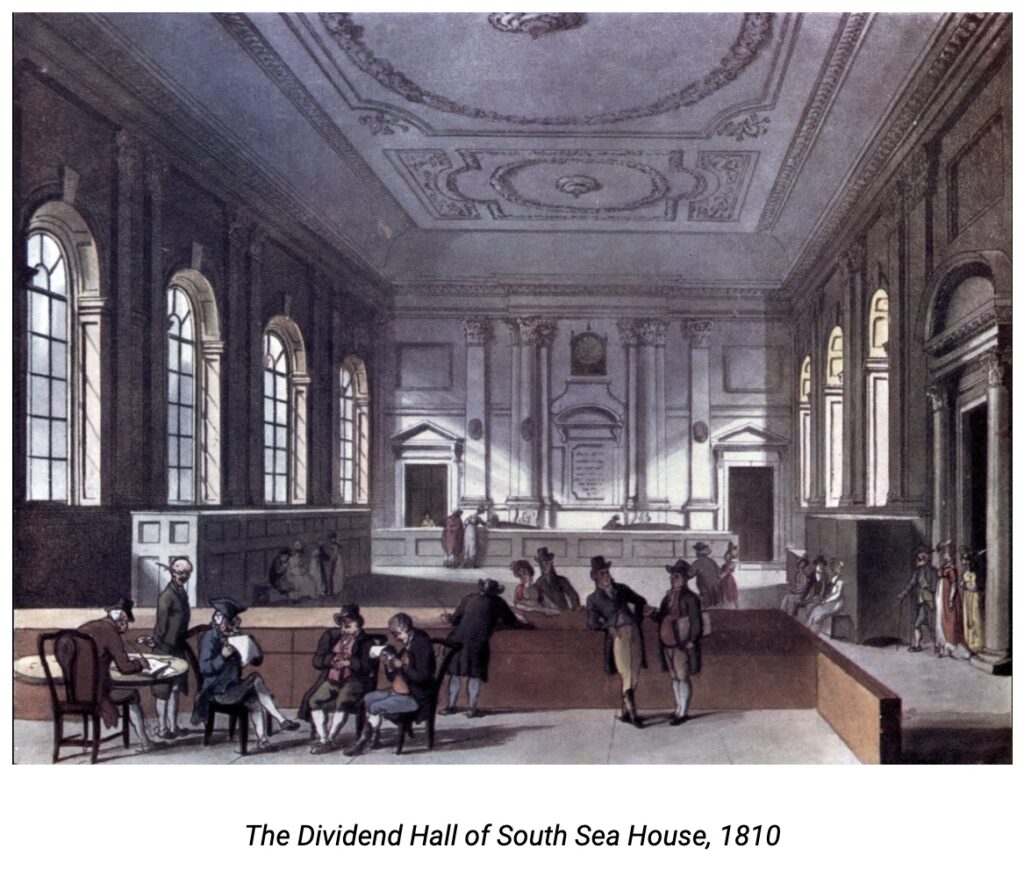
The South Sea Company was at the centre of this financial revolution. Although its profits were to be based on the Asiento this branch of the slave ‘trade’ to the Spanish colonies turned out to be far more difficult than expected. [20] Ongoing warfare with Spain and lower than expected profits contributed to over-inflated stock and devastating shareholder losses in the South Sea Bubble, perhaps the City’s most notorious financial crash, in 1720. However, stock holders were able to draw on the company’s income from the servicing of government debt over the longer term. They included the Church of England, which invested its Queen Anne’s Bounty heavily in the South Sea Company from 1720.
By the time it ceased its slaving activities in 1739, the Company had trafficked 34,000 people and accumulated investments in annuities with a value of around £204,000, equivalent to about £443 million in today’s terms. About 30 per cent of the Queen Anne’s Bounty income was derived from interest and dividends from its investments in the company, affording England’s Anglican clergy some financial security.[21]
It was in assessing the impact of these historic entanglements in both slave and plantation ownership and slave trading that the Church Commissioners launched Project Spire. Currently, and despite furious and sustained opposition in parliament and the right-wing media, the Church Commissioners are engaged with the Charity Commission to consider what regulatory approvals may be required to progress the project.
The Backlash
Since Project Spire was announced, an increasingly coherent and well-organised anti-reparative lobby has devoted considerable resources to trying to pick holes in the historical evidence supporting it. Rather than the SPG’s enslaving, individual clergy members’ slave ownership and slave-traders’ donations, their focus is on Queen Anne’s Bounty and the South Sea Company. Leading the charge are the mainly retired Oxbridge scholars who, in 2021 formed the private lobbying and campaigning company History Reclaimed, in opposition to Black Lives Matter. Over the last five years, History Reclaimed has established itself as the main weapon in a right-wing bid to control public history, regularly supplying news items and comment to The Telegraph, the Daily Mail, The Spectator and GB News, as well as a nexus of right-wing think tanks including Policy Exchange. Its campaign against the BBC’s historical coverage, published by The Telegraph, was part of the ‘dossier’ that precipitated Donald Trump’s current legal case.[22]
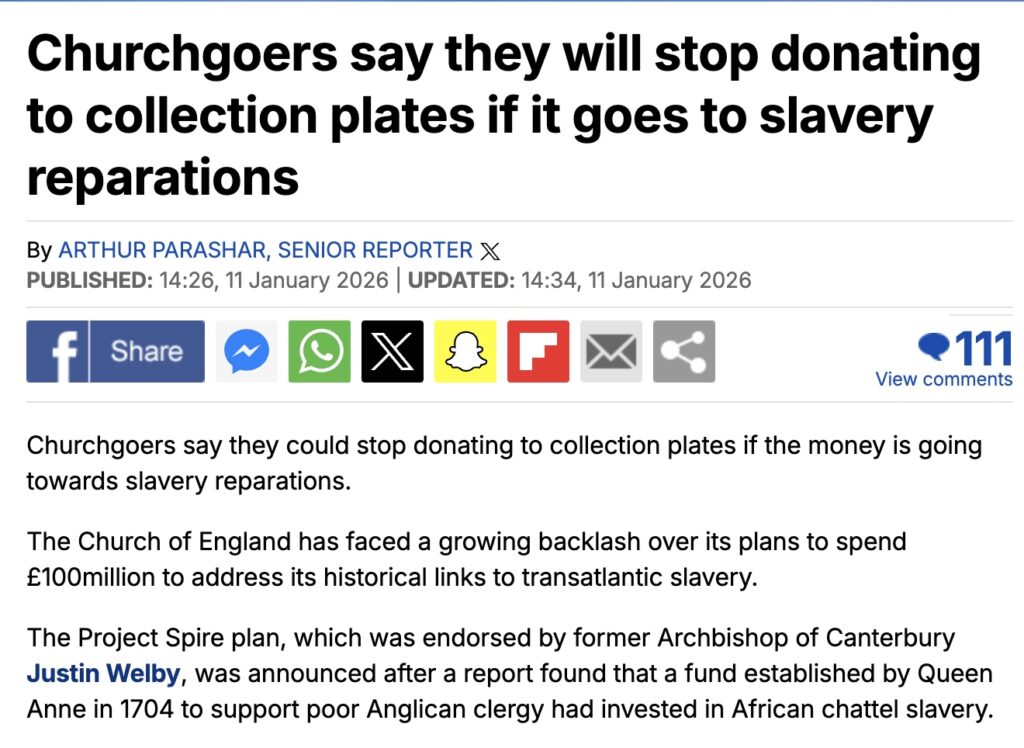
Policy Exchange published a report containing the group’s first serious salvo against Project Spire in early 2025. The author of Boris Johnson’s Commission on Race and Ethnic Disparities Report, Lord Sewell, wrote a vituperative introduction. Fulminating that the Church of England has ‘allowed itself to be grabbed by so many dubious activists and, worst, to inflict upon itself such moralist guilt’, he ascribes the motivation for Project Spire as wanting ‘to be on the cool side of history’ and damns its ‘scandalous over-reach’.
As an historian, I am most concerned by the allegation that the Commission proceeded without caring ‘about facts and evidence’ to produce recommendations that are ‘historically uninformed’. Sewell described the forensic accountants and historians who provided the Commissioners’ historical evidence as ‘activists’ who ‘have distorted the facts around transatlantic slavery to build careers, hustle grants and seek false compensation’. Allegations of historical malpractice run like a poisonous seam through the History Reclaimed/Policy Exchange report. However, the professional researchers’ work was overseen by the retired bishop David Urquhart and Church Commissioner Alan Smith, an ex-banker with HSBC. Neither they nor Grant Thornton, the accountants involved, is any kind of ‘activist’. [23] Sewell’s ‘sense … that the Church and its leadership had no concern about facts or historical rigour’ is entirely misplaced.
There is an important difference between the way that the researchers working for the Church Commissioners went about their work, and the way that both History Reclaimed and Policy Exchange go about theirs. It is one that I, as a non-religious historian, hope that parishioners will bear in mind. When the accountants’ and historians’ research project began, they knew neither what it would reveal nor how it might inform the Commissioners’ response. They had no predisposition either to maximise or minimise the Church’s complicity in slavery. Their purpose was simply to uncover the facts as far as the archival sources and other historians’ studies would allow. History Reclaimed and Policy Exchange, however, are politically-driven. Their publications are explicitly intended to shape ‘the policy agenda’ and they invariably dismiss the examination of colonial violence and racism as ‘woke’ and anti-British, regardless of its veracity.
Whatever merits such a campaign may have, it serves as quite a different motivation for historical research than the more disinterested pursuit of the evidence. Amidst all the general arguments against reparations, the main substance of these right wing activists’ challenge to Project Spire is focused on the contribution that slave trading made to the investments of Queen Anne’s Bounty in the South Sea Company. Here things get quite complex and fine-grained, so please bear with me.
At issue is the difference between shares or stock in the slave trading arm of the South Sea Company and annuities in the arm that loaned funds to the government and received debt payments with interest. Following History Reclaimed, Project Spire’s critics want to create a firewall between the Church’s ‘legitimate’ investments in annuities and any ‘illegitimate’ ownership of shares. This would distance the church from involvement in slave trading and, they hope, render Project Spire null and void.
In a nutshell their specific arguments are: that Queen Anne’s Bounty, having invested in South Sea Company stock in 1720, obtained shares only because in 1723, they were converted from short term government securities, meaning the fund’s managers had no deliberate intention of engaging in the slave trade; that at the time they obtained these shares, the trade in captives was suspended because of war with Spain; that Queen Anne’s Bounty continued to hold more annuities than shares thereafter, and that the shares were obtained ‘on terms which’, in the short term, ‘resulted in serious loss’.
In May 2025 History Reclaimed co-founder Robert Tombs followed up the Policy Exchange report with an essay in the Times Literary Supplement disparaging the historians commissioned by the Church Commissioners for apparently not appreciating the difference between shares and annuities. He alleged that they ‘did not appear to understand what they were reading’ and blamed their apparent historical illiteracy for ‘probably the most expensive historical error in modern British history’, even charging them with inflicting ‘severe reputational damage’ on the Church.
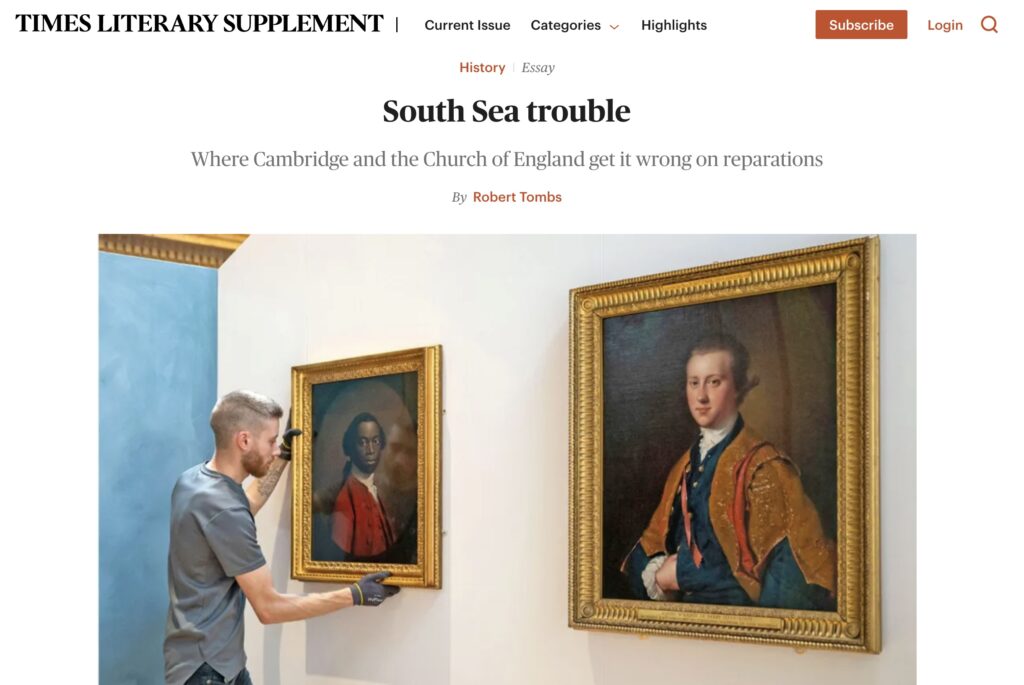
History Reclaimed and their allies want us to believe that the Church Commissioners were persuaded to establish Project Spire only because of their historical advisors’ failure to grasp the difference between South Sea Company shares and Annuities. Katie Lam represents this argument in the House of Commons and Nigel Biggar, co-founder of History Reclaimed and an Anglican priest, in the House of Lords.
In fact it comes as no surprise though, to the historians who worked for the commissioners, that shares and annuities were different. They said so in their report to the Church Commissioners: ‘During 1723, “old” South Sea Company shares … were split into two: for each original share that they owned, South Sea Company investors received a South Sea Company annuity. This was essentially a bond that paid a regular income in perpetuity … that was derived from the interest payments received from the Treasury on government debt; in addition, investors received a “new” South Sea Company share in the [slave] trading side of the company’.[24] Surprising though it may seem, these professional historians did understand the documents they were reading.
Tombs deflects from the shares that Queen Anne’s Bounty continued to retain in the slave-trading company after 1723. He writes only that ‘Queen Anne’s Bounty did own trading stock in the South Sea Company, acquired in 1720 … when no slave trading was happening’. He then skips across the intervening years in which Queen Anne’s Bounty continued to hold these slave trading shares to note that ‘it disposed of the stock between 1728 and 1730’. This makes it seem like no slave trading ever took place while the Church held shares in the company, between 1720 and 1728. In fact the slave trade picked up again in 1721 and between then and and 1728, the years that Tombs conveniently skips over, the company shipped 19,758 captive people from Africa to the Americas and forcibly transported 16,046 people, many of them the same individuals, within the Americas. Some of the Company’s ships from Africa went to Buenos Aires, from whence captives were subsequently marched on foot across the Andes. This trade in captives may not have been as profitable as investors hoped, but it took place nonetheless.
For all the caveats that History Reclaimed and their right wing allies in the press and parliament can summon up, it remains an indisputable fact that, for a decade, the Church of England’s fund managers knowingly held shares in a slave trading company. In a piece published on History Reclaimed’s own website, even co-founder Lawrence Goldman admitted that ‘the Bounty managers seem to have acquiesced in this traffic’. He resorts to the excuse that ‘the Bounty’s involvement was remarkably limited at a time when religious bodies of many kinds … gave slavery moral sanction’.
More importantly though, History Reclaimed’s case against Project Spire presumes that it rests upon a calculation of profitability. Their belief that ‘not much slavery, not much money’, absolves the Church of responsibility for participation in the slave trade sits uneasily with the Church Commissioners’ ethics. What seems to matter for the Church of England is that any part of its Queen Anne’s Bounty was invested in, or derived from, human trafficking. As the Church Commissioners’ chief executive at the time, Gareth Mostyn noted, ‘the degree of “profiting” is not the issue: any financial involvement in this vile practice would be too much.’
Nowhere in their attack on Project Spire have its critics been able to demonstrate flawed historical research. In the end, this is not a dispute over history, but one over morality. So let me conclude by examining what kind of moral case the anti-Project Spire lobby have made. They are right that others practised slavery too and that trans-Atlantic slavery was merely one among other factors that made Britian and the Church relatively wealthy. Surprisingly though, they fail to establish why these observations are relevant for an argument against reparative measures.
They acknowledge that slavery was wrong. If others practise a wrong too, does that make it less of a wrong? As Dylan Evans observes, ‘”Others did it too” is context, not acquittal. Even if human barbarism is universal, responsibility still attaches to particular institutions that organised, scaled, financed, and benefited from specific systems of exploitation’.[25] Clearly the Church of England is one such institution, and moreover one with an explicitly spiritual and moral mission.
Even if the Church engaged in less slave trading and less profitably than some have claimed, but still bought, owned and exploited enslaved people while seeking profit from the trafficking of some 20,000 captives, 3,000 of whom died on the Middle Passage, does that mean it no longer has anything to atone for? How many people would it have had to have owned and trafficked, and what kind of profits should it have made from these endeavours for it to have incurred any moral obligation? The anti-Project Spire lobby provides no answers.
The anti-Project Spire activists are not really concerned about historical details. Rather, they are ideologically opposed to measures of reparative social justice. Their opposition leads them deliberately to conflate an institutional liability that persists across generations with demands that individual parishioners today should feel ‘imaginary guilt’. Project Spire does not require anyone to feel ashamed or guilty. It does, however, require ‘acknowledging institutional responsibility.[26]
Acknowledgements:
Thanks to Helen Paul, Desirée Baptiste, Alan Smith and Nicholas Radburn for helpful comments and corrections.
[1] To clarify some of the relationships within the broad Church of England umbrella: The Church Commissioners for England, established in 1948 through the merger of Queen Anne’s Bounty (1704) and the Ecclesiastical Commissioners (1836), serve as the Church of England’s central endowment manager and a key financial institution within its National Church Institutions. Their primary purpose is to steward a permanent investment fund—valued at £11.1bn at the end of 2024—to support the Church’s mission, heritage, and ministry across England through ethical and responsible investment. They contribute roughly 20% of the Church of England’s annual running costs and distribute resources strategically to dioceses, cathedrals, bishops’ ministries, and areas of significant need. The Commissioners’ work interacts closely with the Church of England, which is the national established church under the leadership of the Archbishops of Canterbury and York, its diocesan bishops, and the General Synod. While the Church of England provides spiritual leadership, governance, and pastoral oversight, the Church Commissioners supply financial support and property management expertise, ensuring long-term sustainability for parish ministry, clergy stipends (pre‑1998 pensions), and strategic growth initiatives. Their accountability extends to Parliament, the General Synod, and the Charity Commission. The Commissioners are, however, distinct from the global Anglican Communion, a worldwide family of 42 autonomous provinces bound not by legal structures but by shared tradition and relationships, with the Archbishop of Canterbury serving as a symbolic focus of unity. Unlike the Commissioners’ financial mandate, the Anglican Communion functions as a fellowship of independent churches engaged in mission, theological reflection, and global collaboration without centralized financial governance.
[2] Katie Lam, ‘The Church of England must change course’, The Critic, 13 Jan 2026, https://thecritic.co.uk/the-church-of-england-must-change-course/
[3] For a good overview of New World slavery as a whole, see Ana Lucia Araujo, Humans in Shackles: An Atlantic History of Slavery, University of Chicago Press, 2024.
[4] The following section is based on Alan Lester, ‘British Reparations for Trans-Atlantic Slavery: Lessons From History?’, where full references can be found: https://alanlester.co.uk/blog/british-reparations-for-trans-atlantic-slavery-lessons-from-history/
[5] Stephanie Smallwood, Saltwater Slavery: A Middle Passage from Africa to American Diaspora (Cambridge, MA: Harvard University Press, 2007), 63; Caitlin Rosenthal, Accounting for Slavery: Masters and Management (Cambridge, MA: Harvard University Press, 2018). Quoted in Michael Joseph, ‘Accounting for Black Lives: ‘Legacies of Slavery’ Projects at the University of Oxford
Michael Joseph’, in Patricia Daley, Michael Joseph, Yasmin Khan And Stephen Tuck, eds, Race, Resistance and Belonging in the University: The Case of Oxford, forthcoming.
[6] C. Evans, Slavery’s Long Goodbye: Capitalism, Nationalism and Christianity in the Age of British Emancipation, Liverpool University Press, forthcoming, pp?
[7] Desirée Baptiste, The King, the Archbishop, and Hereditary Slavery, 8 March 2024, https://desireebaptiste.com/new-essays-1/f/the-king-the-archbishop-and-hereditary-slavery and Jon Ungoed-Thomas, ‘Beatings, brandings, suicides: life on plantations owned by Church of England missionary arm’, The Observer. 25th May 2024. https://www.theguardian.com/world/article/2024/may/25/beatings-brandings-suicides-life-on-plantations-owned-by-church-of-england-missionary-arm
[8] J. Harry Bennett, Jr., ‘The Problem of Slave Labor Supply at the Codrington Plantations’, The Journal of Negro History , Oct., 1951, Vol. 36, No. 4 (Oct., 1951), pp. 406-441; Sven Beckert , Capitalism: A Global Allen Lane, 2025.
[9] Quoted in Bennett, ‘The Problem of Slave Labor,’, 415.
[10] Quoted in Bennett, ‘The Problem of Slave Labor’, 416; Desirée Baptiste and Jon Ungoed-Thomas, Revealed: how Church of England’s ties to chattel slavery went to top of hierarchy, The Observer, 25 May 2024, https://www.theguardian.com/world/article/2024/may/25/revealed-how-church-of-englands-ties-to-chattel-slavery-went-to-top-of-hierarchy; Desirée Baptiste and Jon Ungoed-Thomas, Beatings, brandings, suicides: life on plantations owned by Church of England missionary arm, The Observer, 25 May, 2024, https://www.theguardian.com/world/article/2024/may/25/beatings-brandings-suicides-life-on-plantations-owned-by-church-of-england-missionary-arm
[11] Bennett, ‘The Problem of Slave Labor’, 425.
[12] Bennett, ‘The Problem of Slave Labor’, 429-30.
[13] Frank J. Klingberg ed., Codrington Chronicle – An Experiment in Anglican Altruism on a Barbados Plantation, 1710 to 1834, University of California Press, 1949.
[14] J. H. Bennett Jnr, ‘Of the Negroes Thereon’, in Klingberg ed., Codrington Chronicle.
[15] Between 1830 and 1900, 10 per cent of the students were Black: Klingberg ed., Codrington Chronicle.
[16] Desirée Baptiste and Jon Ungoed-Thomas, Slave trader Colston left bequest to Church of England, archive shows, The Observer, Sat 20 Jul 2024, https://www.theguardian.com/world/article/2024/jul/20/slave-trader-colston-left-bequest-to-church-of-england-archive-shows
[17] Margaret Butler, Ngaire Digby, Mira Knox, Alan Lester, Sheila Marshall, Andrea Mason and Katherine Prior, ‘Newtimber Church and the British Empire’, https://alanlester.co.uk/blog/newtimber-church-and-the-british-empire/.
[18] Steve Pincus, ‘The Pivot of Empire: Party Politics, Spanish America and the Treaty of Utrecht’, in J. Peacey (ed), Making the British Empire, 1600-1800, Manchester University Press, 17-37.
[19] (Brewer 1988, pp. 171-174)
[20] Paul, H. (2021). The South Sea Bubble and the Erasure of Slavery and Impressment. English Studies, 102(7), 888–900. https://doi.org/10.1080/0013838X.2021.1995971; Gregory N. Price and Warren Whatley, The Transatlantic Slave Trade, The South Sea Company and the Financial Revolution in Great Britain, American Economic Association, December 27, 2018: https://www.aeaweb.org/conference/2019/preliminary/paper/i3FRDG5N
[21] Church Commissioners links to African chattel enslavement, https://www.churchofengland.org/historic-links-to-enslavement#na
[22] Alan Lester, History Reclaimed – But From What?, 15 Sept 2021, History Reclaimed – But From What?
[23] Investigating the Church’s links to the Slave Trade | Grant Thornton
[24] Church Commissioners’ Research Into Historic Links To Transatlantic Chattel Slavery: https://www.churchofengland.org/sites/default/files/2023-01/church-commissioners-for-england-research-into-historic-links-to-transatlantic-chattel-slavery-report.pdf
[25] Dylan Evans, ‘King Charles’ guilty secret: Slavery, the British crown, and the need for reparations’, Medium, 30 Jan 2026, https://medium.com/@evansd66/king-charles-guilty-secret-295708950045
[26] Dylan Evans, ‘King Charles’ guilty secret: Slavery, the British crown, and the need for reparations’, Medium, 30 Jan 2026, https://medium.com/@evansd66/king-charles-guilty-secret-295708950045

Edward Colston
Left-wing activist pseudo-scholars seem to dwell in a kind of fairyland in which, but for historical evils such as slavery, perfect equality would prevail in all things.
This is absolutely unsupportable, to say the least.
Here’s a clue from actual history: No society, ever, anywhere on earth, has, or will ever see, all of its constituent groups enjoying a perfect equality on all social measures.
To the extent that any earthly societies enjoy something close to social equality, they are all small, ethnically homogeneous ones.
Every multicultural society on earth that includes groups of vastly different backgrounds, shows serious inequalities among these groups. No “appeal to the legacy of slavery” is necessary for this to be the case.
The contrast between the meticulous historical argument establishing the facts of the historical slave trade, and the vague, hand-waving, wishful thinking that asserts this history is responsible for present-day social inequalities, is severe.
admin
Actually it is quite possible to trace the continuities from slavery through abolition, Caribbean independence with capial flight and heavy indebtedness, immigration to Britain and Windrush, racial discrimination in housing and employment and segregation within the UK, and intergenerational racial inequalities that are current between Britain and the Caribbean and within Britain. It was not possible to do justice to these intervening years in a single lecture though.
Alan Baker
This is an excellent talk. I have two relatively minor points of correction. Firstly, the black and white photo that appears near the beginning and is captioned “Codrington College” is actually a photo of the historic Colonial Hospital in Port of Spain, Trinidad and Tobago.
Secondly, while it is true that some of the enslaved people at Codrington were branded with the word “Society,” this was not to show that they belonged to the Church of England’s missionary arm (the SPG) but because that was the name of one of the two plantations on the Codrington Estate. The plantation at a higher elevation was called “Society” and the one at lower elevation was called “College.” Of course, the reason one of the plantations was called “Society” was because of the connection to the SPG, but nonetheless it is one step further removed.
Alan Baker
This is an excellent presentation. I have two relatively minor points of correction. Firstly, the black and white photo that appears near the beginning and is captioned “Codrington College” is actually a photo of the historic Colonial Hospital in Port of Spain, Trinidad and Tobago.
Secondly, while it is true that some of the enslaved people at Codrington were branded with the word “Society,” this was not to show that they belonged to the Church of England’s missionary arm (the SPG) but because that was the name of one of the two plantations on the Codrington Estate. The plantation at a higher elevation was called “Society” and the one at lower elevation was called “College.” Of course, the reason one of the plantations was called “Society” was because of the connection to the SPG, but nonetheless it is one step further removed.
admin
Thanks you very mjuch Alan,
I’ll attend to those corrections asap. Much appreciated.