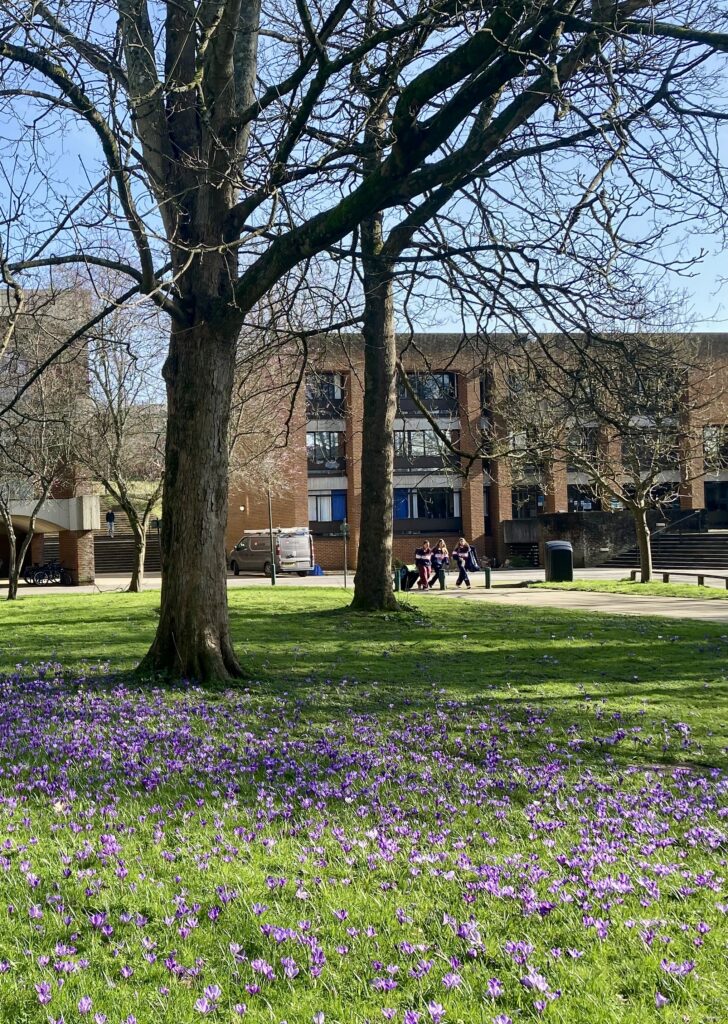
The University of Sussex, Feb 2026, taken by the author.
Alan Lester
The Spectator has published an article by Nigel Biggar smearing the University of Sussex as repressing students who ‘don’t dare voice’ their ‘reasonable dissent’ and attacking me personally. The salvo coincides with the High Court considering the university’s request for judicial review of the Office for Students’ decision against the University. I was not the only Sussex academic named in Biggar’s hit piece, but this response is mine alone. It focuses on what he said about me and unnamed colleagues in the Anthropology Department.
The ‘hook’ for Biggar’s smear was an email from a current University of Sussex student voicing her ‘mild despair’ at being exposed to critical interpretations of kinship theory, queer and trans perspectives and the idea of decolonisation in Anthropology modules. This student apparently told the Conservative Peer that one Anthropology module ‘must be viewed through a “queer and trans lens”’.
I do not teach Anthropology but my colleagues in the department assume that the reference is to a module that offers an understanding of queer and trans perspectives on the world alongside other ‘lenses’. They add, ‘saying that anything – including anthropology – must be viewed in these terms is hard to reconcile’ with their teaching.
Biggar goes on to use the Anthropology student’s email to attack me by name although I am in a different department. It is no secret, however, that I have challenged Biggar’s own well-publicised arguments on the British Empire and its afterlives, which happens to be my research specialism.
I have made it clear that I think his best-selling book on colonialism was driven by a politically-motivated attempt to justify rather than explain or understand the phenomenon and I have edited a collection of fourteen professional historians’ essays that contradict Biggar’s assertions, based on their lifetimes of research and expertise.
More recently, I have pointed out what I see as flaws and inconsistencies in Biggar’s influential historical and moral arguments against reparations for trans-Atlantic slavery.
Making it Personal
Biggar interprets these challenges to his public pronouncements as evidence of my ‘mission in life to discredit’ him, ‘lest anyone should be seduced by’ his ‘utterly moderate views of Britain’s colonial record’.
He also claims that ‘Emma’, the name he has given to his anonymous Sussex Anthropology informant, reported to him that, ‘judging by the amount of classroom time’ I ‘devote to debunking’ him, he now lives ‘rent-free’ in my head.
It comes as no surprise that Biggar has resorted to personal attack. In a response to my critical review of his Colonialism book he asked of me in print, ‘What demon possesses and drives him?, and in the lengthy Postscript to the revised paperback edition, in which he responds to me and nine other critical reviewers, he adds ‘It may be that Professor Lester is unfamiliar with epistemic moral failure – and unforgiving of it – because he has never recognised it in himself’.
What is far more concerning about this article though, is Biggar’s new and totally unfounded insinuation that I and Sussex colleagues intimidate our students and punish them if their views do not align with ours. This is a false and disgraceful accusation.
It is the exact opposite of what we do. We encourage critical thinking and debate.
My Teaching
I don’t know if ‘Emma’, as an Anthropology student, has attended any of my lectures (it is possible). But let me explain what ‘classroom time’ I devote to Nigel Biggar’s contentions. I convene a first year International Development module called Colonialism and its Afterlives. It covers four hundred years of British colonial history, starting with a block of introductory lectures on the Atlantic World, Indian Ocean World and Settler Colonial World and then dives into themes such as colonial domesticity (one of a number of lectures given my colleague Dr Fae Dussart), imperial famines, imperialism and racial discourse and the historiography of empire.
There is no mention of Biggar in any of these lectures since he has never published any relevant research.
My discussion of Biggar’s interventions is confined to the penultimate lecture on contemporary public debates over Empire, titled The Past in the Present: The British Empire in the Culture War. The lecture is based on one that I have given publicly, including as a guest speaker in King’s College London’s Engelsberg Applied History Programme and on my book Deny and Disavow.
When I give variants of this lecture at Sussex, I begin with a declaration of interest, stating that I have been a participant in the public debates we’ll be discussing and that students should bear this in mind as they weigh up the evidence. I encourage students to read Biggar’s publications and provide links to posts by him and his allies in the lobbying group History Reclaimed. Indeed, I set the History Reclaimed website, including Biggar’s essays, as ‘Essential’, rather than merely ‘Recommended reading’. How else would students get to hear both sides of the story? I ask students to read Biggar’s work, compare with my own and other historians’ critiques, such as that of Priya Satia, and draw their own conclusions. I pro-actively invite students to say if they disagree with my arguments and make it clear that I see critical discussion of them as constructive.
This is what academics with integrity do. They expose students to a range of ideas and encourage them to think critically about them, regardless of whether they are their own ideas or opposing ones. It is what I have done for my entire career, and I see no reason to change just because so much of what universities do is now represented maliciously in parts of the media.
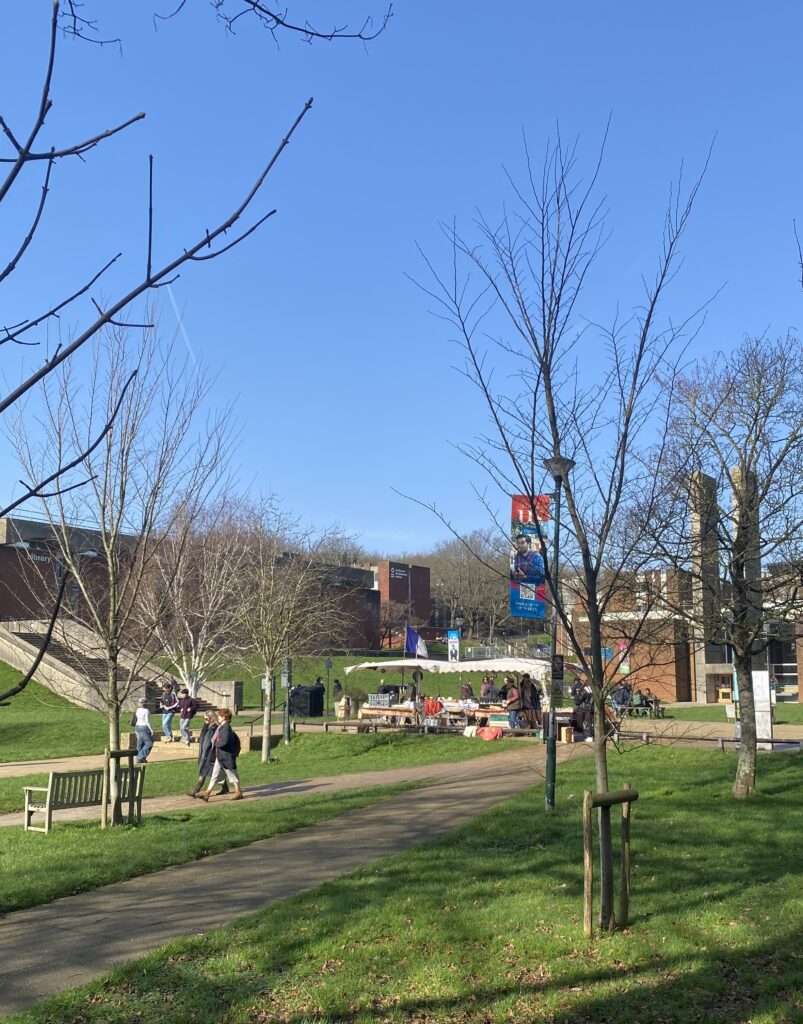
The University of Sussex, Feb 2026, taken by the Author.
Anonymous Informants and Open Debate
Seizing the opportunity of ‘Emma’s’ ‘mild despair’ at the contents of Anthropology modules, Biggar begins his insinuations that I and my colleagues oppress our students by declaring that he has had to give ‘Emma’ a pseudonym ‘lest her repressive professors punish her for what I am about to report’.
The conclusion he decides to draw is this: ‘At Sussex and elsewhere, ideologically distorted history is being force-fed to students like Emma, who don’t dare voice their reasonable dissent, rightly fearing that the professorial ideologues who determine their fates may not reward them for it. That vulnerable students are put in such a fearful position drives a stake into the heart of the liberal culture of freely giving and taking reasons that should prevail on our campuses.’
Biggar pulled out of my last attempt to engage him directly in a free and liberal exchange of ‘reasons’ after another of his Spectator articles, attacking Glasgow’s Kelvingrove Museum for an exhibition on empire and slavery, in June 2024. The ‘hook’ for this article was familiar. Biggar had apparently received ‘an SOS from a distressed citizen of Glasgow’. As with ‘Emma’ he had a compelling reason to ride to an anonymous informant’s rescue by publicly airing his opinions.
Yet Biggar, who often complains of being silenced in a ‘woke’ dominated media, had already had a scathing view of the museum published in The Times in May 2024. The historian Stephen Mullen has pointed out that Biggar misrepresented his work to attack the exhibition.
Remarkably Biggar had a third attack on the same museum published in The Times in June 2025, in which he criticised text that was not even on display.
After sending me the advance text of Biggar’s second assault on Kelvingrove, The Spectator set up a podcast discussion of the issues that had riled him and his anonymous informant. Even though it was at very short notice, I accepted the invitation to take part with alacrity, only too happy to be given the rare chance to debate one of his frequent, usually unchallenged, public interventions.
However The Spectator emailed me to cancel at 10 pm the night before I was set to travel up to their studio. I expressed my disappointment, saying that I assumed Biggar had got cold feet. The Spectator refused to confirm or deny and would not publish the critique that I had prepared alongside Biggar’s tirade.
Biggar is either unaware or unconcerned that my teaching at Sussex and my general conduct throughout these culture war debates has been aligned all along with ‘giving and taking reasons’ – including his own reasoning – at every opportunity. With much of the national media willing to present only his side of the story, it is difficult to get this point across.
In conclusion, based on a single student’s expression of discomfort at exposure to new ideas in a different department, Biggar has used his platform to make an entirely false and disgraceful accusation against me, colleagues and the University of Sussex, all the while complaining that the odds in public discourse are stacked against ‘victims’ like him and his anonymous informants.

Tony Binns
This is a clear and well argued statement on an important matter.
Country Vicar
Spectator reader here – this is disappointing to read. I for one would very much like to hear a sensible conversation between these two men.
admin
Thank you Country Vicar, I really appreciate that. I once thought that The Spectator would not behave in this way, but it seems that the principles it espouses are not necessarily those it enacts.