Alan Lester
It would be a feather in the cap for hard right-wing activists if they were able to block the Church of England’s Project Spire – a reparative justice scheme in recognition of the Church’s investments in slave ownership and slave trading. Fearful of the Church establishing a reparative precedent for other institutions, a group of right wing MPs led by Katie Lam, the right wing think tank Policy Exchange, The Telegraph, The Spectator, The Critic, The Daily Mail and GB News are all trying their very best to undermine it.
The lead campaigner and the right wing press’ main informant though, is Anglican priest Nigel Biggar who was nominated to the House of Lords by Kemi Badenoch. Associated with the Mathias Corvinus Collegium set up by Victor Orban’s former government to spread ‘illiberal conservative’ propaganda internationally, Biggar alone has authored or co-authored a Policy Exchange report, a Spectator podcast, a book and three Telegraph articles attacking Project Spire.
Until late last year the anti-reparative network’s line of attack was allegations that the historians hired by the Church Commissioners to investigate the Church’s complicity in slavery got things wrong. The activists alleged that the historians had confused shares in the slave trading South Sea Company, which were, overall, loss-making, with South Sea annuities, from which most of the profits were generated. In fact the historians had made no such mistake, writing clearly about the differences between shares and annuities in their report.
What the anti-reparative activists were trying to do was distract from complicity to profitability. The unassailable fact is that the Church invested in shares in the South Sea Company (as well as annuities) during a period in which it trafficked nearly 20,000 African captives across the Atlantic and 16,000 (some the same individuals) within the Americas. Having failed to stymie Project Spire with this tactic, it seems that they needed a new weapon.
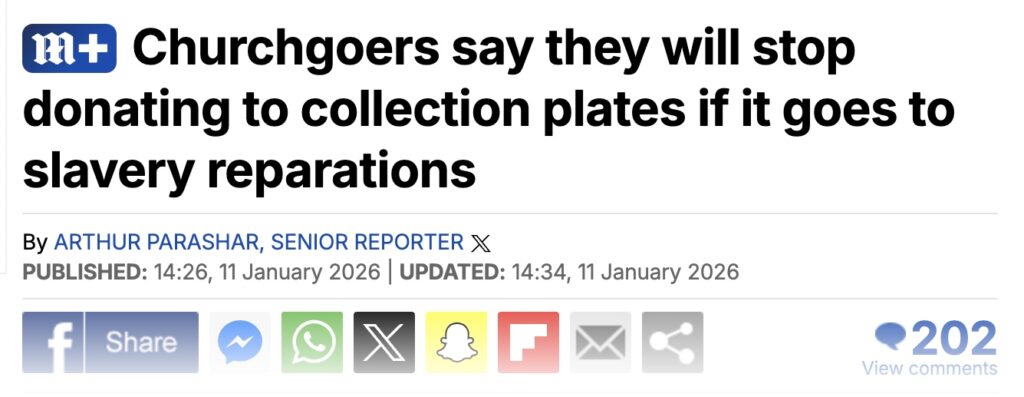
In December last year, a poll of 500 Anglican churchgoers sparked a BBC Sunday Morning Live discussion, articles in the Daily Mail and The Telegraph, and a GB News feature, as well as prominent coverage in Premier Anglican News, Christian Today, Anglican Mainstream, and an article by Nigel Biggar in Anglican Link. Four of the poll’s findings in particular have been presented in all of these platforms as proof that most parishioners are resolutely opposed to the church spending money on Project Spire. It is now being used as the next form of leverage to force the Church to change course.
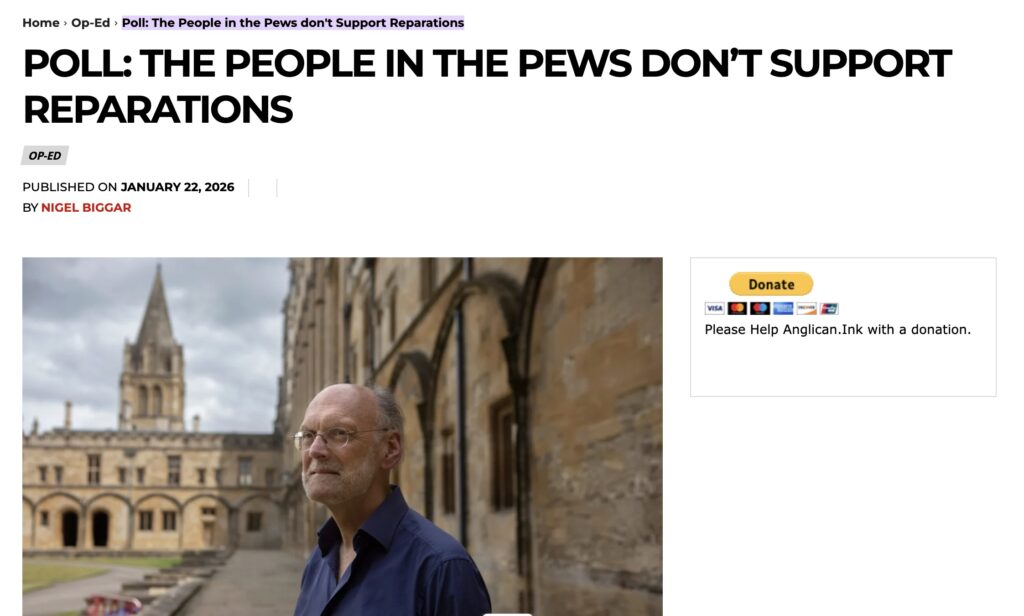
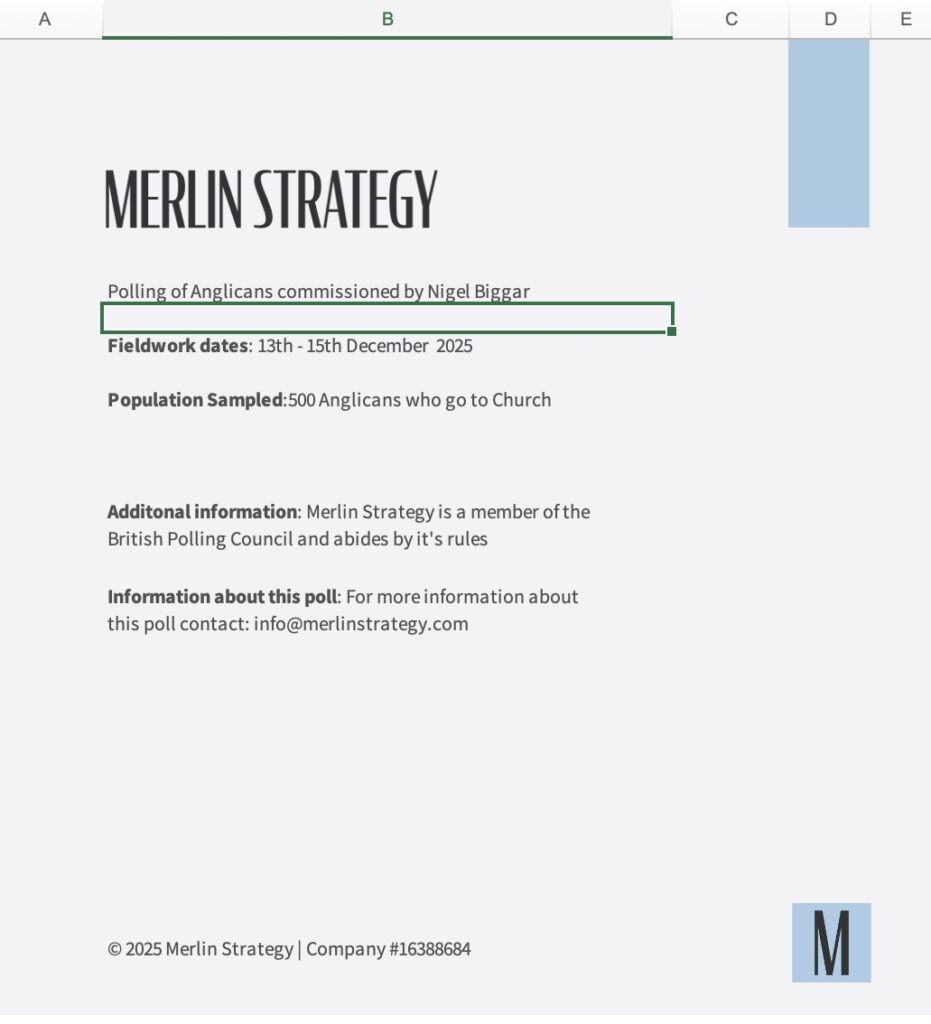
I’ve been looking into this poll in a bit more detail. It was conducted by Merlin Strategy – a company initially associated with the Reform Party because of its occupation of the same office building, although Reform had left the building eight months beforehand. I wrote to Merlin Strategy asking for more information about their methodology, since their website encourages interested parties to do so, but I have heard nothing back. Merlin Strategy is registered with the British Polling Council which assures that its ‘membership is limited to organisations who can show to the satisfaction of the BPC that the sampling methods and weighting procedures used are designed to accurately represent the views of all people within designated target groups’. Yet the BPC also insists that ‘Membership of the BPC does not in any way imply approval by the BPC of any organisation’s methods, and members agree not to make any such claim or otherwise imply the same’.
Merlin Strategy boasts that ‘we design and execute targeted public policy and stakeholder campaigns, creating compelling arguments that support your strategic aims backed by high quality data and analysis.’ They add, ‘We don’t just provide you with numbers, we tell you what they actually mean and help you act on them to achieve your goals’. I am unsure how polling conducted and analysed to support pre-determined ‘strategic aims’ can meet the professional standards of impartiality apparently required by the BPC.
None of the media platforms mentions this, so the first ‘surprise’ upon investigating the data that Merlin provide publicly is that the poll was commissioned by … yes, you guessed it, Nigel Biggar, presumably to support his ‘strategic aim’ of terminating Project Spire. The second is that it poses leading questions to respondents based on misinformation. The third is that, despite the loaded questions, it still provides evidence of widespread support for Project Spire – evidence that has of course been omitted from all of the reporting.
Biggar has summarised the poll’s four most frequently cited results in his latest tirade against Project Spire in The Critic:
‘Most Anglicans do not support the Church of England’s plan to allocate funds to slavery reparations … 81 per cent expect the Church to support local parishes rather than use financial resources on reparations, 64 per cent believe it is “not the role of the Church Commissioners, using funds in their care, to atone for previous injustice such as slavery”, and 61 per cent would switch their giving to alternative charities, if the Church proceeds with its policy’.
I’ll take each of these key results in turn:
- ‘Most Anglicans do not support the Church of England’s plan to allocate funds to slavery reparations’.
Respondents were never actually asked whether they supported the plan to allocate funds to slavery reparations. Instead, they were given a misleading question and then asked to pick their preferences for funding from a menu of options.
The misleading question was: ‘The Church of England has been left an historic endowment of over £10 billion, ringfenced for funding ministry in parishes. How do you think this could best be used?’
In fact the endowment, which the Church Commissioners carefully invest and manage rather than just ‘inherited’, is not ‘ring fenced for funding ministry in parishes’. Its official remit is ‘to provide financial support for the Church, by helping to ensure funding is intentionally used for mission and growth’ – a definition that allows considerable scope for social justice initiatives beyond the scale of the parish.
Having misdirected respondents on the fund’s purpose, these were the options from which respondents chose the best use of money, and the proportion that selected each:
Finding clergy – 9%
Maintain historic buildings – 34%
Provide support for current clergy – 11%
To fund reparation for historic injustices such as slavery – 12%
To provide frequent church services for local congregations – 17%
To support church staff and volunteers – 11%
To fund programmes aimed at promoting diversity within the Church – 5%
To promote church music – 1%
Far from providing evidence of opposition to reparative measures, the responses, even to a misleading question, reveal that reparation was the third most popular choice out of eight possibilities, with 12% naming it as the best use of all uses.
The headline ‘Most Anglicans do not support the Church of England’s plan to allocate funds to slavery reparations’ would have been just as accurate if it had said ‘Most Anglicans do not support the Church of England’s plan to allocate funds to maintain historic buildings’ or ‘… provide frequent services’, or any other of the choices provided.
The next two ‘facts’ were derived from questions that set up false binaries. The first presented a choice between doing reparative justice or supporting parishes that ‘are in financial difficulties’. Given this choice it is not surprising that:
2. ‘81 per cent expect the Church to support local parishes rather than use financial resources on reparations’.
In fact the commissioners are increasing support for parishes and investing far smaller sums in Project Spire. Support for parishes is being increased by almost nine per cent to £416.4 million in the coming three-year period, with funding set aside for churches in the lowest income communities jumping from £91 million to £133.5 million. There will also be £236 million to invest in the local church through supporting dioceses in their longer-term strategies in the coming three years. Separately, in recognition of the major financial pressures they have faced since the pandemic, £200 million additional time-limited support is being set aside for dioceses over the next nine years, of which £100 million will be in the next three years. Project Spire will be funded additionally to all this, with the relatively small sum of £100 million over nine years, not just three. Neither the respondents to the survey nor the press were given any of this context.
Next we come to the claim that:
3. 64 per cent believe it is “not the role of the Church Commissioners, using funds in their care, to atone for previous injustice such as slavery”
Here the binary question was ‘Which of the following is closer to your view? It is not the role of the Church Commissioners, using funds in their care, to atone for previous injustice such as slave’ [sic] or ‘It is the role of the Church Commissioners, using funds in their care, to atone for previous injustice such as slavery’. There was no explanation of what the Church Commissioners role really is, as defined by the Church itself.
That role is to support ‘the Church of England’s ministry, particularly in areas of need and opportunity … through responsible and ethical management of the Church of England’s permanent endowment fund, … helping to ensure funding is intentionally used for mission and growth’. I wonder how responses would have differed had respondents been better informed of the formal role?
Finally, there is the bombshell claim that:
4. ‘61 per cent would switch their giving to alternative charities, if the Church proceeds with its policy.’
To yield this result, respondents were asked, ‘Which of the following is closer to your view? If the Church Commissioners were allocating money to reparation, I would instead donate more to other charities that are [words missing in published data]’, or
‘If the Church Commissioners were allocating money to reparation, I would continue donating the same as before’. The responses were split 61 per cent – 39 per cent.
What stands out here is the refusal of any media platform to report the responses to the preceding, more open and non-binary, question. Respondents were told ‘Every year local parishes pay over £300m to fund national and diocesan activities. If the national church decided to commit £100m of its endowment to slavery-related ‘reparative justice’, would this increase or decrease the amount you would normally contribute?’
Even though reparative measures planned over nine years were misleadingly compared with annual parish payments in this question, and even though the £300m pa in parish contributions goes into an entirely separate pot than that from which Project Spire will be funded, the responses still clearly did not yield Biggar’s intended outcome and have accordingly been omitted from all the reporting.
Ten per cent of churchgoers said they would contribute a lot more because of the commitment to reparative justice, 11% that they would increase their contribution a little and 41% that it would make no difference to how much they contribute. Only 33% said they would reduce their contributions by a little or a lot, with 5% unsure.
So in fact a majority of respondents – 62% – are happy either to continue contributing the amounts they already do, or would actually increase their contributions to support reparative justice measures. And this based on misinformation that multiplies the scale of the envisaged reparative measures nine-fold. Even a poll designed to elicit negative responses to Project Spire in accordance with Nigel Biggar’s ‘strategic aims’, presents a very different picture to that presented in the right-wing media.
